38 works in this view — arrow keys or swipe to move between them.
Dance in Art · 1650
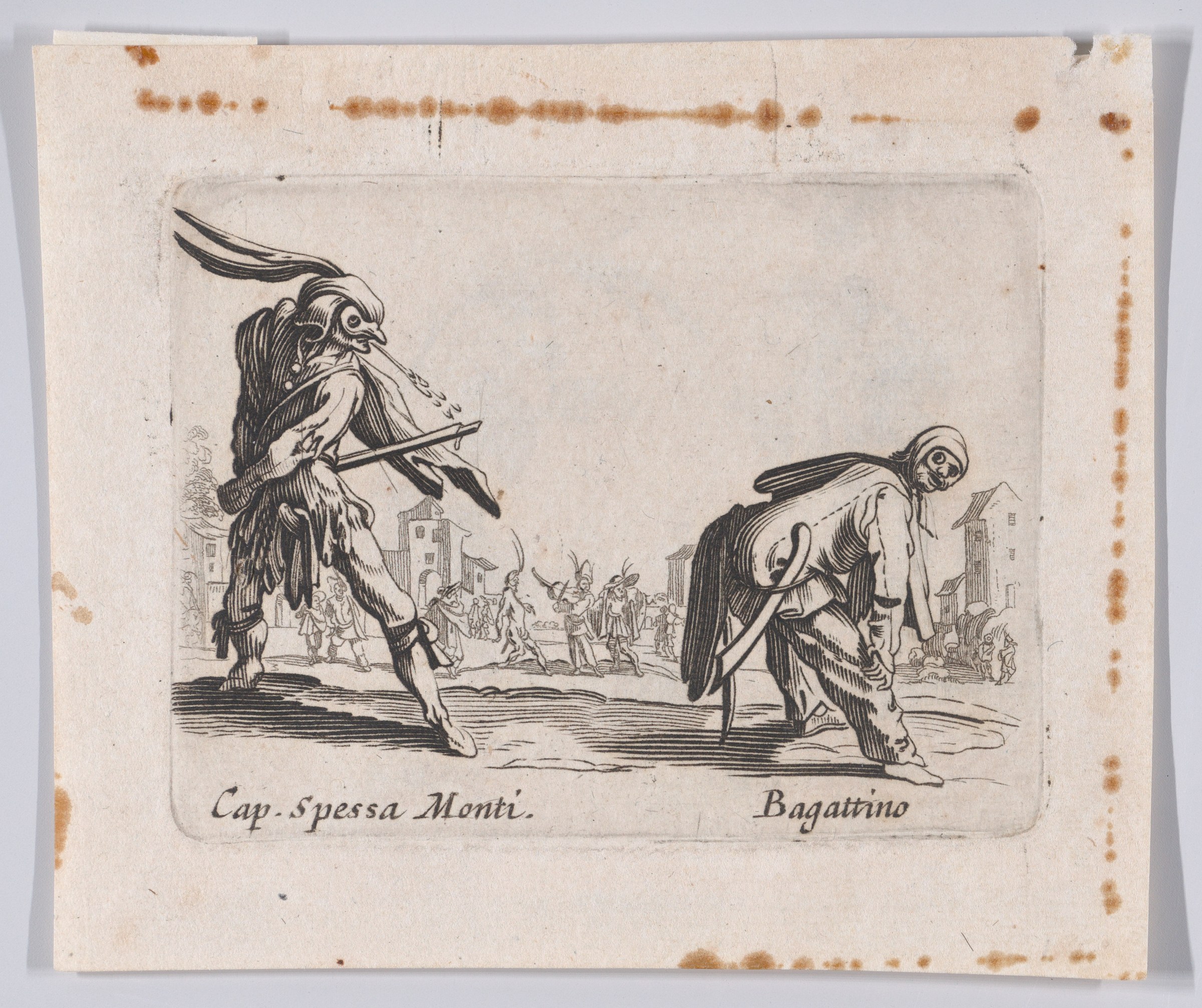
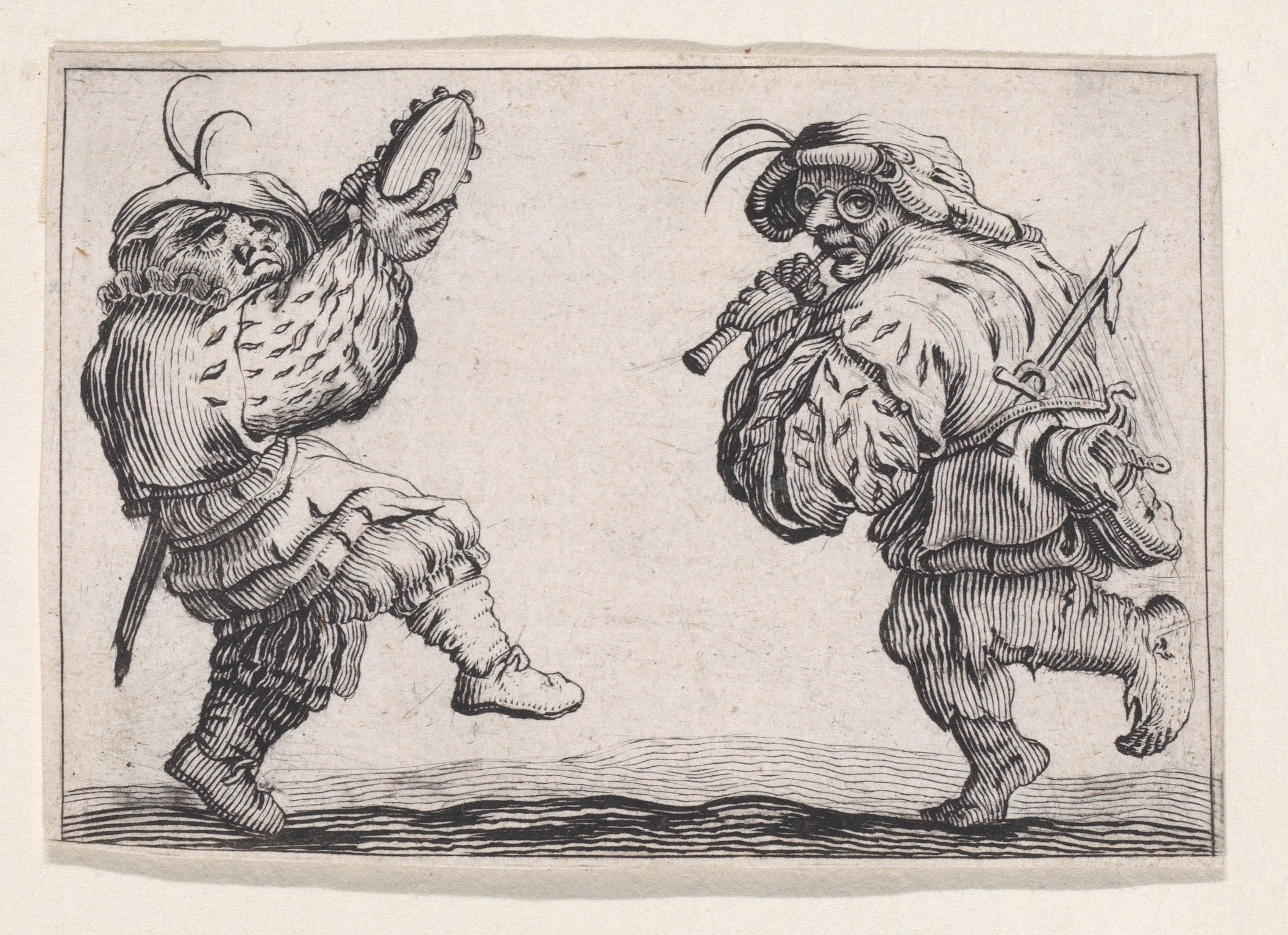
Dancers with the Flute and the Tambourine Met DP888298
anonymous
- Medium:
- Oil Painting
- Era:
- Pre-1700 (Renaissance/Baroque)
- Source:
- Wikimedia Commons
- Rights:
- Public domain — free to use, share and adapt.
- Recorded as:
- CC0
This work documents a now-lost tradition of popular, satirical representation of peasant and carnival dance in print culture. The caricature tradition—exaggerated features as markers of social status and comic intent—was a dominant vehicle for representing lower-class festivity and popular music in the Renaissance, and this print preserves evidence of how such dancing was understood, valued, and mocked by the educated classes. The specificity of the instruments and postures offers clues to actual folk dance practice.
What you are looking at
Two grotesque figures meet on a bare stage or ground plane, rendered in precise black ink line work against an unshaded background. Both are bearded men with exaggerated features—bulbous noses, heavy brows, and wild hair held back by headbands. The figure on the left wears a pleated tunic and holds a tambourine aloft in his right hand, his body twisted in an energetic posture. The figure on the right, dressed in draped garments with similar pleating, grasps a curved wind instrument (likely a curved flute or horn) and a staff or lance in his other hand. Both men are caught mid-movement, their knees bent, their weight shifted forward in a dynamic encounter. The rendering is characteristically Northern Renaissance in its attention to fabric texture and anatomical exaggeration—the pleating is rendered with precise parallel lines, and the musculature and bone structure are heavily emphasized through cross-hatching and stippling.
The dancing
The two figures face each other in opposed stances, each leaning forward with bent knees and active arm positions. The left figure raises the tambourine high, arm extended upward; the right figure holds his instruments lower, one arm extended outward. Both bodies are asymmetrical and twisted, suggesting rotational movement or the moment of meeting in space. The posture is not balletic—the weight is grounded and forward, the carriage energetic and folk-like rather than courtly. This is popular or rustic movement, not trained dance.
The dance depicted
This appears to depict a folk or carnival dance, possibly a peasant revel or dance of musicians and jesters common in Northern Renaissance prints of social comedies. The tambourine and wind instrument identify these as musicmakers first, dancing second. The grotesque, caricatured faces and exaggerated expressions belong to the tradition of comic or satirical prints about popular festivity, lower-class amusement, and carnival licence. The dynamic encounter suggests a greeting, confrontation, or beginning of a dance dialogue. The style is consistent with 16th-century German or Dutch satirical prints, though the date of 1650 in the record would place it in the early Baroque, potentially as a later copy or reissue of an older composition.
How it was made
This is an engraving or etching on paper, not an oil painting as the record states. The medium is evident from the precise black line work, the absence of tone or shading in the background, and the hatching and stippling used for modeling form. The technique is typical of Northern Renaissance print production—individual lines build form, texture is suggested through parallel marks, and the composition is designed for circulation as a multiple impression. This is a work of popular print culture, intended for broad distribution and collection, not a unique panel painting.
About this work
This is a Northern Renaissance satirical print depicting two grotesquely rendered male musicians or jesters in a folk dance or festive encounter. Both figures are identified by their instruments—a tambourine and a curved wind instrument—and by their exaggerated, almost caricatured features, which place them outside courtly culture and within the tradition of comic social prints. The dynamic, asymmetrical postures and the moment of meeting suggest a dance or musical greeting captured mid-movement. The catalogue record misdescribes the medium as oil painting and the date as 1650, but the engraving technique and Northern Renaissance style suggest a 16th-century origin or a 17th-century print issued from an older plate.
How to look at it
Attend to the moment of encounter: the two figures are not yet fully engaged in synchronized movement, but rather in the instant of meeting or greeting, which may be part of the dance's narrative. Notice how the engraver has rendered the energy of the moment through twisted, asymmetrical postures and bent knees—this is not a stable, posed moment, but a captured gesture of motion. The exaggerated facial features and the crude, heavy-lined rendering of the bodies are intentional markers of comic intent and social satire; the grotesqueness is part of the meaning. Compare the carriage and posture to courtly or trained dance—the weight is forward, the movement is earthbound and vigorous, not ethereal or elevated.
The artist
The artist is unknown, which is typical for prints of this period and style. The work belongs to a large tradition of Northern Renaissance and early Baroque satirical prints, including works by Lucas Cranach, Hans Burgkmair, and other printmakers of Germany and the Netherlands who specialized in social comedy, carnival scenes, and moral satire. The style suggests a professional printmaker or engraver working in the tradition of such workshops, where compositions were reissued, copied, and recirculated over decades or centuries.
The period
The 16th and 17th centuries saw a flourishing of satirical and comedic prints in Northern Europe, particularly in Germany and the Netherlands. These prints often depicted peasant festivities, carnival dances, and popular music-making as occasions for moral commentary or social satire. Simultaneously, the Renaissance elite were beginning to codify courtly dance forms (minuet, pavane, galliard) and to distinguish 'civilized' dance from the 'rude' dances of common folk. This print sits squarely in that tension—depicting popular dance with exaggerated caricature, marking it as comic and socially other. The tradition of using grotesque human figures to represent festive music-making persisted well into the 17th century in print.
Where it lives
The work is sourced from Wikimedia Commons, with no holding collection recorded. As an engraving or etching, it belongs to the category of prints—multiple impressions of a single plate, likely issued and reissued over time, and now found in various public and private collections.
Dance in this work
Questions about this work
Are these two people actually dancing, or are they just musicians?
Both. In Renaissance print culture, musicians and dancers were often one; the instruments and the postures mark these as people engaged in festive music-making, and the dynamic, forward-leaning stances and bent knees suggest movement and dance. The encounter itself—the moment of meeting—may be the 'dance.'
Why do these figures look so grotesque and ugly?
That is satirical intent. Northern Renaissance printmakers used exaggerated, distorted features to mark figures as comic, morally base, or socially inferior. By rendering peasants and popular musicians as grotesque, the artist invites the educated viewer to laugh at their entertainment as coarse and uncivilized—a common cultural strategy of the period.
What kind of dance is this, and was it a real tradition?
The print likely depicts a generic 'peasant revel' or folk festivity rather than a named, choreographed dance form. However, such scenes were based on observed or remembered popular dance and music-making. The tambourine and wind instrument were common in folk music and festive contexts, and the postures suggest energetic, social, non-courtly movement.
The record says this is an oil painting from 1650—is that correct?
No. This is clearly an engraving or etching on paper, made by a printmaking process, not an oil painting. The black line work, the absence of color and atmospheric perspective, and the hatching technique are all signatures of print media. The style is more consistent with 16th-century Northern Renaissance work, though a date of 1650 could reflect a later reissue or state of an older plate.
More dance artwork