49 works in this view — arrow keys or swipe to move between them.
Dance in Art · 1700
Dansende boer, RP-T-00-1876
Unknown (Rijksmuseum collection)
- Medium:
- Oil Painting
- Era:
- 1700s (Enlightenment/Minuet Era)
- Source:
- Wikimedia Commons
- Rights:
- Public domain — free to use, share and adapt.
- Recorded as:
- CC0
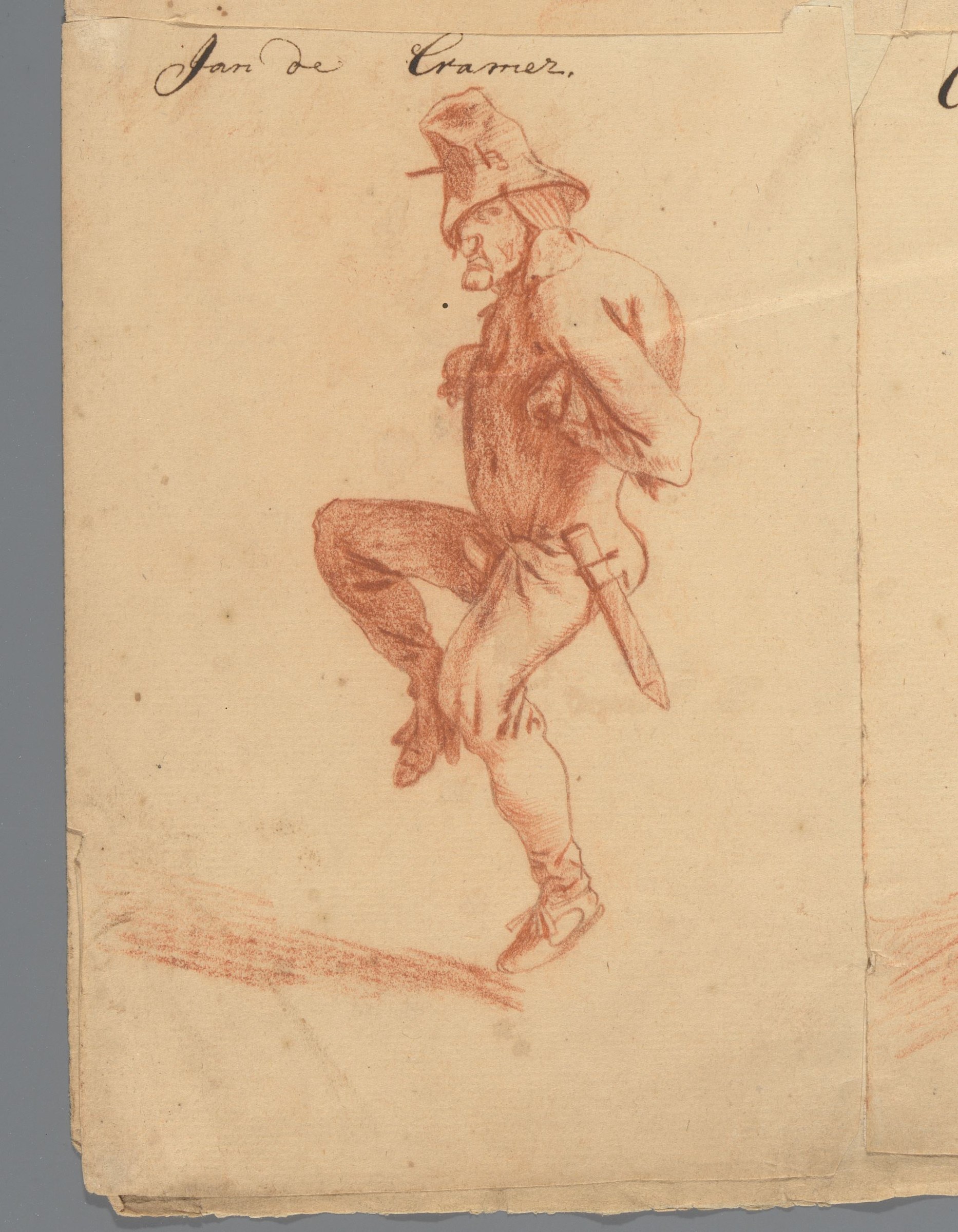
This drawing is a rare visual record of how peasant dances were actually performed—not described in a manual, but observed and rendered with anatomical specificity and energy. It shows the unadorned, high-impact physicality of popular dance, unmediated by courtly refinement, and captures a moment in European culture when dance was becoming a subject of artistic attention beyond the elite.
What you are looking at
A single male figure is depicted in a dynamic leaping or jumping pose against a plain background. He wears a broad-brimmed hat and loose breeches typical of rural dress, with a short jacket or doublet. His posture is energetic and exaggerated: one leg is drawn up sharply toward his torso while the other extends behind, and his arms are spread wide for balance. The figure's weight appears to be momentarily airborne, captured at the apex of a vigorous jump. His facial expression is lively, with an open mouth suggesting exertion or delight. The drawing is executed in red chalk on paper, a medium that allows for expressive linear marks and soft shading to define the musculature and folds of fabric.
The dancing
The single dancer is shown in a pronounced vertical leap with asymmetrical leg positions—the left leg sharply bent upward and the right extended downward behind the body. The torso is slightly twisted, and both arms are raised and spread for counterbalance. The weight distribution and suspended posture suggest the moment of maximum elevation. The exaggerated articulation of the joints and the emphatic positioning convey vigorous, unrestrained movement rather than the controlled extension of courtly dance.
The dance depicted
This appears to be a peasant or folk dance, likely Dutch or Flemish based on the inscription 'Jan de Cramer' and the rural costume. The style of movement—high, energetic jumping with bent knees and twisting torso—is consistent with popular social dances of the 17th and early 18th centuries, such as the galliard or country jig, which were performed by common people at festivals and celebrations. The artist has captured not the formal deportment of court dances but the uninhibited, athletic exuberance of vernacular celebration. The specific style cannot be identified with certainty, but the vitality and physical abandon suggest a social dance performed in a festive context.
How it was made
This is a drawing in red chalk on laid paper, a medium well-suited to capturing gestural movement and the warmth of human form. Red chalk allows for both linear detail and broad tonal shading, and its capacity for blending and gradation made it a favored medium for figure studies and observational sketches. The inscribed title suggests this may have been a study for or after a printed source, possibly documenting a recognized type or character. The technique and presentation suggest this was a work of independent artistic interest, not merely a preparatory sketch, and would have circulated among collectors and studios as an example of lively figure drawing.
About this work
This is a red chalk drawing depicting an animated male dancer in rural costume, captured at the moment of a vigorous upward leap. The inscription 'Jan de Cramer' identifies either the dancer, the subject type, or a performer known for this style of dancing. The work dates to the 18th century and belongs to a tradition of depicting popular, vernacular dance—the everyday celebrations of common people rather than the formalized movements of the court or stage. It is a character study as much as a dance document, preserving both the physical exuberance of folk celebration and the artist's eye for capturing a fleeting moment of athletic movement.
How to look at it
Attend to the moment chosen—not the preparation or landing, but the apex of the jump, where the dancer's weight is fully committed to the air. Notice how the artist has twisted the torso and splayed the limbs asymmetrically to convey the disruptive energy of the movement, in sharp contrast to the vertical stability prized in court dances. The broad hat and loose clothing emphasize the informal context; this is a figure in his own world, not performing for aristocratic scrutiny. The red chalk medium itself—warm, tactile, unfussy—suits the subject's earthiness.
The artist
The work is attributed to an unknown artist, though the inscription suggests it may be copied from or after a print. Red chalk figure studies were common in European workshops from the Renaissance onward, and this example likely belongs to a tradition of character or type studies—visual inventories of recognizable social figures, professions, or performers. The practice of documenting folk dancers in fine-art media reflects growing interest in recording popular culture.
The period
In the early 18th century, vernacular and peasant subjects were becoming fashionable in visual art, particularly in prints and drawings. Court dances like the minuet remained the standard of refined movement, but artists and collectors showed increasing curiosity about how ordinary people danced. This period also saw the emergence of published dance manuals that included illustrations of popular as well as courtly dances. The energetic, almost acrobatic quality of this leap reflects the physical character of country dances and folk celebrations that persisted alongside formal ballroom culture.
Where it lives
This drawing is held in the Rijksmuseum collection, catalogued as RP-T-00-1876. It is a work on paper in red chalk, likely created in the 18th century. The catalogue records it as a drawing (tekening) after an anonymous print, suggesting it may be a copy or adaptation of an earlier engraved image.
Dance in this work
Questions about this work
Who was Jan de Cramer?
The inscription 'Jan de Cramer' most likely names either a specific performer known for this style of dancing or a stock character type in popular entertainment or prints. Without further documentation, it cannot be confirmed whether this refers to an actual historical figure or a generic character type. The work may be copied from or after a printed source that identified this figure.
What kind of dance is this?
The vigorous jumping and athletic posture are consistent with country or folk dances of northern Europe in the 17th–18th centuries. High-energy social dances like galliards, jigs, and regional folk celebrations involved jumping, twisting, and uninhibited movement. Without specific documentary evidence, the exact dance form cannot be named with certainty.
Why is this drawn in red chalk rather than painted?
Red chalk was the favored medium for figure studies and character sketches across European workshops. It was quick, expressive, and well-suited to capturing movement and gesture. The warmth and immediacy of red chalk also conveyed the vitality of the subject—a direct, observational record rather than a formal, finished composition.
What does the costume tell us?
The broad-brimmed hat, loose breeches, doublet, and simple footwear are typical of rural or lower-class dress of the 17th–18th centuries in northern Europe. The informal, practical clothing marks this as a peasant or common performer, not a courtier. The costume is part of the artwork's function as a character study—identifying the social type and cultural context of the dance.
More dance artwork