36 works in this view — arrow keys or swipe to move between them.
Dance in Art · 1863
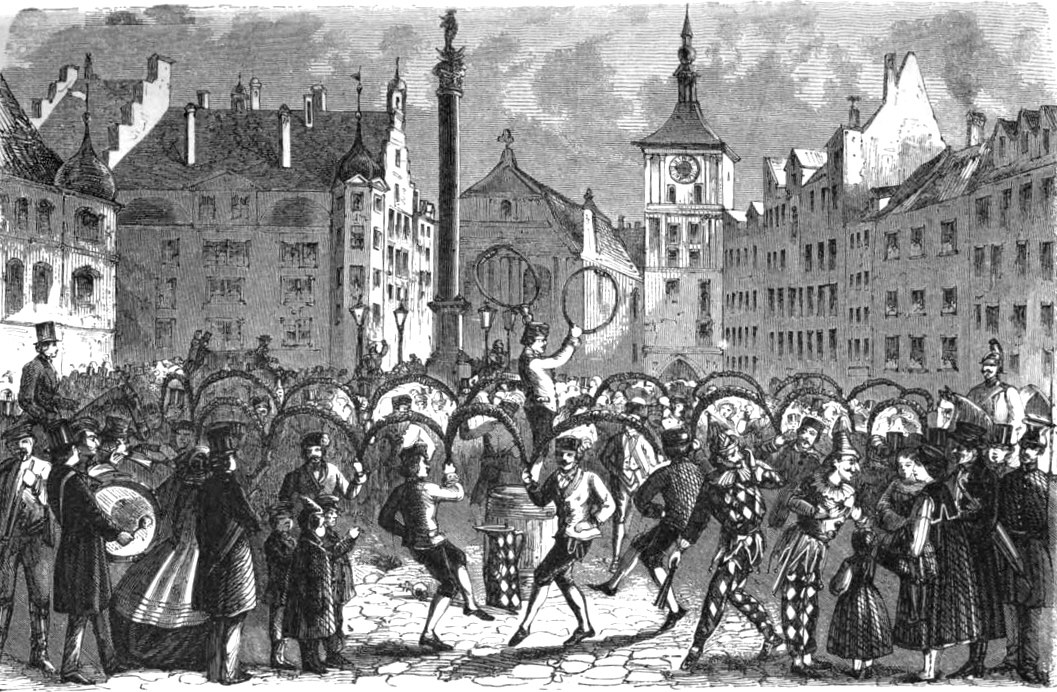
Das festliche Jahr img081 Der Schäfflertanz in München
Unknown
- Medium:
- Oil Painting
- Era:
- Mid 1800s (Polka Era)
- Source:
- Wikimedia Commons
- Rights:
- Public domain — free to use, share and adapt.
- Recorded as:
- Public Domain
The Schäfflertanz is one of the oldest continuously documented carnival traditions in Europe, and this nineteenth-century image captures it as a street spectacle and guild ritual rather than as a seated theatrical performance. For historians of European folk tradition and civic ceremony, this image shows how pre-modern customs survived industrialization by becoming public festival rather than everyday practice. The engraving also documents the moment when regional traditions were being collected, illustrated, and circulated through print media—marking the transition from living practice to documented folklore.
What you are looking at
A crowded street carnival or festival scene, rendered in detailed wood engraving, fills a Munich town square. The plaza is ringed by multi-story Renaissance and Baroque buildings with ornate architectural details, including a prominent clock tower. Dozens of figures crowd the square in elaborate costumes and masks: jesters in patterned motley, figures in long cloaks and formal dress, masked revelers, and costumed performers. Many carry large circular objects—shields or ceremonial props—held aloft. The composition is dense and theatrical, with the crowd arranged loosely around a central space, creating a sense of movement and festive chaos. The light engraving technique renders fine detail in the architectural setting while keeping the figures relatively flat, emphasizing the decorative and processional character of the event rather than individual movement.
The dancing
The figures are mostly upright and stationary rather than actively dancing, though some show animated gesture. Many hold their arms raised or extended to display decorative circular objects (shields or tambourines). The dress is theatrical and varied—some figures wear the tight patterned clothing of court jesters, others broad cloaks and formal Renaissance or early modern dress. The majority appear to be spectators and costumed participants in a procession rather than dancers in a bounded dance formation. Few show the weight shift, bent legs, or partner positioning typical of social or theatrical dance.
The dance depicted
This depicts the Schäfflertanz (Coopers' Dance), a traditional Bavarian guild festival and procession that dates to the medieval period and continues in Munich to the present day. The Schäfflertanz is not a continuous choreographed dance but rather a ritualized ceremonial movement with moments of formal stepping and turning, interspersed with costumed procession and theatrical display. The circular objects are likely the shields or wooden rings (Schäffler-reifen) that define the visual character of the event. The image captures the carnival and festival aspect rather than concentrated dancing, reflecting how this tradition was experienced—as public spectacle, guild celebration, and street theatre rather than an ordered dance performance.
How it was made
This is a wood engraving, a relief printmaking technique that allowed fine detail and mass reproduction. The technique's ability to render precise architectural lines and create tonal variation through cross-hatching made it ideal for complex crowd scenes and urban landscapes. Wood engravings were the dominant medium for illustrations in printed books and periodicals during the nineteenth century, suggesting this was made for publication—likely in a German illustrated journal or artistic documentation of regional traditions. The technique allowed the artist to preserve fine detail while maintaining visual coherence across a crowded composition.
About this work
The Schäfflertanz (Coopers' Dance) is one of Bavaria's longest-surviving guild traditions, documented here in a nineteenth-century wood engraving of a Munich street performance. The image captures not a single choreographed dance but a festive civic ritual combining costumed procession, ceremonial display, and theatrical performance. The Schäfflertanz represents the preservation and celebration of medieval guild identity through spectacle rather than through continuity of movement—it is danced only once every seven years, making its appearance a public spectacle of cultural memory. This engraving documents the tradition at a moment when European folklore and regional custom were becoming subjects of artistic and antiquarian interest.
How to look at it
Attend first to the architectural setting—the artist has rendered the Munich plaza and its Renaissance buildings with precision, framing the event as a documented historical moment in a specific place. Then trace the figures: note the variety of costume and the mixture of active figures (some in animated pose) with static ones. Look for the circular shields or rings that appear throughout the crowd—these are the defining prop of the Schäfflertanz. The composition does not show a linear progression or an ordered formation, but rather a crowd gathered in and around a plaza, suggesting this is documentation of spectacle and gathering rather than choreographic moment.
The artist
Unknown. The work appears in a publication titled *Das festliche Jahr* (The Festive Year), a nineteenth-century illustrated survey of German holidays and civic festivals. The engraving style and composition suggest it was made for a German publisher's documentary record of traditional celebrations, following the wider nineteenth-century European interest in collecting and illustrating folk customs.
The period
The nineteenth century saw intense European interest in documenting and preserving folk traditions, partly through Romantic-era celebration of indigenous culture and partly through antiquarian scholarship. Germany was particularly active in this project, with festivals and folk customs being illustrated, described, and celebrated as expressions of national character. The Schäfflertanz, dormant for much of the eighteenth century, was revived in Munich in 1780 and had become a documented civic spectacle by the time this engraving was made. The image reflects the era's appetite for illustrated books and periodicals documenting regional life and ceremony.
Where it lives
From *Das festliche Jahr* (The Festive Year), a nineteenth-century German publication documenting regional festivals and civic celebrations. The image source is Wikimedia Commons; no holding collection is recorded in the catalogue.
Dance in this work
Questions about this work
What is the Schäfflertanz and when is it performed?
The Schäfflertanz (Coopers' Dance) is a Bavarian guild tradition dating to the medieval period, revived in Munich in 1780. It is performed only once every seven years, in odd-numbered years, as a processional street spectacle. It combines costumed performance, ceremonial movement, and the manipulation of large wooden shields or rings (Schäffler-reifen). The tradition represents the survival of guild identity through public festival rather than everyday practice.
Why are the figures holding circular objects?
The circular objects are the Schäffler-reifen (coopers' rings or shields), the defining visual element of the dance. Originally wooden rings used by the coopers' guild in their craft, they became ceremonial props and are manipulated, carried, and displayed as part of the spectacle. They serve both as guild emblem and as a visual focus for the crowd.
Is this image showing actual dance movement or festival spectacle?
This image documents the festival spectacle aspect—the processional, costumed, and ceremonial character of the event rather than concentrated choreographed dancing. While the Schäfflertanz involves formal stepping and ritual movement, this engraving captures the broader civic and theatrical experience: the crowd, the costumes, the architectural setting, and the public nature of the tradition.
Why was this published in a book about festivals?
*Das festliche Jahr* was part of a nineteenth-century European movement to document and illustrate regional folk traditions, holidays, and civic ceremonies. By the 1860s, illustrated books and periodicals were the primary means of circulating images of local customs to a broader audience. This engraving served to preserve and publicize the Schäfflertanz as an example of Bavarian cultural heritage.
More dance artwork