37 works in this view — arrow keys or swipe to move between them.
Dance in Art · 1863
Das festliche Jahr img351 Die Kirwer in Mähren
Unknown
- Medium:
- Oil Painting
- Era:
- Mid 1800s (Polka Era)
- Source:
- Wikimedia Commons
- Rights:
- Public domain — free to use, share and adapt.
- Recorded as:
- Public Domain
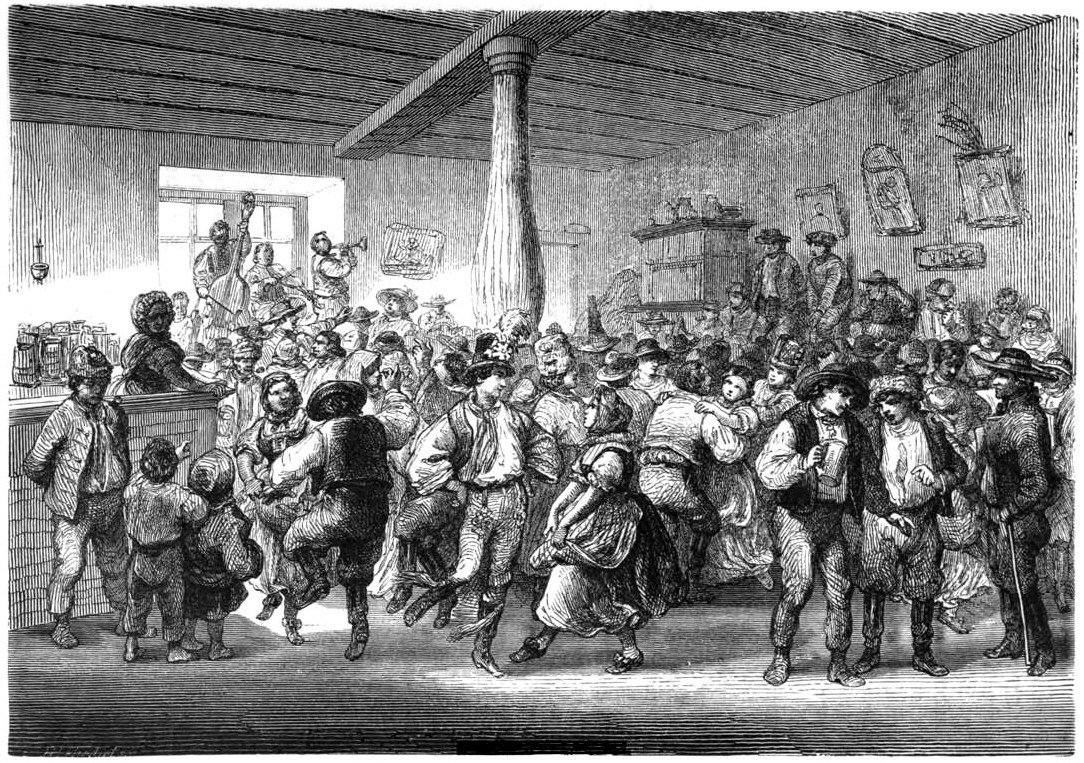
This engraving documents the social context and material reality of Central European folk festivity at a moment when such traditions were already becoming subjects of antiquarian interest and artistic documentation. It shows that rural dance was embedded in broader patterns of community gathering, not isolated as a performative event; the Kirmes was as much about socializing, food, and collective presence as it was about structured movement.
What you are looking at
This is a crowded interior scene rendered in wood engraving, showing a packed public hall or market space with a tall central support column. The composition is dense with figures—at least fifty people, ranging from adults to children—packed together in a celebratory or festival mood. The figures wear 19th-century dress: women in long skirts with bonnets and shawls, men in jackets and hats, children in period costume. The setting has a utilitarian character: exposed wooden beams overhead, bare walls, and a large central column supporting the roof. On the left, figures cluster around what appears to be a counter or service area; on the right, people stand more freely. The engraving's fine linear hatching creates depth and shadow, with the densest blacks marking the crowd's darkest clothing and deepest shadows. The overall mood is one of animated gathering—a village fair, harvest festival, or public celebration typical of rural Central European life.
The dancing
The bodies are shown in upright, social postures rather than in extended dance movement. Many figures stand shoulder-to-shoulder in clusters, some with arms at their sides, others gesturing conversationally. A few bodies suggest rotation or mild swaying—particularly in the center-right of the composition—but no clear partnered holds or ballroom frames are visible. The figures are presented as participants in a gathering rather than as dancers executing steps. Children and adults are interspersed throughout, contributing to a sense of general festivity rather than formal choreography.
The dance depicted
The image depicts a Kirmes or Kirwer, a rural Central European village fair or harvest festival celebration. While music and social dancing were traditional at such events, this engraving captures the gathering and merrymaking rather than a clearly choreographed dance performance. The crowded, social nature of the scene—with people of all ages mixing freely—is consistent with folk festival traditions, particularly the Moravian Kirmes suggested by the title. The dress and setting point to mid-19th-century rural Central Europe, where such celebrations included both structured dances (polkas, contra dances) and informal socializing. No specific dance style is clearly visible in the postures or holds, but the context is unmistakably that of folk festivity.
How it was made
This is a wood engraving, a relief printing process using the end grain of hardwood blocks incised with a burin. The fine, uniform parallel lines characteristic of the medium—visible throughout the composition—create tonal modeling and texture. Wood engraving allowed for precise detail and small scale, made it well-suited to book and periodical illustration, and implies this work was designed for publication and circulation to a middle-class readership. The date 1863 places it in the height of the Victorian illustrated press, when such festive rural scenes held documentary and nostalgic appeal for urban audiences. The technique's requirement for a reversal of the image suggests this is a printed impression rather than a unique drawing.
About this work
This wood engraving documents a Moravian village fair—likely the Kirmes or Kirwer—as a site of community gathering and celebration in mid-19th-century rural Central Europe. The packed interior space, the mixture of ages and social classes, and the festive dress all mark this as a folk celebration where dance played a traditional role, though the engraving captures the social gathering itself rather than a specific moment of choreographed movement. The work is a record of how rural communities marked seasonal transitions and collective identity through public festivity.
For historians of folk dance and social custom, the image is valuable for its density of period detail—the clothing, the setting, the demographic mix, and the evident role of public interior spaces in community life. The engraving's circulation in print form means it shaped how urban 19th-century audiences understood rural tradition.
How to look at it
Attend first to the density and social character of the crowd: this is not a performance before an audience, but a community gathering from within. Notice the range of ages and the informal mixing; there is no stage, no clear separation of dancers from observers. The engraver's careful attention to dress—the precise rendering of bonnets, shawls, jackets, and hats—anchors the scene to a specific time and place. The tall central column dividing the space and the visible architectural details (beams, bare walls) ground the scene in a real public building—a market hall or barn—rather than an idealized setting.
The period
By 1863, European folk traditions were being actively collected, documented, and aestheticized by urban artists and publishers responding to Romantic nationalism and growing industrial urbanization. Wood-engraved illustrations of rural life, peasant dress, and folk customs were popular in the Victorian press and in gift books; they served both documentary and escapist functions for middle-class readers. The Moravian region, part of the Austro-Hungarian Empire, was a recognized site of distinctive folk culture, and its traditions were subjects of ethnographic and artistic interest. At the same time, industrial modernization and migration were transforming rural life, lending such scenes a valedictory quality—a record of disappearing custom.
Where it lives
The work is recorded as part of 'Das festliche Jahr' (The Festive Year), suggesting it was part of a broader illustrated series or publication documenting seasonal festivals and folk customs. It is sourced from Wikimedia Commons, a digital repository of public-domain works, but the original holding collection is not recorded.
Dance in this work
Questions about this work
Is this a dance performance or a social gathering?
It is a social gathering at a folk festival where dance would have played a role, but the engraving captures the broader celebration rather than a specific choreographed moment. The crowded, mixed-age, indoor setting is typical of a village fair or Kirmes—a community event that included music, food, socializing, and informal dancing.
What is a Kirmes or Kirwer?
A Kirmes (also Kirwer, Kirchweih) is a traditional Central European village fair, often held to mark a harvest, patron saint's day, or other seasonal or civic occasion. These events brought together the entire community—families, children, adults—for eating, drinking, socializing, and dancing. The tradition was particularly strong in the German-speaking regions and Moravia.
How does the engraver show this is a festive occasion?
The engraver conveys festivity through density and animation: the crowded interior, the upright and animated postures, the careful rendering of varied period dress (bonnets, shawls, hats, coats), and the mixture of ages and apparent social classes. The busy composition itself communicates excitement and occasion.
What does this tell us about folk dance in the 19th century?
It shows that folk dance was embedded in broader community events and not performed as isolated spectacle. The Kirmes was a site where social dance, family gathering, courtship, and collective identity all converged. The image documents the material and social context—the actual spaces, dress, and demographics—in which folk tradition was lived.
More dance artwork