49 works in this view — arrow keys or swipe to move between them.
Dance in Art · 1750
David Tenniers Wirtshaus-Tanz ubs G 0869 III
David Teniers (I/II/III?)
- Medium:
- Oil Painting
- Era:
- 1700s (Enlightenment/Minuet Era)
- Source:
- Wikimedia Commons
- Rights:
- Public domain — free to use, share and adapt.
- Recorded as:
- Public Domain
This work is crucial evidence for understanding popular and vernacular dance in the early modern period, showing the uninstructed, energetic movement of ordinary people in its actual social context. Unlike courtly dance images, which prescribe correct form, peasant-dance prints like this one document what people actually did, and the genre's popularity in print form shows that educated urban audiences were intensely curious about the dancing of the common folk. It demonstrates that dance, then as now, existed on a spectrum from formal performance to spontaneous social expression.
What you are looking at
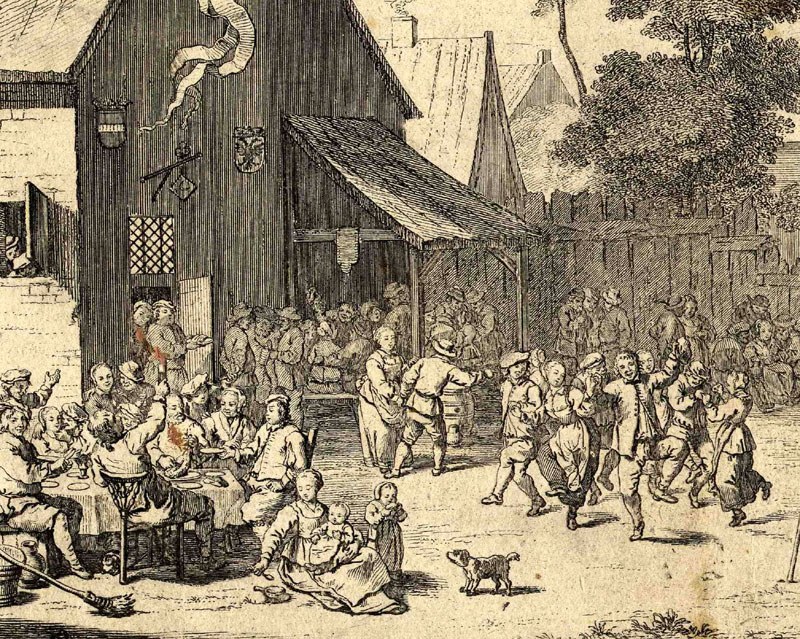
A village festival or tavern celebration with approximately fifty figures, peasants and common folk in 17th-century dress, assembled in a packed outdoor courtyard beside a large timber-frame building. The composition is dense and layered: in the foreground, figures sit at a table laden with food and drink on the left; the center stage hosts dancing couples and musicians; background figures press together near fences and buildings, with trees visible at the top right. The light is even and clear, in the manner of northern Renaissance prints, with no dramatic chiaroscuro. A small dog moves through the crowd. The mood is one of unruly festivity—bodies are animated, some figures gesture broadly, and the overall impression is of peasant revelry captured in mid-celebration, the kind of scene popularized in 16th- and 17th-century Flemish genre art.
The dancing
The central dancers move in an open formation, not in a formal closed hold. The figures nearest the middle ground show active, somewhat flailing arm positions and bent knees, suggesting energetic village dancing rather than court steps. Individual dancers appear to lead and follow, but with the loose, enthusiastic carriage of social celebration rather than trained technique. The crowd's postures vary widely—some seated, some standing with arms raised, some in conversation—typical of a festival where dancing is one activity among many. The density of figures and lack of clear spatial separation between dancers and spectators indicates this is a social, communal event rather than a performance for an audience.
The dance depicted
This depicts peasant or folk dancing in a village or tavern setting, the kind of social dance that would have been common in the Holy Roman Empire and Low Countries during the 16th and 17th centuries. The loose, vigorous body language and open formations match historical descriptions of village dances such as the Nachtanz or rowdy variations on popular dances, rather than the controlled court dances of the period. The setting—a working-class feast with musicians, food, and drink—confirms this as Wirtshaus-Tanz (tavern dance), a traditional subject in Flemish and German art. The image shows dancing as a spontaneous, embodied social practice rather than as learned or stylized movement.
How it was made
The catalogue record identifies this as a 17th-century etching or engraving (Radierung). The image shows the characteristics of an intaglio print: fine parallel lines (hatching) used to model form and create shadow, a delicate linear quality, and the dense linear texture typical of copper engraving or etching. The technique allowed for fine detail in the crowd and the architecture, and the work was clearly made for circulation—multiple impressions could be printed from the plate. The precise, observational linework suggests this is a reproduction or study of a painted original, consistent with the Flemish practice of engraving popular paintings for a wider market.
About this work
This is a 17th-century engraved or etched representation of a Flemish or German village dance, showing fifty or more figures in and around a tavern during a festival celebration. The work belongs to a robust tradition of peasant-genre prints that documented popular social life and were highly popular in northern Europe. It is both an artifact of print culture and a valuable document of how common people actually danced—without the courtesies and constraints of the ballroom, in the messy, joyful reality of a village feast. The print's circulation and survival suggest it met a real market appetite for scenes of rustic festivity, comedy, and social observation.
How to look at it
Attend to the variety of body positions and the lack of synchronized formation: no two dancers are in the same posture, and there is no visible line or circle of dancers. Notice how the artist has filled the space with overlapping figures at different depths, creating a sense of crowding and movement. Look at the gestures—raised arms, bent knees, forward leans—that convey exertion and abandon rather than grace or control. The presence of musicians, food, drink, and spectators all doing different things shows dancing as one strand in the fabric of social celebration, not as a formal performance or ritual.
The artist
The work is attributed to David Teniers, likely Teniers II (1610–1690), a celebrated Flemish painter and printmaker known for peasant scenes, village celebrations, and genre imagery. Teniers was a prolific creator of paintings of Wirtshaus-Tanz, kermis (village festival) scenes, and tavern life, which were then frequently engraved for circulation. His works were highly popular across northern Europe, both as paintings and in printed form, and established many of the visual conventions for depicting peasant festivities that persisted through the 18th century. As a printmaker as well as painter, Teniers understood how to compose a scene for the linear language of engraving.
The period
The 17th century saw an explosive growth in Flemish and Dutch genre painting, particularly scenes of peasant life and festivity, driven partly by a new urban, merchant-class audience interested in scenes of rural and working-class life. At the same time, social dance was becoming more formalized at court—minuets and branles were codified, and dancing masters published instruction manuals—yet popular dancing remained vigorous, varied, and largely undocumented except through prints like this. Kermis (festival) and tavern scenes became one of the most popular subjects in print culture, suggesting that images of peasant revelry held a powerful appeal, whether as comedy, morality tale, or simple documentation of social difference.
Where it lives
The work is listed as from a Wikimedia Commons source. The catalogue notes it as part of a collection labelled 'Malerakademie' (Painters' Academy), suggesting it may have been bound into an educational or reference volume. The precise current holding is not recorded.
Dance in this work
Questions about this work
What kind of dance is this?
This is a peasant or folk dance, likely a Nachtanz (an after-dance) or village festival dance of the kind that was common in the German and Low Countries in the 16th–17th centuries. The loose, vigorous movement and social setting (a tavern or festival) distinguish it from the formal dances of the court. The print documents what common people actually did when they danced together for pleasure and celebration.
Why would artists make prints of peasant dancing?
By the 17th century, urban audiences—merchants, scholars, the educated middle class—were fascinated by the lives and customs of rural and working people. Peasant-genre prints served multiple purposes: they could be funny or satirical, they documented 'otherness' and difference, and they satisfied genuine curiosity about how ordinary people lived. Teniers's kermis scenes were bestsellers, reprinted many times and distributed across Europe.
Is this a real scene or invented?
It is almost certainly based on real observation of village festivals and tavern gatherings, but composed and selected for impact as a print. Teniers and other genre painters did draw from life, but they arranged, exaggerated, and added detail to create a coherent narrative and a satisfying image for print. It is documentary in spirit but not reportage.
How does this compare to court dance of the same period?
Court dances of the 17th century—minuets, allemandes, courantes—were codified, taught by professionals, and performed with restrained elegance in formal settings. This peasant dance is spontaneous, collective, energetic, and physical. The contrast was deliberate: prints like this emphasized the vigor, abandon, and social chaos of popular dancing as a foil to courtly discipline.
More dance artwork