49 works in this view — arrow keys or swipe to move between them.
Dance in Art · 1900
Defregger 1900 (148087751)
Adolf Rosenberg
- Medium:
- Oil Painting
- Era:
- 1900-1920 (Ragtime/Early Jazz)
- Source:
- Wikimedia Commons
- Rights:
- Public domain — free to use, share and adapt.
- Recorded as:
- Public Domain
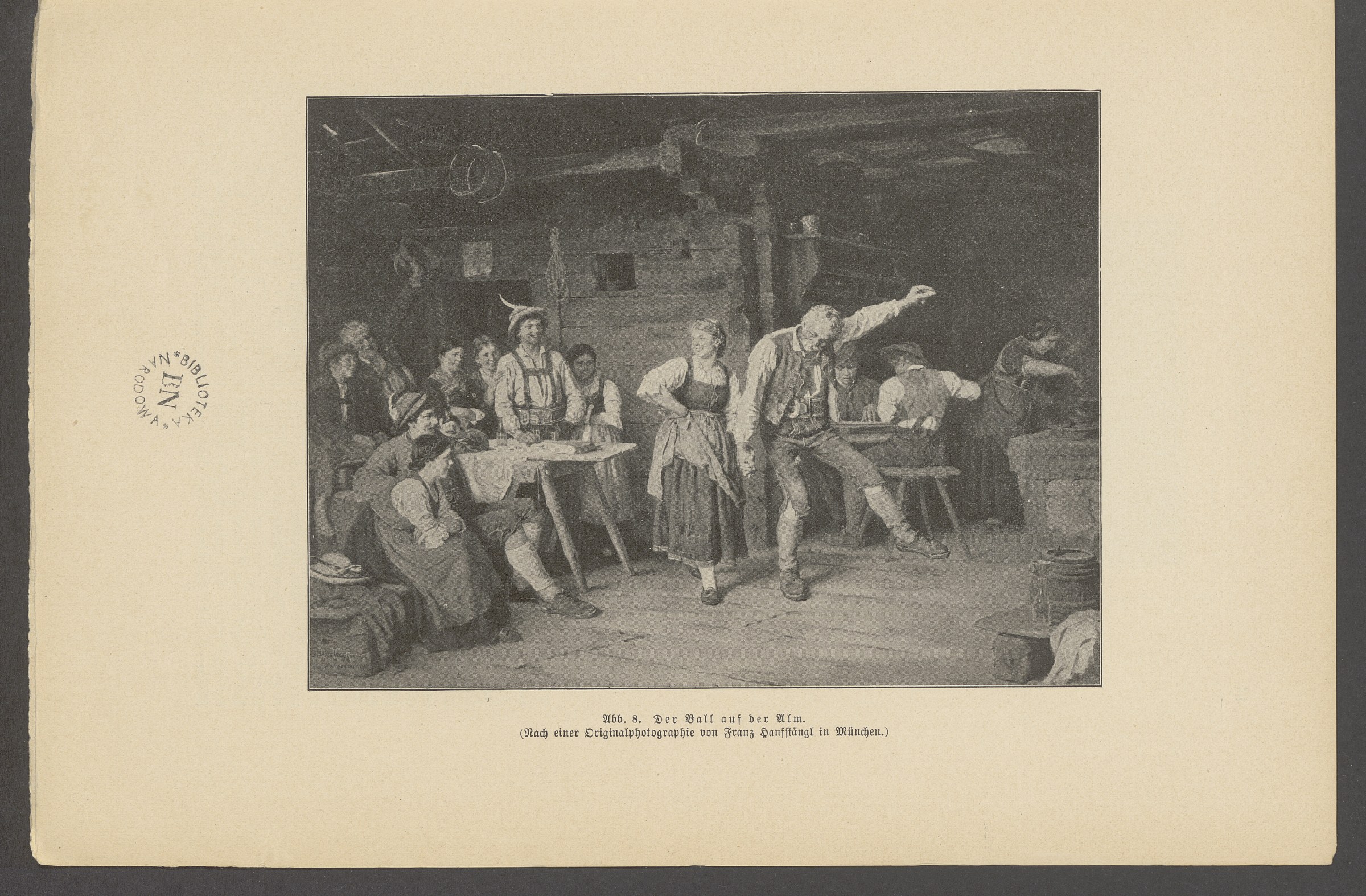
This image documents the living practice of Alpine folk dance in its authentic social context — not staged for theatrical consumption but recorded as it occurred in village life. It provides visual evidence of movement, costume, spatial relationships, and gender dynamics in a dance form that influenced European art dance and remains central to Bavarian cultural identity. Historians and practitioners of folk dance rely on such photographs as primary evidence of nineteenth-century technique and social function.
What you are looking at
A lively interior scene set in what appears to be a rustic Alpine tavern or inn, with timber framing and simple furnishings visible in the background. A group of villagers in traditional Bavarian dress — women in dirndls with aprons, men in lederhosen and embroidered jackets — gather to watch or participate in a dance. The central figures are actively dancing: a man with one arm raised gestures expansively while a woman in a full dirndl skirt responds with her own animated posture. Other figures sit and stand around the periphery, observing or waiting their turn. The lighting is dramatic and warm, emphasizing the convivial atmosphere of a folk celebration. The composition captures a moment of collective joy and community participation rather than a formal performance.
The dancing
The two central dancers are upright and energetic, with the man's raised arm suggesting a turning movement or invitation. The woman faces him with her body angled forward, her skirt suggesting rotational momentum. Their distance and posture indicate a folk dance pattern allowing for approach and retreat rather than a closed ballroom hold. The surrounding figures are seated or standing casually, their eyes directed toward the action, confirming this as participatory social dance rather than theatrical display. The body language throughout is relaxed and uninhibited, characteristic of village celebration rather than court convention.
The dance depicted
This depicts a traditional Bavarian or Alpine folk dance, most likely a Ländler or related regional variant. The setting, costume, and gestural vocabulary — the upright posture, raised arms, and rotational energy — are consistent with nineteenth-century Alpine social dancing as documented in German and Austrian folk practice. The mixed-gender participation, the raised-arm gesture, and the informal village setting all support identification as folk-regional dance. The image captures the social function of such dances: communal, participatory, and tied to celebration and courtship within rural communities.
How it was made
This is a photogravure or heliogravure reproduction, as indicated by the halftone tonal quality and the fine detail characteristic of late nineteenth-century photomechanical printing. The source is stated to be an original photograph by Franz Hanfstängl, a Munich-based photographer specializing in folk and genre subjects. This reproductive process allowed mass circulation of documentary imagery and made folk culture accessible to urban middle-class audiences in illustrated books and journals. The technique preserves photographic naturalism while permitting artistic composition, bridging documentary and genre art.
About this work
This is a documentary image of Bavarian village dance captured through photography and reproduced as a photogravure for publication around 1900. It records a moment of social participatory folk dancing in an Alpine setting, preserving both the movement vocabulary and the communal context of regional dance practice. The work sits within the broader late-nineteenth-century European interest in folk culture as subject matter for both ethnographic documentation and artistic representation. For a dance gallery, it offers visual evidence of how regional dance functioned as social glue in pre-industrial communities and how that practice appeared to contemporary urban observers.
How to look at it
Attend to the raised arm of the dancing man: it is neither a ballroom frame nor a rigid classical position, but an open, invitational gesture characteristic of participatory social dance. Notice the woman's response — her body turns toward him with her full skirt catching the movement, suggesting a rotational, approaching pattern. The surrounding seated figures provide crucial context: they are not an audience in the theatrical sense but participants in a social ritual where spectating and dancing are interchangeable roles. The interior setting, with its rough timber and domestic objects, anchors this as village life rather than performance.
The artist
The photograph is attributed to Franz Hanfstängl (1804–1877), a Munich photographer pioneering documentary and genre photography in Bavaria. Hanfstängl specialized in rural and folk subjects, creating a substantial archive of Bavarian village life, costumes, and customs. His work was widely reproduced and circulated in German illustrated publications, making him instrumental in establishing folk culture as a subject worthy of serious photographic attention. The work belongs to a tradition of German ethnographic and artistic photography that merged scientific documentation with romantic aestheticism.
The period
In 1900, European folk dance was experiencing simultaneous processes of documentation, romanticization, and decline. Rural dance traditions were being recorded by photographers and folklorists even as industrialization and urbanization threatened their survival. Simultaneously, folk forms were being adapted for theatrical performance and concert hall presentation, leading to the development of art forms like the ballet Russes' engagement with Russian folk material. In the German-speaking lands, the Alpine and Bavarian folk heritage was being claimed as cultural property and nationalist symbol, particularly in Bavaria and Austria. The photograph's publication in 1900 represents this dual impulse: to preserve authentic practice while making it available to audiences increasingly distanced from rural life.
Where it lives
The image is a photogravure reproduction published in Bielefeld by Velhagen & Klasing in 1900, part of an illustrated book on Bavarian culture. The original source is identified as a photograph by Franz Hanfstängl of Munich. The object is thus both a historical photograph in its initial production and a mass-circulation print in its current form.
Dance in this work
Questions about this work
Is this a posed studio scene or documentary photography?
The setting appears to be an authentic village interior, and the lighting and composition suggest this is documentation of actual practice rather than a staged tableau. However, photography in 1900 always involved some degree of arrangement and direction. The casual postures and informal grouping of the surrounding figures suggest less formal staging than typical genre photography of the period, and the photograph's use as documentary evidence in folk studies supports its reading as relatively naturalistic.
What dance is this exactly?
The costume, setting, and movement vocabulary point to a Ländler or related Bavarian/Alpine folk dance. The raised-arm pattern, the rotational energy, and the mixed-gender social participation are consistent with this family of dances. Without additional documentation, a more specific identification (particular regional variant or local name) is not possible from the image alone, but the genre is clear.
How was this photograph reproduced in the book?
This is a photogravure or heliogravure, a photomechanical process that converted a photographic negative into an intaglio printing plate. This allowed the tonal nuance and detail of the original photograph to be reproduced in quantity for books and journals, bridging the gap between unique photographs and mass-printed imagery. By 1900, this was a standard method for art and documentary reproduction.
What is the significance of Hanfstängl's work?
Franz Hanfstängl was a pioneering documentary photographer who elevated folk culture and rural life to serious artistic and ethnographic subjects. His extensive archive of Bavarian material made folk dance, costume, and village life visible to urban middle-class audiences and helped establish such subjects as worthy of preservation and study. His work influenced how folk culture was understood and valued in nineteenth-century German society.
More dance artwork