49 works in this view — arrow keys or swipe to move between them.
Dance in Art · 1900
Defregger 1900 (148087902)
Adolf Rosenberg
- Medium:
- Oil Painting
- Era:
- 1900-1920 (Ragtime/Early Jazz)
- Source:
- Wikimedia Commons
- Rights:
- Public domain — free to use, share and adapt.
- Recorded as:
- Public Domain
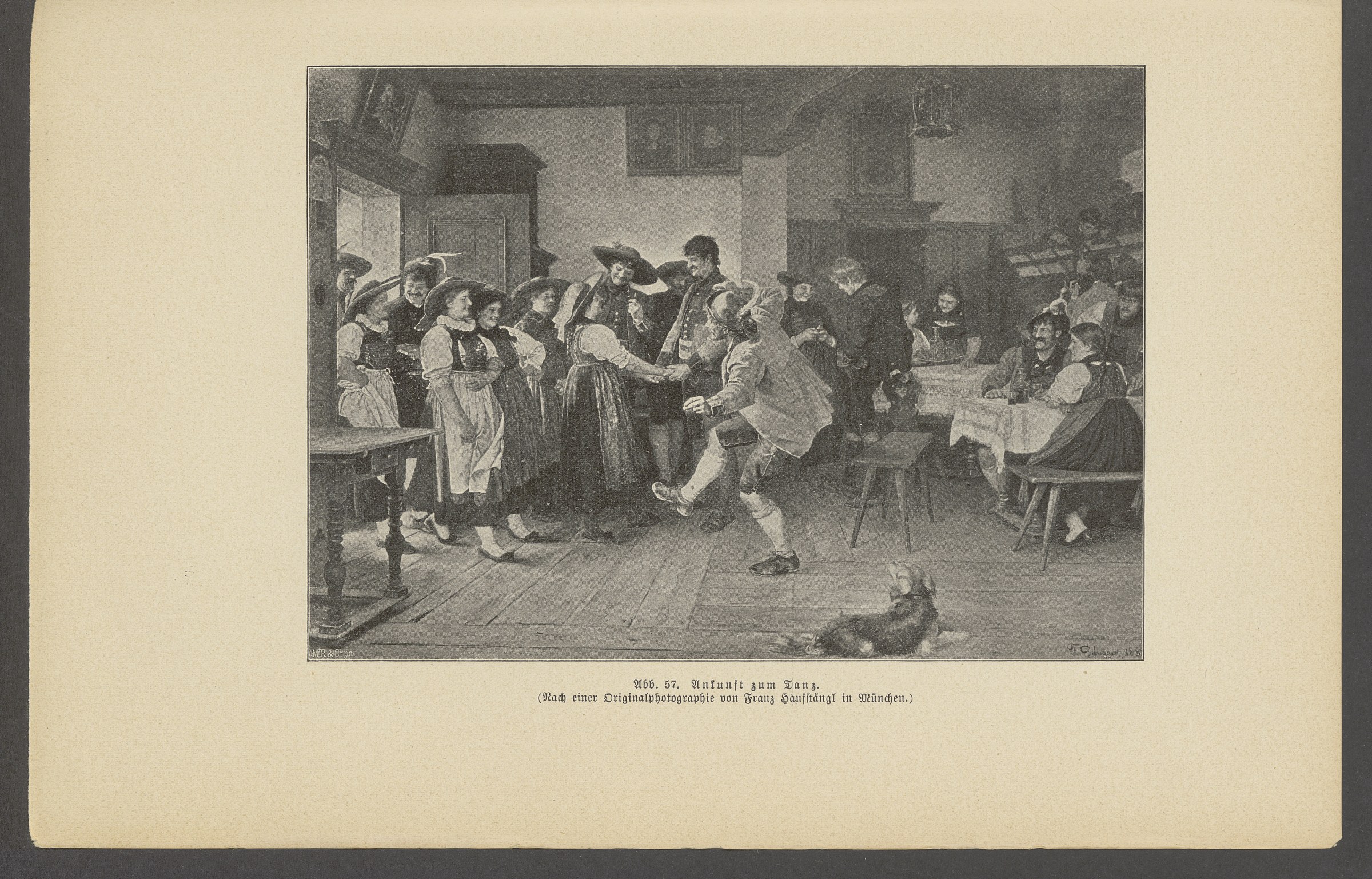
This image preserves a visual record of Central European folk dance practice in the early 20th century, showing how bodies moved, how costume facilitated movement, and how such dances functioned as social ritual within community life. For historians of folk tradition and social dance, it provides concrete evidence of the Ländler and related forms before mechanical recording became common.
What you are looking at
A lively tavern or inn scene in what appears to be Alpine or Bavarian folk tradition, with roughly twenty figures arranged in an interior space with timber beams and simple furnishings. The composition centers on a moment of social dance or courtship play: several women in traditional dress (long skirts, white aprons, fitted bodices) stand and sit in loose groups while men in leather breeches and hats move among them. The foreground shows a man in mid-gesture toward a seated woman, with one leg extended as if executing a hop or stamp. A small dog lies on the wooden floor in the lower right, an intimate domestic detail. The lighting is even and gray, characteristic of the engraving or lithographic process, with careful cross-hatching to suggest volume and shadow. The scene feels documentary in intent—a record of actual folk custom rather than a composed theatrical spectacle—yet the artist has selected a moment of clear narrative interest, with multiple simultaneous interactions creating a sense of collective merriment.
The dancing
The male dancer in the center has one leg raised in what reads as a hop or stamped step, his upper body upright and engaged, his posture suggesting vigorous weight transfer. Around him, the women occupy seated and standing positions, their bodies angled toward the action but without closed partnering holds. Several men wear hats characteristic of Alpine folk dress and assume active, reaching postures. The overall frame is open and processional rather than ballroom-formal; bodies move through the space rather than turn in place. The grouping suggests a participatory dance where individuals step in and out of the action rather than maintain fixed partnerships.
The dance depicted
This depicts Bavarian or Tyrolean folk social dance, most likely a variant of the Ländler or a related courtship dance tradition. The costume, setting, and compositional choice—the raised-leg step, the informal grouping, the alternation between active and waiting figures—are consistent with Alpine hop-waltz traditions where men court women through vigorous footwork and playful gestures, often in a tavern setting. The raised leg and forward momentum suggest the characteristic spring of such dances. The image captures not a formal choreography but the social practice of folk dance: a moment when one man steps forward to dance while others watch and wait their turn. The dog suggests this is everyday social life, not a staged performance.
How it was made
This is a wood engraving or steel engraving, a process that allowed for fine detail and wide circulation as a printed illustration. The technique creates the subtle grays and deep blacks visible in the shadows and costume folds. The level of narrative detail—the dog, the background figures engaged in conversation, the precise rendering of costume textures—suggests this was made for a book or periodical rather than as a standalone print. The catalogue record attributes it to Adolf Rosenberg and dates it 1900, noting it was published by Velhagen & Klasing in Bielefeld, a major German publisher of illustrated editions. This indicates the work was part of a larger editorial project documenting folk life or cultural tradition.
About this work
This is a wood or steel engraving from around 1900 documenting Bavarian folk dance in its social setting: a tavern scene where men and women of the Alpine region engage in courtship dance with characteristic hopping steps and vigorous movement. The artist has chosen a moment of clear action—one man stepping forward in an active gesture while others wait—that conveys the participatory, informal nature of folk tradition. The work sits at the boundary between ethnographic documentation and narrative genre painting, recording not a choreographed stage dance but the lived custom of a specific region and time.
How to look at it
Pay attention to the raised leg of the central male dancer—it is neither the pointed extension of ballet nor the smooth gliding of a waltz, but a vigorous, grounded hop suggesting elastic spring and downward momentum. Notice how the artist has frozen the dance mid-action rather than at a moment of repose; this conveys the continuous, energetic quality of the tradition. Observe how the other figures—seated, standing, watching—create a frame around the dancer, showing that folk dance was a communal activity where not everyone moved at once. The costume details, particularly the leather breeches and the cut of the women's skirts, are rendered with care because they enabled and shaped the movement itself.
The artist
The work is attributed to Adolf Rosenberg in the catalogue record. Rosenberg was a prominent German art critic and historian active in the late 19th and early 20th centuries, known for his scholarship on art history and for his editorial work. However, the signature visible in the image reads "F. Defregger 1900," suggesting the artist is Franz von Defregger, an Austrian painter famous for scenes of Tyrolean folk life. Defregger (1835–1921) made his career documenting the customs, dress, and daily life of Alpine communities with ethnographic precision and narrative warmth. His works were widely reproduced as engravings and lithographs for educational and popular publications.
The period
In 1900, folk dance documentation was emerging as a serious cultural and artistic interest across Europe. Industrialization and urbanization were perceived as threats to traditional regional practices, prompting artists, scholars, and collectors to record folk customs before they disappeared. This period saw the rise of ethnographic illustration as both art and archive. In Austria and Bavaria specifically, Alpine folk culture was experiencing a romantic revival in intellectual and artistic circles, celebrated as authentic expression untouched by modern life. Simultaneously, the international ballroom dancing world was formalizing and standardizing dances, making these regional variations increasingly visible as distinct and endangered traditions worth preserving visually.
Where it lives
The work was published in 1900 by Velhagen & Klasing in Bielefeld, a major German publisher known for illustrated books on culture, history, and regional life. It appears as an engraving in a bound or serial publication. The source is listed as Wikimedia Commons, indicating the image is available in digital form through public collections.
Dance in this work
Questions about this work
What is the dance in this image?
This is Bavarian or Tyrolean folk dance, likely a Ländler or related courtship dance. The characteristic hop step, the informal tavern setting, and the interactive social structure between men and women stepping forward to dance are all typical of Alpine folk tradition. The raised-leg step visible in the central figure is distinctive to these traditions and differs markedly from the smoother movements of contemporary ballroom dancing.
Why is there a dog in a dance scene?
The dog signals that this is not a staged or formal performance, but a representation of actual social life—a moment of everyday dancing in a tavern or gathering space. Its presence is part of the documentary intent: the artist is showing how folk dance functioned within real community settings, not as art separated from daily existence. This kind of detail was important to ethnographic illustration of the period.
Is this signed? Who is the artist?
A signature reading "F. Defregger 1900" is visible in the lower right of the engraving. This indicates Franz von Defregger, an Austrian painter renowned for his depictions of Tyrolean and Alpine folk life. The catalogue record attributes it to Adolf Rosenberg, possibly in error or because Rosenberg may have been the editor or publisher of the project in which this engraving appeared.
What technique was used to make this?
This is a wood or steel engraving—a relief printing process that allowed for fine detail and widespread circulation in books and periodicals. The technique creates the subtle gradations of tone and the crisp detail visible in the clothing, architecture, and figures. Its publication by a major German publisher indicates it was part of a larger editorial project, likely an illustrated book documenting European folk traditions.
More dance artwork