49 works in this view — arrow keys or swipe to move between them.
Dance in Art · 1869
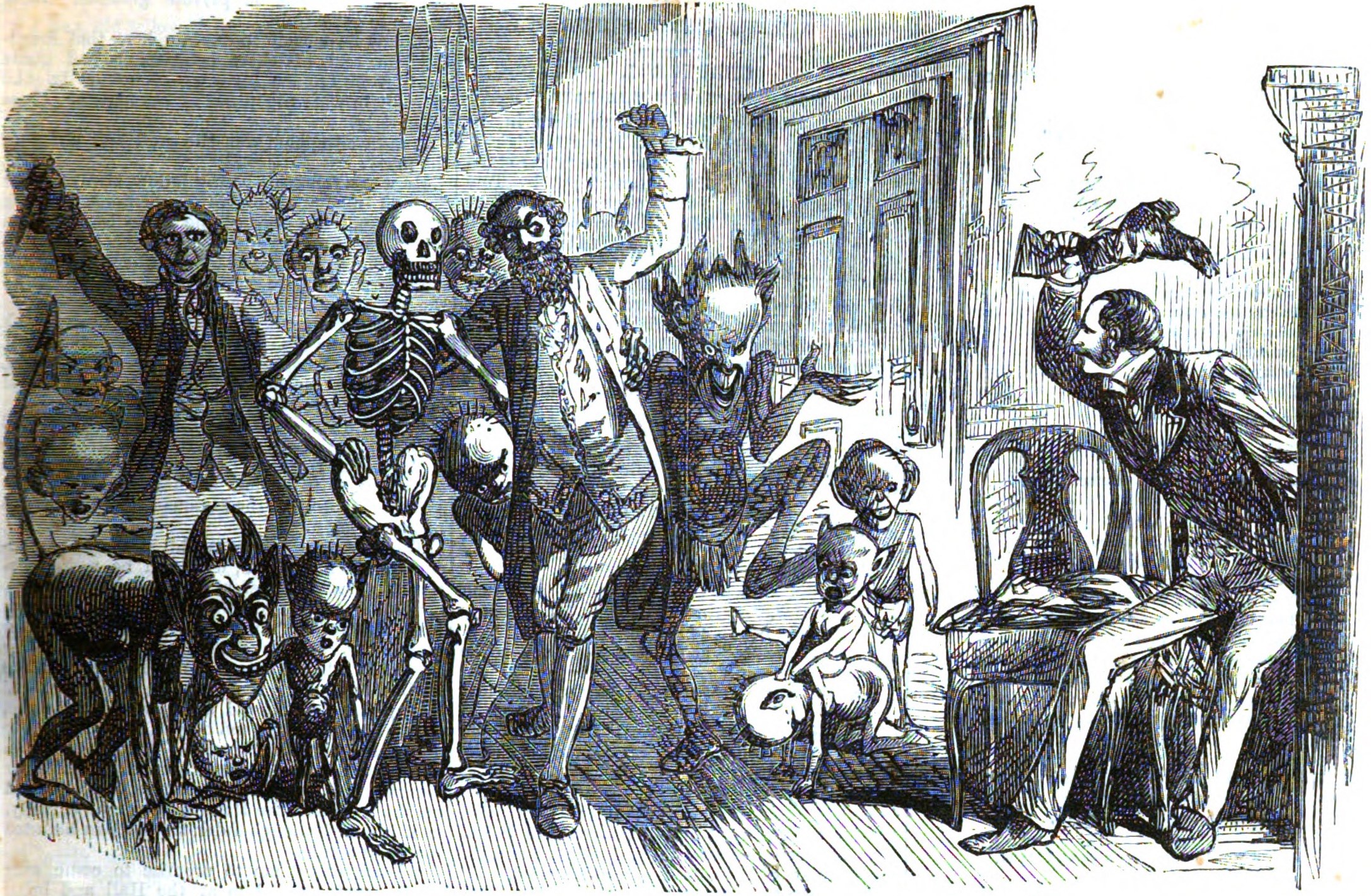
Demons and Elves of Every Size and Kind Danced Across the Room
Unknown
- Medium:
- Oil Painting
- Era:
- Late 1800s (Victorian Ballroom)
- Source:
- Wikimedia Commons
- Rights:
- Public domain — free to use, share and adapt.
- Recorded as:
- Public Domain
This image reveals how Victorian popular culture used dance as a symbol of order and propriety, and how that order was comedically or horrifically disrupted in supernatural narratives aimed at young readers. It also documents the visual vocabulary available to engravers working at speed for weekly periodicals: how to suggest movement, chaos, and the fantastic using only line. For dance historians, it shows how ballroom culture saturated Victorian imagination even in contexts of pure fantasy.
What you are looking at
A fantastical ballroom scene crowded with supernatural figures—skeletons, demons, imps, and elfin creatures—engaged in frenzied movement and dance. The composition is chaotic and densely packed, with figures overlapping across the frame. In the foreground, a skeleton in formal dress with a scythe dominates the left side; beside it crouches a horned demon. The center and right side swarm with smaller imp-like beings, some with bat wings and distorted features, their bodies twisted in exaggerated attitudes of movement. The setting is a grand interior with tall doors and paneled walls visible in the background, suggesting a Victorian mansion or ballroom. Two human observers—a man and woman in period dress—sit calmly at right, watching the supernatural carnival unfold. The lighting is sketchy and atmospheric, with deep shadows creating an unsettling mood despite the apparent gaiety of the scene.
The dancing
The bodies throughout are rendered in exaggerated, almost contorted postures—bent spines, wild arm gestures, grotesque leaps. The skeleton holds its scythe aloft in a conductor-like pose. The smaller demons and elves gesture wildly, their limbs akimbo, suggesting violent or frenetic movement rather than any formal dance hold. The human spectators maintain composed, upright postures in sharp contrast to the supernatural chaos. No recognizable ballroom frame or closed hold appears; the supernatural figures move as individuals or in loose, disordered proximity.
The dance depicted
This is not a depiction of a recognizable dance form but rather a phantasmagoric fantasia on the idea of supernatural revelry. The title and source—a Christmas supernatural story in a boys' periodical—place this squarely in Victorian Gothic entertainment tradition. The exaggerated, disorderly movement parodies or invokes the formal ballroom dances of the Victorian era by inverting them: instead of ordered quadrilles or waltzes, we see chaos; instead of human nobility, a carnival of the demonic and grotesque. The 'dance' is theatrical spectacle—a visual joke on what happens when propriety is abandoned.
How it was made
This is a wood engraving or steel engraving, a medium evident from the fine parallel line hatching, the crispness of detail in shadow and form, and the tonal range achieved through varying line density. Such engravings were the primary means of illustration in Victorian periodicals, allowing for mass reproduction in cheap weekly story papers. The technique required great skill to render complex compositions with multiple overlapping figures and atmospheric effects. As a periodical illustration, this work reached thousands of working-class and middle-class readers—children and adolescents—as part of their weekly entertainment.
About this work
This is a wood or steel engraving commissioned as an illustration for 'Will He Return? or, The Strange Message,' a supernatural Christmas story published in Boys of England in late 1869. It depicts a crowded ballroom invaded by demons, elves, and skeletons, observed calmly by two human spectators. The work is a Victorian Gothic fantasy rather than a documentary record of dance; it invokes the formality of ballroom culture precisely to undermine it through supernatural intrusion and grotesque excess. The image belongs in a dance gallery not as a record of how any dance was actually performed, but as evidence of how Victorians imagined dance within fantasy narratives—as a marker of civilization and order that could be spectacularly violated.
How to look at it
Observe how the engraver uses density of line and overlap to create visual chaos in the center and right of the frame, contrasting with the more legible forms of the skeleton and demon in the foreground. Notice the complete absence of symmetry or formal arrangement—this is a parody of ballroom order. Pay attention to the human spectators: their composure and upright posture, their apparent indifference or amusement, frames the supernatural chaos as a kind of entertainment or moral lesson. The composition suggests movement through gesture and contortion rather than through any actual footwork or frame; the 'dancing' here is pure spectacle, not technique.
The artist
The engraving is uncredited, which was typical for periodical illustrations of this era. Hundreds of skilled wood and steel engravers worked anonymously for Victorian publications, reproducing sketches by staff artists or commissioned illustrators. The style is competent and confident—the engraver understood how to manage complex compositions, create atmosphere through hatching, and render both human and grotesque anatomy convincingly. The work was likely produced on a tight schedule to meet the magazine's publication deadline.
The period
In 1869, ballroom dancing was the dominant social dance form among the middle and upper classes, codified in strict rules of propriety and partner arrangement. The same period saw a flourishing of Victorian Gothic literature and supernatural storytelling in periodicals aimed at youth—part of the expansion of mass entertainment through cheap weekly papers. Christmas numbers of story papers were particularly popular and often featured fantastical or supernatural content. This illustration sits at the intersection: it uses the visual language of ballroom culture (the grand interior, the formality of the setting) as a canvas for Gothic fantasy, appealing to young readers' appetite for the macabre and the marvelous. The engraving also demonstrates the technical sophistication of mid-Victorian illustrative art, at a moment when photography was beginning to establish itself but the engraved image remained the dominant medium for periodical reproduction.
Where it lives
This engraving was published as an illustration on page 9 of the Christmas number of Boys of England, vol. 6, no. 161 (13 December 1869–1 January 1870). The periodical was a popular weekly story paper for adolescent male readers. The image was digitized by Google from a copy held in the New York Public Library and downloaded via HathiTrust Digital Library.
Questions about this work
What dance is being shown here?
No specific dance form is being depicted. This is a fantastical ballroom scene designed for entertainment rather than as a record of actual dance practice. The exaggerated, chaotic movement is meant to amuse rather than to instruct. The work invokes the formality of Victorian ballroom dancing precisely by inverting and parodying it through supernatural intrusion.
Was this image published in color?
No. This was a wood or steel engraving, printed in black and white, as was standard for periodical illustration in 1869. The tonal range was achieved entirely through variations in line density and hatching, a technique visible throughout the image.
Who was the artist?
The engraver's name does not appear on the illustration, which was typical practice for periodical engravings of this period. The work may have been based on a sketch by a staff or commissioned artist, then transferred to the wood or steel block and engraved by a specialist craftsperson, often in a workshop rather than by a single named hand.
Why are the human spectators so calm?
Their composure serves a narrative and moral function in the story. It may suggest that such supernatural visitations are understood as entertainment, lesson, or test rather than genuine threat. It also creates visual comedy through contrast: the orderly, composed humans observe with equanimity the frenzied chaos of the supernatural realm.
More dance artwork