49 works in this view — arrow keys or swipe to move between them.
Dance in Art · 1883
Die Gartenlaube (1883) b 012
Various artists
- Medium:
- Oil Painting
- Era:
- Late 1800s (Victorian Ballroom)
- Source:
- Wikimedia Commons
- Rights:
- Public domain — free to use, share and adapt.
- Recorded as:
- Public Domain
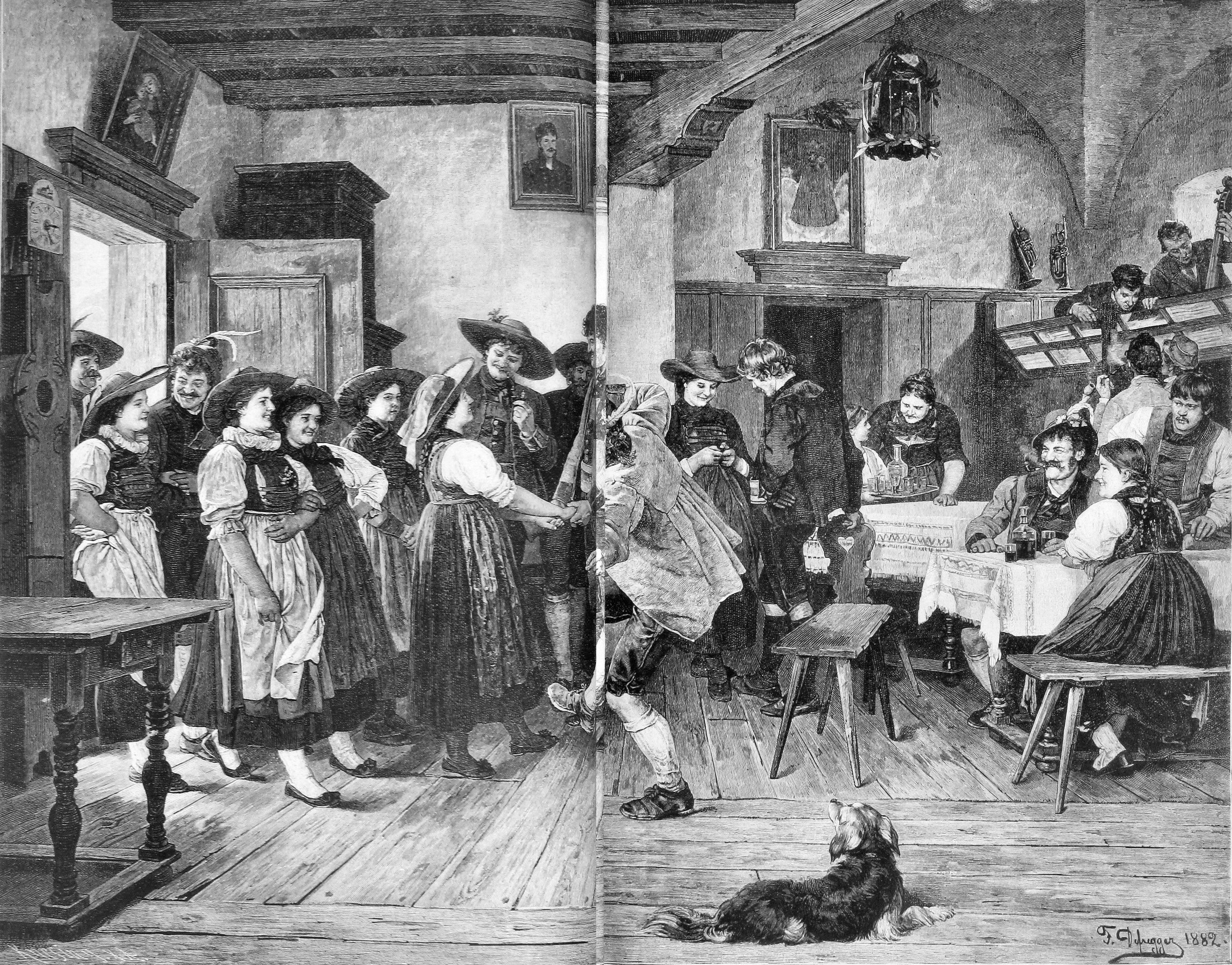
This image documents the waltz at a threshold between elite ballroom culture and popular village practice—a moment when the dance was spreading from court and city ballroom into rural communities across the Alpine region. It shows how a couples' dance was integrated into village social ritual and how its form was preserved (or transformed) through that process. For historians of dance and the social history of the waltz, it is evidence of the dance's reach and adaptation across class and geography.
What you are looking at
An engraved scene of a village dance or ball, set in what appears to be a modest Alpine or Central European inn or gathering hall. The space is divided by a broad wooden beam running through the middle; on the left, couples queue for the dance or wait in animated conversation, while on the right, musicians and seated spectators frame an open floor where a couple is actively dancing. The figures are dressed in period folk costume: the women wear light linen sleeves, dark bodices with white aprons, and hats or bonnets; the men wear leather breeches, vests, and hats typical of 19th-century Alpine dress. The floor is bare wood, and the architecture—beam ceiling, simple walls, a small altar or shrine visible above—suggests a working community space rather than a formal ballroom. A dog lounges prominently in the foreground, part of the genre's vernacular detail. The light is even and clear, typical of wood-engraved illustration.
The dancing
The couple at the dance's center stand in a closed ballroom hold, the man's arm supporting the woman's waist while their hands meet at shoulder height—a frame consistent with 19th-century waltz or popular European couple dances. The woman's body turns slightly away in the characteristic rotation of the waltz, her skirts beginning to lift with the motion. The waiting figures on the left are upright and engaged, some in profile, some turned toward the action; their posture and dress suggest anticipation and social pleasure rather than theatrical formality. The seated figures on the right are static, watching; there is a clear distinction between active dancers and the community gathered to witness.
The dance depicted
This depicts a social waltz or landler—the couple dance most popular in Alpine and Central European village contexts in the 19th century. The title 'Antritt zum Tanze' ('Going up to the Dance') suggests the moment just before or at the opening of a public dance, a common subject in German and Austrian folk-life imagery. The hold, the woman's turn, and the informal gathered setting all point to the waltz as it was danced outside the ballroom, in village festivals, inns, and community gatherings. The engraving's focus on the social ritual—the queue, the music, the witnesses—rather than steps or technique, indicates this is a record of a cultural practice, not a dance manual.
How it was made
This is a wood engraving, a relief technique that produces fine, precise lines and was the dominant medium for book and periodical illustration in the 19th century. The tonal work—the way light is built from parallel lines and dots—shows mastery of the medium's capability for narrative detail and spatial clarity. The technique allowed for mass reproduction in newspapers and magazines, and the tight, observant style suggests this was likely created for a popular illustrated publication. The signature at the lower right ('T.F. Defregger 1883') confirms authorship and date.
About this work
This is a wood-engraved illustration of a village dance in Alpine dress, showing the social moment at which a couple steps forward to dance the waltz. The work captures not the refined ballroom waltz but its vernacular form as practiced in rural communities—a social ritual framed by musicians, witnesses, and the architecture of village life. The engraving belongs to a 19th-century tradition of folk-life imagery that documented regional customs and dress, often with sympathetic anthropological intent. It is a record of how the waltz lived outside the concert hall, embedded in community ceremony and seasonal gathering.
How to look at it
Look first at the composition: the artist has divided the space to show both the action (the couple, the moment of engagement) and the social context (the queue, the musicians, the onlookers). The couple's hold and the woman's turn are recognizable to any reader familiar with ballroom dance. Notice the dress—the engraver has rendered the linen, the embroidery, and the cut with precision, indicating these are not generic figures but specific regional costume. The dog in the foreground is a vernacular detail that anchors the scene in lived community rather than idealized performance. The title directs attention to the threshold moment—the 'going up to the dance' rather than virtuosity.
The artist
Franz Defregger (1835–1921) was an Austrian painter and illustrator specializing in Alpine folk scenes and village life. His work was widely reproduced as engravings for popular periodicals, especially the German illustrated weekly Die Gartenlaube ('The Garden Arbor'), for which this work was created. His style combined careful observation of costume, architecture, and social custom with a sympathetic, if sometimes romanticized, view of rural life. He was influential in establishing the visual conventions of Alpine folk-life imagery in the 19th century.
The period
The 1880s saw the waltz at the height of its social dominance across Europe, nearly 100 years after its emergence in Vienna. By this time the dance had migrated far beyond its original urban elite context and was the standard couple dance in village festivals and community gatherings. Simultaneously, there was intense interest among urban, educated audiences in documenting and preserving 'folk' customs, dress, and practice—partly nostalgic, partly anthropological—as industrialization and urbanization transformed rural life. Illustrated periodicals like Die Gartenlaube were the primary vehicle for circulating these images to a middle-class readership hungry for images of authentic village life.
Where it lives
The image is sourced from Wikimedia Commons and is identified as a wood engraving from Die Gartenlaube, a German illustrated weekly published 1853–1937. The notation 'b 012' in the catalogue record likely refers to an issue or collection reference within a holding archive. The work belongs to the broader tradition of periodical illustration that dominated 19th-century visual culture and was the primary medium through which middle-class audiences encountered images of folk custom.
Dance in this work
Questions about this work
What dance is this?
This depicts a waltz, the most common couple dance in Alpine and Central European communities in the 19th century. The closed hold, the woman's turn, and the paired stance are unmistakable. The setting and dress indicate this is the waltz as danced socially in village gatherings rather than in formal ballrooms.
What is 'Antritt zum Tanze'?
The title translates as 'Going up to the Dance' and refers to the moment when a couple steps forward to begin dancing. It is both a literal description of the scene and a conventional subject in Alpine folk-life art—the threshold moment when the social act of dancing begins.
Who was Defregger?
Franz Defregger (1835–1921) was an Austrian painter and prolific illustrator of Alpine folk scenes. He was closely associated with Die Gartenlaube, for which he created many wood-engraved illustrations. His work was central to the 19th-century visual codification of Alpine regional identity and costume.
How widespread was the waltz by the 1880s?
By 1880, the waltz had become the dominant social dance across Europe, from urban ballrooms to village festivals. This engraving is evidence of how thoroughly the dance had penetrated rural communities and been adapted to local social custom. The publication in a mass-circulation weekly shows how widespread interest in documenting this practice had become.
More dance artwork