49 works in this view — arrow keys or swipe to move between them.
Dance in Art · 1891
Die Gartenlaube (1891) b 012
Various artists
- Medium:
- Oil Painting
- Era:
- Late 1800s (Victorian Ballroom)
- Source:
- Wikimedia Commons
- Rights:
- Public domain — free to use, share and adapt.
- Recorded as:
- Public Domain
This work documents the actual pedagogy of late 19th-century ballroom dance, showing how waltz and cotillion were taught in formal settings by masters to upper-class students. It captures the formality, the authority of the instructor, and the role of spectatorship in social dance education—dimensions largely absent from more theatrical or celebratory dance imagery. For historians of dance pedagogy and social dance, the image is a primary document of how correct movement was defined, demonstrated, and learned in this era.
What you are looking at
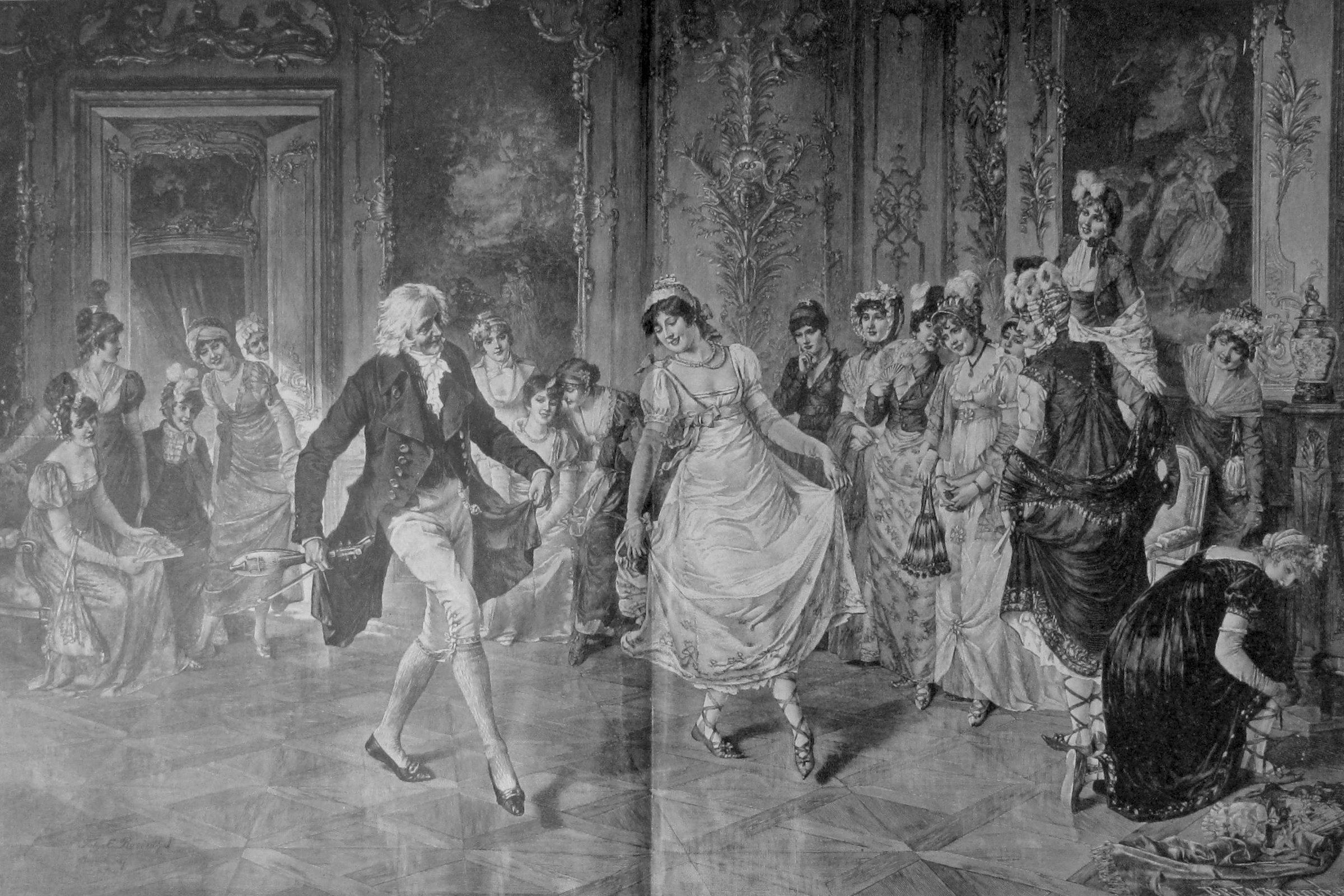
A formal dance lesson unfolds in an opulent interior, likely a ballroom or salon of the late 19th century. The space is defined by tall mirrored panels with ornamental gilding and painted wall panels depicting classical scenes. A distinguished older man in dark formal dress—a teacher or master of ceremonies—stands at left center, gesturing instruction or leadership. A young woman in a high-waisted white gown with classical drapery dominates the center, her posture upright and composed as she performs. Around them, arranged in loose formation, stand a dozen or more figures in evening dress: some women in pastel gowns with period coiffures and jewels, others in darker formal attire. The assembled group watches with attention; some appear to be waiting their turn. The polished floor reflects light, emphasizing the formal nature of the occasion. The composition suggests a moment of instruction or demonstration rather than an energetic group dance—a teaching moment frozen in a cultivated social setting.
The dancing
The central female dancer stands with classical posture: squared shoulders, lifted frame, and what appears to be a modest forward extension of one leg. Her arms are positioned with control—not in an exuberant theatrical gesture but in the restrained, purposeful placement expected of ballroom instruction. The male instructor leans slightly forward with an open gesture of guidance or command. The surrounding figures maintain upright, attentive posture; their placement suggests they are students or observers rather than active dancers. The overall frame is one of formality and restraint: no wild movement, no partnered turn, no improvisation—instead, the careful deportment of a managed social event.
The dance depicted
This is almost certainly a depiction of a waltz lesson or cotillion instruction from the Gilded Age ballroom tradition. The high-waisted white gown, the formal male instruction, the attentive spectators, and the polished ballroom setting all point to late 19th-century social dance pedagogy. The posture and frame of the central figure are consistent with the Classical or Victorian Waltz (historic-gilded-age tradition). The scene emphasizes the didactic and social dimensions of ballroom dance rather than virtuosity: the point is refinement, proper form, and social competence. The gathering of witnesses suggests this was a recognized pedagogical practice among the upper classes, where a master or dancing master would demonstrate correct technique to assembled society.
How it was made
The catalogue records this as an oil painting, and the image confirms that assessment. The medium allows for the subtle gradation of light on fabric, the reflective quality of the polished floor, and the depth of the mirrored interior space. The artist has employed careful linear perspective and has modeled the figures with attention to fabric weight and the play of gaslight or candlelight across surfaces. The technique is representational and detailed but not photographic; it is the work of a skilled academic painter of the period, capable of rendering both architectural space and social nuance. Such oil paintings were commissioned works for educated audiences and were often reproduced as prints or engravings for wider circulation.
About this work
This is a late 19th-century oil painting depicting a formal ballroom dance lesson or cotillion demonstration among the European or American upper classes. The work records not the moment of joyous social dancing but the pedagogical moment: the teaching of correct form, posture, and movement by a recognized master to students and observers of high social standing. The setting—an ornate salon with mirrored walls and classical decoration—reinforces that this is an elite social practice, not a popular entertainment. The painting belongs to a tradition of Gilded Age ballroom imagery that celebrated refinement, correct deportment, and the social role of dance in maintaining class distinctions and cultural capital.
How to look at it
Observe the posture and arm placement of the central dancer: how she holds herself with lifted frame and controlled extension, how her arms are positioned not for display but for balance and form. Notice the positioning of the instructor—his gesture is one of authority and guidance rather than partnership. Look at the arrangement of the onlookers: their attention, their dress, their status as students and witnesses rather than participants. The painting freezes the moment not of movement but of instruction: the moment when the master demonstrates or corrects, when learning takes place. The refinement of the setting—the mirrors, the gilding, the polished floor—tells you this is an elite practice, governed by rules and decorum.
The artist
The catalogue attributes the work to various artists and credits a painting by Toby E. Rosenthal (1848–1917), an American academic painter known for historical and genre scenes. Rosenthal trained in Europe and was skilled at rendering interior scenes and social gathering with careful attention to light, fabric, and social psychology. His work often captured moments of instruction, ceremony, or social interaction rather than action or spectacle. The painting's careful composition and technical refinement are consistent with Rosenthal's academic practice and his reputation for social realism.
The period
In the 1890s, ballroom dancing was at the height of its social prestige among European and American elites. The waltz and the cotillion had dominated fashionable dancing for decades, and the role of the professional dancing master—the arbiter of correct form—was well established. The era was one of heightened attention to etiquette, social refinement, and the visible markers of class distinction. At the same time, dance was beginning to be challenged by new forms: ragtime and syncopated music were beginning to circulate, and theatrical dance was becoming more adventurous. This image, with its emphasis on classical posture and restrained instruction, belongs to the twilight of the old ballroom order. In art, the 1890s saw growing interest in capturing social life and interior scenes, particularly among academic painters influenced by Realism and Naturalism.
Where it lives
The work is sourced from Wikimedia Commons, which indicates it is likely in the public domain or held in a public collection. The original holding institution is not recorded in the catalogue. The work was published in *Die Gartenlaube*, a German family journal and illustrated periodical of the late 19th century, indicating it was reproduced as a print or engraving for a broad middle-class German audience.
Dance in this work
Questions about this work
What dance is being taught in this painting?
The formal ballroom setting, the high-waisted white gown, the posture of the central dancer, and the presence of a master instructor all point to a waltz or cotillion lesson. These were the dominant social dances of the 1890s among European and American elites. The emphasis is on correct classical form and deportment rather than virtuosity or expression.
Who is the older man in the dark coat?
He appears to be the dancing master or instructor—the professional who taught correct technique to upper-class students. By the late 19th century, such figures were established authorities in their field, often trained in Europe and employed to maintain standards of propriety and refinement among the aristocracy and haute bourgeoisie.
Why are all these people watching one couple dance?
This is a teaching demonstration or lesson, not a social dance. The onlookers are students waiting their turn or observers learning by watching. Formal ballroom instruction in this era often took this pedagogical form: the master would demonstrate, correct, and have individuals or couples perform while others observed and learned.
What does this tell us about ballroom dance in the 1890s?
It reveals that ballroom dancing was a highly formalized, rule-governed social practice among the upper classes, governed by professional masters and emphasizing correct posture, restraint, and classical form. It was as much about learning social codes and demonstrating refinement as it was about the joy of movement. The scene also shows that dance education was a group or semi-public affair, not private instruction.
More dance artwork