49 works in this view — arrow keys or swipe to move between them.
Dance in Art · 1874
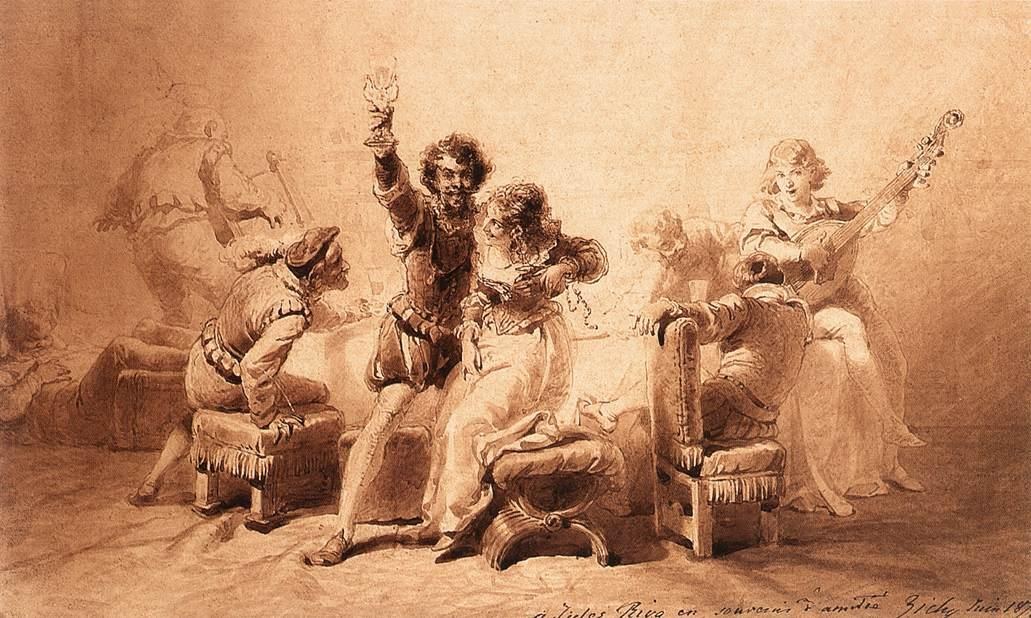
Drinking- song - Zichy, Mihály - 1874
Mihály Zichy
- Medium:
- Ink
- Era:
- Late 1800s (Victorian Ballroom)
- Source:
- Wikimedia Commons
- Rights:
- Public domain — free to use, share and adapt.
- Recorded as:
- Public Domain
The image preserves a fleeting moment of social performance that reveals the texture of domestic entertainment in the 18th century: song, gesture, and relaxed bodily presence as the currency of intimate gatherings. For historians of dance and social life, it documents the non-professional, non-theatrical movements and gestures that constituted everyday pleasure—crucial context for understanding what formal dance meant against the background of ordinary sociability.
What you are looking at
A sepia-toned ink drawing presents an intimate indoor gathering of five figures arranged in a loose semicircle in what appears to be a salon or drawing room. The central figure, a man with dark curled hair, stands with one arm raised in animated gesture, apparently singing or declaiming to the assembled company. He wears a dark velvet jacket over a light shirt. To his left sits a woman in a pale, high-waisted gown; to his right, another woman in similar dress leans toward him with evident attention. A man in a broad-brimmed hat reclines on a cushioned seat at left, while a fourth figure—possibly female—sits at right with what may be a musical instrument (a lute or guitar) resting against her chair. The figures are disposed on low, cushioned furniture scattered across the floor. The drawing style is loose and sketchy, with atmospheric wash suggesting depth and shadow; the background figures fade into indistinct suggestion. The overall mood is one of convivial entertainment: this is a moment of music, song, and social pleasure.
The dancing
The five figures are arranged as an audience to the central male singer, whose raised arm and animated posture suggest he is in the midst of performance or emphatic expression. The seated women display attentive poses—leaning, turning toward the speaker—but are passive rather than actively dancing. The figure at right appears to hold a stringed instrument as a prop or support. No closed holds, synchronized stepping, or formal dance frame is evident; the bodies are relaxed and socially disposed rather than trained in concert. This is a scene of amateur or semi-professional entertainment among companions, not a formal or technically demanding dance.
The dance depicted
This appears to depict a social musical gathering rather than a dance proper—specifically, the convivial entertainment of a drinking song or vocal performance in a late 18th-century European salon. The title identifies it as a 'drinking-song,' a familiar form of communal entertainment in which wine, song, and recitation were the chief pleasures. While music and social movement are present, the image does not show choreographed or formal dance; instead it captures the informality of domestic or tavern entertainment among equals. The woman with the stringed instrument may be providing accompaniment, positioning this at the margin between music-making and dance.
How it was made
The work is executed in brown or sepia ink with wash, a technique that allows rapid, expressive rendering of figure and atmosphere while maintaining fine detail in the faces and foreground. The loose brushwork and sketchy background suggest this is either a finished drawing intended for reproduction (possibly as an engraving) or a study for a larger work. The medium and style are consistent with late 18th-century European printmaking practice—ink washes were a economical way to suggest tone and depth before engraving or lithography, and this drawing may well have served as a model for a published print. The sketch-like quality suggests immediacy and spontaneity, capturing a fleeting social moment rather than a posed, formal composition.
About this work
Mihály Zichy's 'Drinking-song' is a sketch of an intimate moment of social entertainment in a late 18th-century salon: five figures gathered around a man in the act of singing or declaiming, his gesture animated and central while the others listen and attend. The work is important not as a document of choreographed dance, but as evidence of the social contexts in which music, movement, and pleasure intersected in the private sphere. It belongs in a dance archive because it shows how song, gesture, and bodily presence were inseparable from social life and entertainment of the period—the forms of movement and expression that surrounded and informed the more formal dances of the era.
How to look at it
Attend to the raised arm and open mouth of the central figure, which convey the moment of performance itself—the singer at the height of expression. Notice how the surrounding figures orient themselves toward him: their posture, lean, and gaze all direct attention inward and upward, composing a visual hierarchy that privileges the performer. The loose, rapid ink technique allows Zichy to suggest both the specificity of individual faces and the atmospheric unity of the room; the background figures fade deliberately, emphasizing the social focus of the foreground. This is a drawing that prioritizes the social geometry of attention and response over the formal beauty of the bodies themselves.
The artist
Mihály Zichy (1827–1906) was a Hungarian painter and printmaker known for his prolific output of society scenes, portraits, and romantic illustrations. He worked extensively in ink and lithography, producing numerous drawings and prints depicting fashionable life, entertainment, and social occasions. His style was naturalistic and observant, attentive to the gestures and dispositions of figures in informal settings. Zichy was a successful and widely reproduced artist whose work circulated in print form across Europe, making his scenes of social life accessible to a broad public.
The period
In the 1870s, when this work was made, the salon tradition was entering its final phase of dominance in European urban culture. Music, recitation, and song were central to middle- and upper-class entertainment, with amateur performance and conviviality valued as marks of refinement and social grace. The formal dances of the ballroom—waltz, polka, quadrille—were well established, but the informal entertaining captured here—the drinking song, the musical evening—remained vital to social life. Zichy's attention to these scenes reflects both the importance of such gatherings and the artist's interest in capturing contemporary manners and customs.
Where it lives
The work is recorded as a 1874 ink drawing by Mihály Zichy, sourced from Wikimedia Commons. No current holding collection or accession information is recorded. The sketch appears to be a finished work in its own right, though it may also have served as a study for a published print or larger composition.
Questions about this work
Is this actually a dance scene?
Not in the formal sense. This is a scene of social entertainment centered on singing and recitation rather than choreographed dance. However, it belongs in a dance archive because it shows how gesture, music, and bodily presence were inseparable from social performance in the period, and because it documents the contexts of pleasure and movement in which formal dance was embedded.
What is the man in the center doing?
He appears to be singing or declaiming—reciting poetry or performing a song—with animated gesture. His raised arm and open-mouthed expression suggest he is in the midst of vocal performance, while his audience attends silently from their seats.
What is the woman on the right holding?
She appears to be holding or seated near a stringed instrument, likely a lute or guitar. She may be providing musical accompaniment to the singer, or the instrument may simply be a prop indicating the musical context of the scene.
Why did Zichy draw this subject?
Zichy was known for his attentive, naturalistic scenes of contemporary social life and entertainment. This drawing captures a moment of fashionable and cultivated leisure—the kind of intimate gathering that marked polite society in the 19th century.
More dance artwork