38 works in this view — arrow keys or swipe to move between them.
Dance in Art · 1840
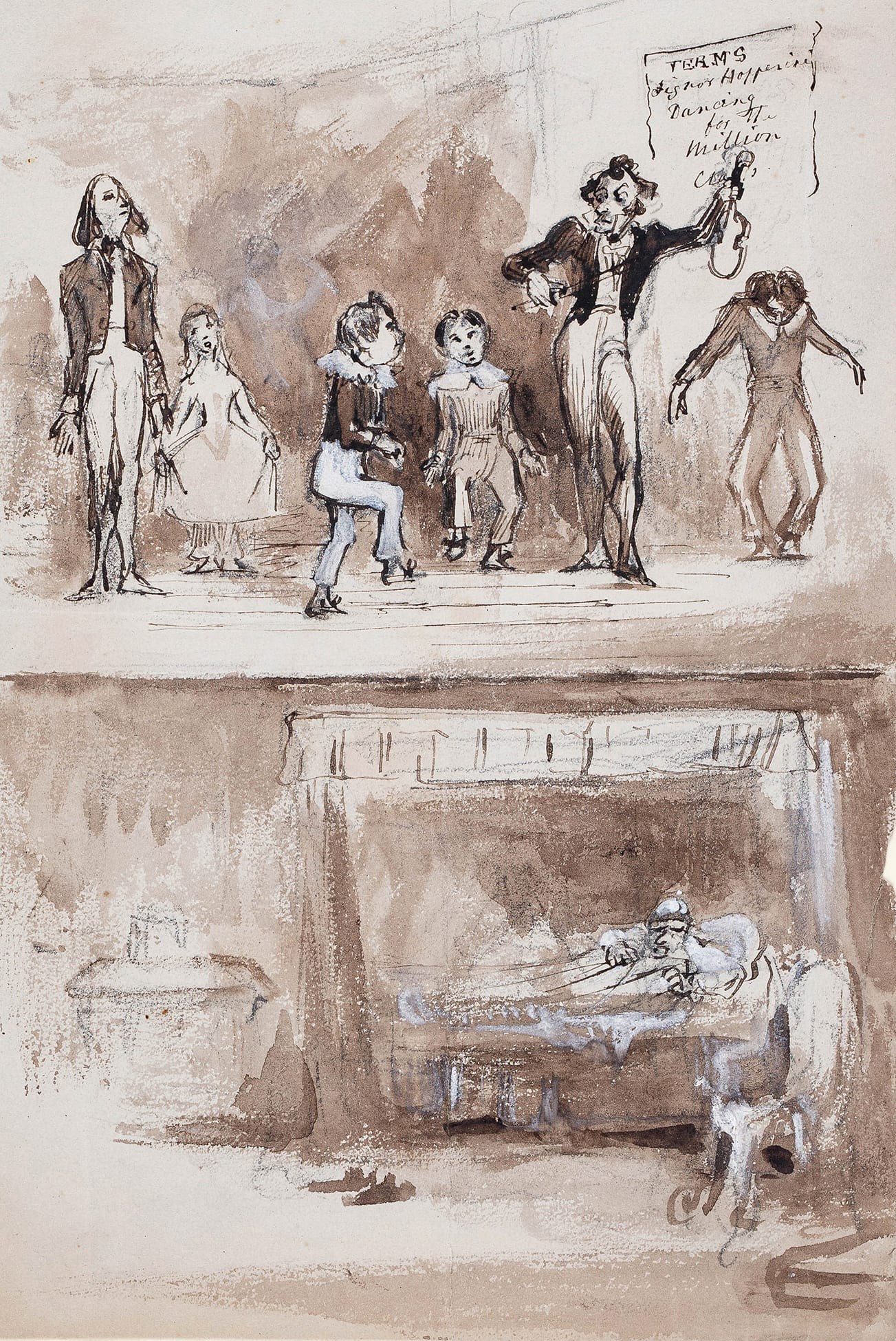
Ebenezer Landells - Signor Hopperini's' dancing class disturbing the downstairs neighbour
Ebenezer Landells
- Medium:
- Gouache
- Era:
- Mid 1800s (Polka Era)
- Source:
- Wikimedia Commons
- Rights:
- Public domain — free to use, share and adapt.
- Recorded as:
- Public Domain
The work is a rare visual document of mid-nineteenth-century domestic dance instruction and the social status claimed by dancing masters of the period. It testifies to the currency of dancing as a marker of gentility and the anxiety it provoked, offering a counterpoint to the earnest, aspirational depictions of dancing found in fashion plates and academy scenes. For dance historians, it shows how the figure of the dancing master—especially one with a Italianate stage name—was understood as comic, pretentious, and disruptive to household peace.
What you are looking at
The composition is divided into two scenes. In the upper register, a dancing master conducts a lesson in what appears to be a modest drawing room. Five children of varying ages stand or crouch in the space, their bodies angled awkwardly as if startled or confused by instruction. The master, a thin man in dark coat and light breeches, gestures dramatically with one arm raised, holding what may be a cane or pointer in his other hand. A note in the upper right corner reads "TRAMS" (possibly referring to a publication or sequence). Below, the scene descends literally and figuratively: a cross-section reveals a room beneath, where an irate figure reclines in a bathtub, one arm thrust forward in protest or anger. The juxtaposition—gentleman tenant below, dancing class above—illustrates the comedic premise of the title: the noise and chaos of the lesson disturbs the neighbor's peace. The drawing style is loose and energetic, with brown wash and pen creating a sketch-like quality. The artist captures the moment of maximum disruption: children in awkward positions, the master in emphatic gesture, the victim below driven to fury.
The dancing
The children display no unified dance frame or technique; their bodies are scattered and unaligned, some crouching, some standing with arms at odd angles, suggesting confusion or discomfort rather than trained movement. The dancing master stands in a posture of exaggerated instruction—one arm raised high, the other holding what may be a stick or cane—typical of the period's caricature of pompous instructors. The bathing figure below lies prone in the tub, one arm extended outward in a gesture of exasperation. There is no evidence of a partner hold or coordinated choreography; instead, the composition emphasizes individual disorder and the master's futile attempt at control.
The dance depicted
This is a satire of dancing instruction rather than a depiction of actual dance performance. The humor derives from the contrast between the dancing master's presumed gentility and technique and the chaos he produces. The children appear to be pupils in a private lesson, likely learning country dances, cotillion figures, or basic movement suitable for the drawing rooms of the 1840s middle class. No specific dance style is performed; rather, the image mocks the pretension of 'Signor Hopperini,' a pseudo-Italian name suggesting an imported master who trades on Continental glamour. The 'disturbance' of the downstairs neighbor is the work's real subject: it documents the social friction created by fashionable accomplishment in a shared dwelling.
How it was made
The work is executed in pen, brush, ink, and gouache on paper, as noted in the auction record. The brown wash creates volume and shadow, while pen lines define forms with economy. This combination allows for rapid notation and comic exaggeration—the master's gesture reads instantly, the children's confusion is conveyed through scattered pose. The technique is typical of mid-nineteenth-century illustration and sketch practice, suited to reproduction or inclusion in a folio of studies. The two-register composition (upstairs/downstairs) suggests influence from broadside comics and caricature tradition, which used such vertical stacking to show cause and effect or social contrast.
About this work
This is a humorous genre scene from circa 1840 that satirizes the fashion for dancing masters and private instruction among the aspiring middle classes. Ebenezer Landells, a prolific illustrator and wood-engraver, captures a moment of domestic disruption: a drawing room lesson conducted by an absurdly named instructor above, a furious bathing tenant below. The image plays on anxieties about gentility, social climbing, and the noise and disorder that fashionable accomplishment could bring to shared urban or suburban housing. It belongs in a dance archive not because it records authentic technique, but because it documents how dancing—or its pretense—was embedded in the social life of the period, and how the public recognized the figure of the dancing master as a subject of ridicule and fascination.
How to look at it
Attend first to the contrast between the two registers: the frantic, disorganized lesson above and the solitary, furious protest below. The master's exaggerated posture—arm raised, pointing stick in hand—is a caricature of pedagogical authority that the children's disordered bodies undermine. Note how the artist has frozen the moment of maximum disruption: the children are not arranged in a dance figure but scattered, crouching, confused. The bathing figure's extended arm reaches toward the ceiling, toward the source of the noise. The composition is satirical in intention and means: the drawing's apparent crudeness and haste are itself a joke about the vanity of 'instruction.' What appears clumsy is deliberate comic exaggeration.
The artist
Ebenezer Landells (1808–1860) was an accomplished English illustrator, wood-engraver, and magazine editor. He trained as an engraver and became known for his satirical and genre scenes, particularly in wood engraving, a medium that allowed for mass reproduction in periodicals and books. He was a founding contributor to *Punch* (the humor magazine launched in 1841) and worked extensively for *The Illustrated London News*. His style was sharp, economical, and alert to social comedy—the mannerisms and pretensions of tradespeople, servants, and the aspirant middle class. This sketch, from an album of studies, shows his practice of rapid notation and comic observation. Landells' work bridges fine art and commercial illustration; his studies were valued both as finished drawings and as working material for engraved reproductions.
The period
The 1840s saw a flourishing of middle-class domestic accomplishment and the market for private instruction. Dancing was a crucial feminine (and secondarily masculine) accomplishment, taught in the drawing room by itinerant or resident masters. The period was also the height of satirical print culture in Britain: *Punch*, founded in 1841, set the tone for visual humor that mocked social pretension. Landells' image sits within this tradition—it laughs at the vanity of dance instruction while acknowledging its real social importance. The image dates to the Waltz Revolution era, when waltz and quadrille dominated fashionable dance, though this scene shows no specific choreography. The vertical composition (upstairs/downstairs) also reflects mid-nineteenth-century interest in social cross-section and domestic interior as a site of comedy and moral observation.
Where it lives
The work was offered for sale by the London dealer Abbott and Holder in January 2020, described as part of an album of Landells' studies. It is a sheet from what was evidently a working collection of sketches, the kind an illustrator would maintain as reference and demonstration of skill. The notation and medium suggest it was drawn for its own sake as a finished study, not as preparatory work for an engraving, though it may have been subsequently adapted for print.
Dance in this work
Questions about this work
Who was Signor Hopperini?
The name is invented for comic effect—a Italianate pseudonym designed to lend false Continental prestige to what is implied to be a charlatan or mediocre instructor. 'Hopperini' suggests jumping or hopping (from *hop*), which may itself be a pun. The character is fictional and embodies the period's satire of social climbing through fashionable accomplishment.
What kind of dance would have been taught in such a lesson?
In the 1840s, private drawing-room instruction focused on cotillion figures, quadrilles, country dances, and increasingly the waltz. These were social dances for mixed or single-sex groups, performed at assemblies, private balls, and social gatherings. The lesson shown here gives no clue to specific choreography; the chaos and disarray are the point.
Why is this image divided into two rooms?
The vertical cross-section shows cause and effect: the dancing lesson above is the cause, the neighbor's rage below is the effect. This compositional device was common in satirical prints and broadsides of the period, allowing the artist to show both the absurdity of the lesson and its social consequences in a single frame.
Is this a finished work or a sketch?
It appears to be a finished study—drawn with intention, using gouache, ink, and brush to create tonal effects. It was part of an album of Landells' studies, suggesting it was valued as a complete work in itself, though it may also have served as reference for a wood-engraved reproduction.
More dance artwork