49 works in this view — arrow keys or swipe to move between them.
Dance in Art · 1792
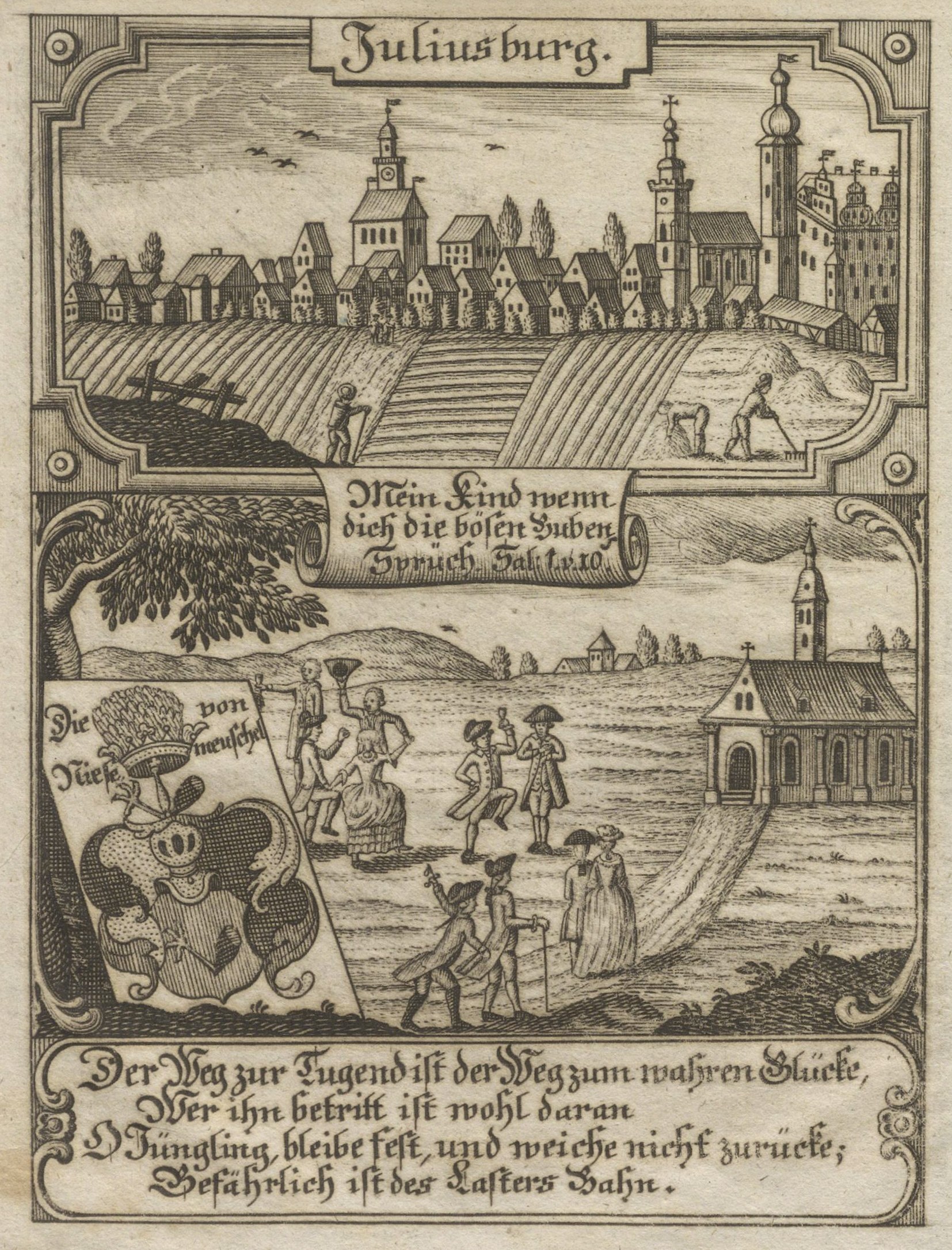
Eckarth 1792 01 Juliusburg
Unknown
- Medium:
- Oil Painting
- Era:
- 1700s (Enlightenment/Minuet Era)
- Source:
- Wikimedia Commons
- Rights:
- Public domain — free to use, share and adapt.
- Recorded as:
- Public Domain
The image is historically significant as evidence of how movement, gesture, and bodily disposition were deployed in 18th-century prints to communicate narrative and moral instruction, predating modern dance documentation. For dancers and historians, it illustrates the conventions of representing movement and social interaction in periodical and broadsheet culture, showing how posture and spatial arrangement carried semantic weight distinct from formalized dance.
What you are looking at
This is a copperplate engraving presented as a title page for a 1792 German periodical, showing a panoramic bird's-eye view of the town of Juliusburg (now Dobroszyce, Poland) across the upper two-thirds of the composition. The town is rendered in meticulous detail with pitched roofs, church spires with crosses, poplar trees, and fortified walls. A river or stream runs through the foreground with sloped banks suggesting defensive earthworks. In the lower half, beneath a cartouche containing German text, two separate narrative scenes unfold: on the left, figures in 18th-century dress gather outdoors under a large tree, some appearing to gesture in conversation or instruction; on the right, a group of people in similar period dress are distributed across an open landscape near a small chapel, some standing, some seated or bending, arranged in what appears to be a didactic or narrative moment. The right panel shows more animated postures—several figures with raised arms or bent bodies, suggesting movement or gestural demonstration. An ornamental heraldic coat of arms (identified in the record as belonging to von Niesemeuschel, unrelated to the town) occupies the lower left. The entire composition is framed by decorative Renaissance-style borders with corner ornaments.
The dancing
The figures throughout are small, rendered in silhouette or outline typical of 18th-century topographical engraving, which limits visibility of precise dance technique. In the left scene, figures appear to stand in conversational clusters or scattered poses. In the right scene, several figures display notably raised or extended arms and bent-knee positions that suggest active movement rather than static stance. The postures are oriented toward each other rather than in formal rank, and the scattered arrangement suggests informal social interaction rather than choreographed formation. Children and adults appear to be mixed in the groups.
The dance depicted
The image does not appear to depict a recognizable formal dance. The catalogue record indicates the engraving illustrates a biblical proverb ('My child, if evil boys tempt you...,' Proverbs 1:10), suggesting the lower scenes are moralizing narratives rather than dance documentation. The raised-arm postures and bent bodies in the right panel may represent exhortation, play, or disciplinary gesture rather than dance steps. The informal gathering and didactic framing point to this being a lesson or warning scene rendered through bodily attitude, not a choreographed performance or social dance form.
How it was made
This is a copperplate engraving, a technique allowing fine linear detail and mass reproduction suitable for periodical publication. The record confirms it is a full-page engraving (Kupferstich) serving as the frontispiece or title page (Jahrgangstitelblatt) of the Privileg. Zittauisches Historisches, Topographisches, Biographisches monathliches Tage-Buch for 1792. The medium enabled the combination of topographical precision in the townscape with narrative vignettes below—a common structure for periodical title pages of the era. Engraving's formal, deliberate line suited both documentary and allegorical purposes.
About this work
This engraving is a title page for a 1792 German periodical combining topographical documentation of a Silesian town with moralizing biblical narrative rendered through gesture and posture. While the figures display animated bodily attitudes—particularly in the right scene—they do not represent a formal dance tradition or style. Instead, the image captures an early modern convention of representing instruction, temptation, and moral instruction through expressive gesture within a landscape setting. The work belongs in a dance archive as a document of how bodily attitude and spatial arrangement were used in 18th-century visual culture to convey moral and social narratives, even when the primary intent was topographical.
How to look at it
Attend to the two lower narrative scenes: their loose groupings and varied postures contrast sharply with the ordered precision of the townscape above, signaling a shift from documentation to narrative. Notice the raised arms, bent knees, and turned bodies in the right scene—these convey agitation, exhortation, or alarm rather than dance steps. The engraver's choice to show figures mid-gesture rather than static illustrates how bodily movement and attitude were understood as legible signs of moral and social condition. The small scale and outline technique prioritize clarity of narrative action over anatomical detail.
The artist
The artist is unknown. The engraving was produced for the Zittauer periodical, a Saxon regional publication combining news, history, biography, and topography. The quality and style are consistent with professional town-view engraving of the late 18th century, likely produced in Zittau or a nearby urban center.
The period
In 1792, formal dance in German-speaking lands was dominated by minuet, country dance, and emerging waltz forms in elite and bourgeois contexts. The engraving's moralizing tone and rural setting reflect the period's growing interest in depicting vernacular life and moral instruction through popular prints and periodicals. Topographical engravings of towns often included small narrative or genre scenes to enliven the composition and appeal to local readership. The emphasis on gesture and posture as carriers of moral meaning was consistent with 18th-century natural philosophy and pedagogy.
Where it lives
The work is a full-page engraving from the Privileg. Zittauisches Historisches, Topographisches, Biographisches monathliches Tage-Buch, Jahrgang 1792, identified as the frontispiece or title page (Vorsatz zur 1. Ausgabe des Jahrgangs) of that calendar-year edition. The source listed is Wikimedia Commons; no holding institution is recorded in the catalogue.
Questions about this work
Is this a dance scene?
Not primarily. The image is a topographical title page for a 1792 periodical featuring two narrative vignettes illustrating a biblical proverb about avoiding evil influence. The figures display animated postures and gestures, but these represent moral instruction or social warning rather than formalized dance. The scattered groupings and raised-arm gestures suggest exhortation or alarm, not choreographed movement.
What is being depicted in the lower scenes?
The caption identifies them as illustrating Proverbs 1:10 ('My child, if evil boys tempt you...'). The scenes show adults and children in a landscape with varied postures—some with arms raised, others bent or gesturing—representing the encounter between innocence and temptation. The right scene's greater animated posture may show the 'evil boys' in action, while figures on the left represent warning or instruction.
Why is a topographical engraving in a dance archive?
The work documents how bodily gesture and posture were used in 18th-century visual culture to communicate narrative and moral instruction. The engraver rendered movement and attitude to convey social and emotional meaning—a visual language distinct from but parallel to formalized dance. For historians of embodiment and movement, the image shows how ordinary gesture was understood and represented in print culture.
More dance artwork