49 works in this view — arrow keys or swipe to move between them.
Dance in Art · 1894
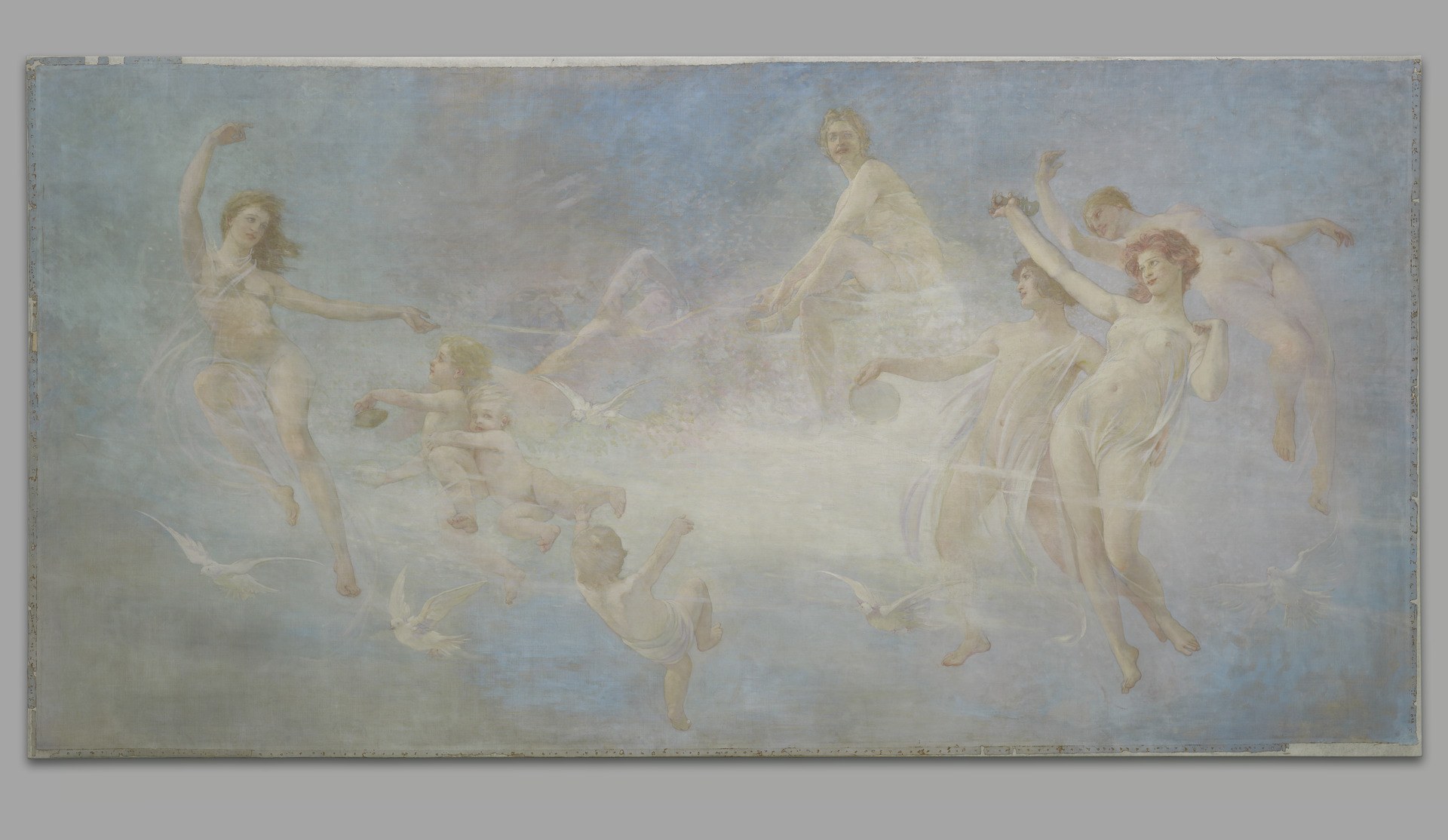
Edwin Howland Blashfield - Triumph of the Dance - 1926.77 - Yale University Art Gallery
Edwin Blashfield
- Medium:
- Oil Painting
- Era:
- Late 1800s (Victorian Ballroom)
- Source:
- Wikimedia Commons
- Rights:
- Public domain — free to use, share and adapt.
- Recorded as:
- Public Domain
This work documents a crucial moment in how dance was conceived in American high culture: not as technique or social practice, but as an abstraction—an ideal of beauty and movement worthy of mural-scale treatment in public or institutional spaces. For historians of dance patronage and artistic aspiration, the work reveals what educated American audiences of the 1890s valued in dance imagery and why allegorical rather than documentary representations dominated fine art.
What you are looking at
A celestial gathering of allegorical female figures floats against a soft blue-grey atmosphere. The composition is horizontal and frieze-like, with approximately nine to twelve figures arranged in a loose diagonal sweep from lower left to upper right. The figures range from nude or semi-nude to draped in flowing white and cream garments of classical cut. Some wear fillets or wreaths in their hair. At the lower left, a crouching or reclining figure reaches or gestures outward; the composition builds through standing and moving figures toward the upper right, where several figures are caught in active motion—arms raised, bodies turning, drapery swirling. The light is diffused and warm, modeling the flesh tones softly against the pale background. The overall effect is of weightless, buoyant movement through an undefined space rather than any earthly setting. The palette is restrained: pale flesh tones, cream and white drapery, gold accents, and the blue-grey of the atmosphere.
The dancing
The figures display the languid, elongated proportions and soft modeling characteristic of late-19th-century academic practice. Their poses emphasize fluidity rather than balletic precision: bodies twist and curve, arms extend in sweeping arcs, and weight appears distributed through graceful, undulating lines rather than the centered, vertical alignment of formal dance training. The drapery clings and flows around the bodies in ways that obscure rather than clarify any technical footwork. Several figures appear to be turning or spiraling, with their free arms raised or extended, and the overall impression is of floating movement rather than grounded steps. The composition lacks the rigid frame and close partnering of ballroom dance.
The dance depicted
This work depicts the classical allegorical theme of the 'Triumph of the Dance'—not a specific historical dance form but an imaginative apotheosis of Dance as an abstract virtue or muse. The figures are not identifiable as performers of a particular style: there is no pointe work, no ballroom hold, no folk costume or classical position that would pin the work to theatrical ballet, social dance, or any codified tradition. Instead, the image presents an ideal of movement itself—graceful, weightless, and transcendent. The soft neoclassical language and the floating chorus suggest the influence of Renaissance and Baroque allegory, but the execution and sentiment are thoroughly 19th-century Romantic.
How it was made
The catalogue record identifies this as an oil painting. The soft, luminous handling of light and the translucent quality of the drapery are consistent with oil technique, and the diffused, almost atmospheric quality—achieved through subtle glazing and blending—would be difficult to obtain in any other medium. The work appears to be a mural-scale or large independent composition, suggesting it was created for a public or institutional space rather than domestic display. The painterly approach emphasizes the ideal and allegorical over the documentary, subordinating detail to overall harmony of line and tone.
About this work
Edwin Howland Blashfield's *Triumph of the Dance* is an allegorical composition celebrating Dance as an abstract ideal rather than a specific historical form. The work depicts a celestial chorus of classically draped figures in buoyant, floating motion, rendered in soft oils with a restrained, luminous palette. Created in the 1890s, it belongs to the tradition of academic mural painting and decorative allegory that dominated American institutional commissions of the period. The work does not illustrate a codified dance style or a recognizable social context; instead, it expresses a Romantic-era conception of dance as grace, freedom, and transcendence.
How to look at it
Attend to the composition's rhythm and flow rather than individual figures. The eye moves in a wave from lower left to upper right, following the ascending diagonal of increasingly active poses. Notice how the artist has used drapery to create a sense of weight and momentum without grounding the figures in space. The soft, diffused light creates an ethereal quality that distances the scene from any earthly or theatrical setting. This is not a representation of how people actually danced in the 1890s, but a visualization of what 'the Dance' as an ideal might look like—transcendent, weightless, and eternally beautiful.
The artist
Edwin Howland Blashfield (1848–1936) was a prominent American muralist and painter in the late 19th and early 20th centuries. He trained in Paris and Rome and became one of the leading decorative artists of the American Renaissance movement, executing major commissions for public buildings, libraries, and wealthy patrons. His practice was rooted in academic tradition and classical allegory, and he was deeply influenced by Italian Renaissance fresco painting. Blashfield's work typically combined classical subject matter with contemporary technique and a focus on ideal rather than literal representation.
The period
In the 1890s, American fine art was dominated by academic painting and the City Beautiful movement, which championed classical aesthetics and allegorical decoration as expressions of national refinement. Dance in this period was fragmenting into distinct spheres: theatrical ballet was emerging as a serious art form (though still scandalous in conservative American circles), social ballroom dancing remained a marker of genteel status, and modern dance was beginning to challenge academic conventions. However, in high art and mural decoration, dance was typically represented not as a contemporary social practice but as a timeless classical ideal—a safe vehicle for depicting the human body in motion without the moral complications of real dancers.
Where it lives
The work is recorded in the Yale University Art Gallery (accession 1926.77), where it likely remains. The catalogue indicates it entered the collection in 1926 and was sourced via Wikimedia Commons for this reference.
Questions about this work
Is this a representation of a specific dance or ballroom style?
No. This is an allegorical work depicting Dance as an abstract ideal, not as a historical form or social practice. There are no pointe shoes, no ballroom frame, no folk costume, or other markers of a specific style. The figures float in an imaginary space governed by classical aesthetic principles rather than the rules of any actual dance.
Why did American artists paint dance as allegory rather than as real dancers?
In the late 19th century, depicting dance in fine art meant navigating questions of morality and status. Real dancers—especially women—were often associated with theater, scandal, and sexuality. Allegory offered a way to celebrate dance as beauty and grace while keeping it safely abstract and timeless, untethered to the messy social realities of actual performance.
What does the composition's style tell us about when this was painted?
The soft, academic handling, the classical subject matter, and the emphasis on ideal beauty over realism are all hallmarks of late-19th-century academic painting and the American Renaissance movement. By the early 20th century, such allegorical approaches would seem increasingly dated as modernism emerged.
More dance artwork