49 works in this view — arrow keys or swipe to move between them.
Dance in Art · 1913
Egon Schiele 011
Egon Schiele
- Medium:
- Oil Painting
- Era:
- 1900-1920 (Ragtime/Early Jazz)
- Source:
- Wikimedia Commons
- Rights:
- Public domain — free to use, share and adapt.
- Recorded as:
- Public Domain
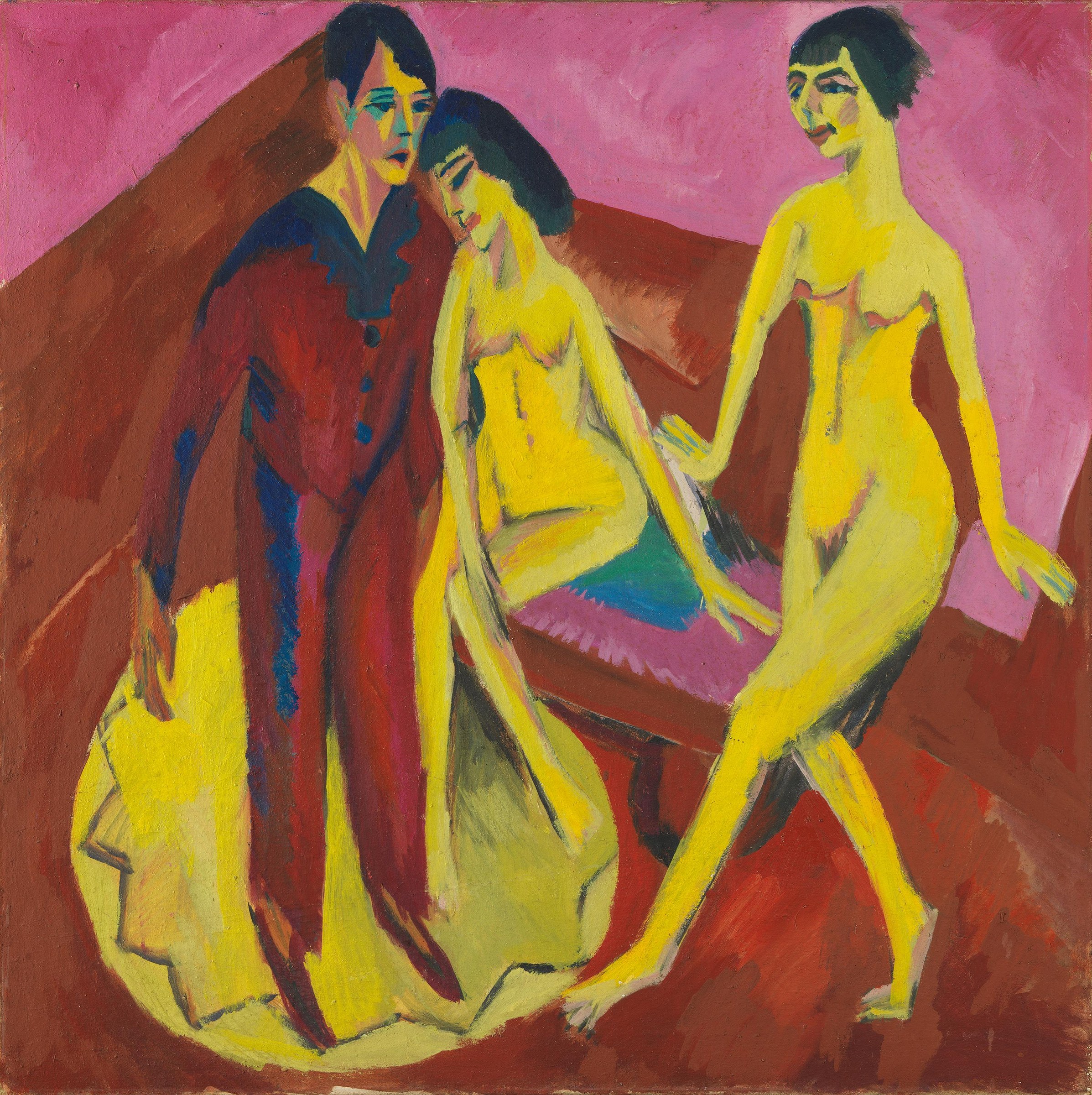
For dance history and visual culture, this drawing is significant as a document of how early 20th-century artists perceived the expressive potential of the human body freed from formal ballroom or classical ballet convention. The Expressionist approach to the figure—emphasizing inner state over outer form—influenced modern dance pioneers who were working in parallel to develop movement vocabularies based on authentic feeling and physical truth rather than inherited steps.
What you are looking at
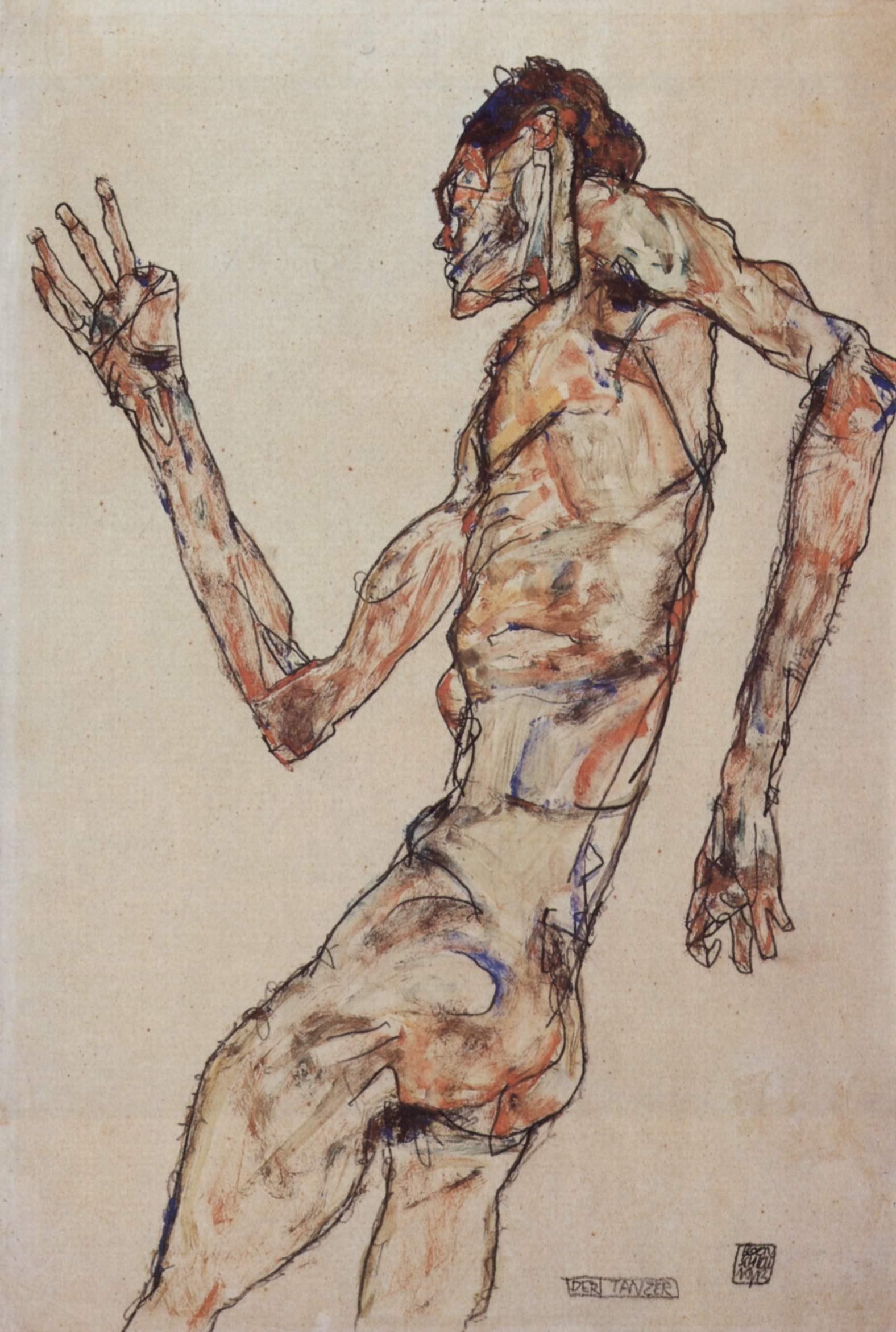
A single male figure occupies the composition, rendered in watercolor and ink with expressionist intensity. The body is depicted in a dynamic, contorted pose suggesting extreme physical exertion or emotional turmoil. The figure's torso twists sharply, one arm raised with fingers splayed in a gesture of agitation or appeal, while the other arm extends downward. The head is thrown back, the face angular and distorted, the mouth open as though crying out. The artist has applied washes of ochre, rust, and pale cream across the musculature, with darker outlines in ink defining the anatomy with clinical precision. Blue-purple accents mark veins or shadows in the limbs. The figure appears to be in motion, weight shifted, legs positioned as though mid-stride or mid-collapse. The pose is neither graceful nor controlled—it reads as raw physicality, possibly anguish or ecstatic expression, against a plain pale ground.
The dancing
A single male dancer or performer, depicted from approximately the waist down but with the full body visible. The body is severely twisted: the torso rotates one direction while the legs suggest forward motion or instability in another, creating a sense of wrenchedness. One arm extends upward with fingers splayed wide in an uncontrolled gesture; the other hangs or reaches downward. The head is tilted back, mouth open. There is no graceful line or supported extension—instead, the artist emphasizes strain, angular joints, and the visible musculature of effort or distress. The weight appears unstable, distributed unevenly across the body.
The dance depicted
This is almost certainly a life study or expressive figure drawing rather than documentation of a specific named dance form. The pose and treatment suggest the artist's interest in the body as a vehicle for emotional or psychological states—raw physicality rather than technique. The extreme contortion and distressed expression are characteristic of Expressionist figure work of the early 20th century, which often used the body to convey inner turmoil, ecstasy, or liberation from social constraint. If this depicts a dance at all, it is likely a free or interpretive movement practice or perhaps a moment of emotional catharsis, rather than a ballroom, folk, or codified theatrical form.
How it was made
Watercolor and ink on paper, the artist working quickly and directly. The watercolor washes allow transparent layering of color—ochres, pinks, and creams building form—while the ink provides sharp linear definition of musculature and anatomical structure. This combination permits both spontaneity and anatomical precision. The medium's speed and fluidity are suited to capturing gesture and emotional intensity rather than finish; the paper shows throughout, and the artist has not smoothed or refined the image. This is a working study, likely made from a live model or from memory, intended for the artist's own development or for circulation among artists and collectors interested in modern figure practice.
About this work
This is an Expressionist life study in watercolor and ink, dated 1913, depicting a single male figure in an extreme, contorted pose that emphasizes emotional and physical intensity over technical grace. The artist uses anatomical precision in the linear work and expressive color application to convey a body in distress, exertion, or ecstatic release. The work sits within the early modernist rediscovery of the figure as a subject for psychological expression rather than idealization or narrative.
How to look at it
Attend to the artist's choice of the moment of maximum strain or emotional release. The figure is not at rest, not in a controlled extension, but at a point of rupture or intensity. Notice how the artist has used anatomical line—the ink outlines—to make the body's structure visible and almost sculptural, while the watercolor washes soften and warm the form, creating tension between precision and expressiveness. The open mouth, the splayed fingers, the twisted torso all suggest that this body is not performing for an audience but rather expressing something internal and involuntary. This is a study in how a body looks when it is not in control.
The artist
Egon Schiele (1890–1918) was an Austrian Expressionist painter and draftsman whose brief career focused intensely on the human figure, particularly the male and female nude. Schiele worked with shocking physicality and emotional directness, often depicting the body in extreme poses, twisted and angular, to express psychological states. His approach rejected both academic idealization and decorative aesthetics; he was interested in the body as a vehicle for raw, often disturbing honesty. He worked in pencil, ink, and watercolor, often combining them for immediacy and expressive power. His work was controversial in his lifetime—he was prosecuted for obscenity—and he died of influenza at 28. His figurative studies and portraits were foundational to Expressionism and continue to influence artists interested in the body as psychological document.
The period
In 1913, classical ballet was entering a period of radical revision. Sergei Diaghilev's Ballets Russes had begun to commission modernist composers and visual artists; Nijinsky's controversial Afternoon of a Faun (1912) and Rite of Spring (1913) were challenging academic ballet vocabulary with angular, twisted, non-linear movement. Simultaneously, modern dance pioneers—Isadora Duncan, Ruth St. Denis, Ted Shawn—were developing movement systems based on natural, emotional, and often extreme physicality as a break from ballet's artifice. In visual art, Expressionism emerged as a movement deeply interested in the body as a vehicle for emotional authenticity rather than beauty. Schiele's work sits at the intersection of these concerns: he was contemporaneous with the radical dance experiments happening in Paris and Vienna, and his Expressionist figure work shares with modern dance a commitment to emotional truth over aesthetic convention.
Where it lives
The work is sourced from Wikimedia Commons. The catalogue record is spare: no current holding institution is recorded, no accession number provided. It survives as a historical document within the broader archive of Schiele's works, many of which are held in European museums but widely circulated through photographs and reproductions.
Questions about this work
Is this a specific dance or just a figure study?
It is a figure study rather than a document of a named dance form. The pose is too extreme and the focus too much on emotional and psychological expression to be a record of ballroom, folk, or classical technique. It may have been influenced by or created alongside modern dance experimentation, but the work is primarily a study in how the human body expresses intensity through distortion and strain.
Why is the body so twisted and distorted?
Schiele was an Expressionist committed to using bodily form to convey inner states. He rejected idealized or graceful representation. The twist, strain, and asymmetry are not flaws but intentional expressions of emotional or psychological turmoil, liberation, or raw physicality. The body becomes a document of feeling rather than an object of beauty.
What does the open mouth and raised arm mean?
These gestures suggest vocalization, appeal, or ecstatic release—the body in a state of emotional overflow. The artist has frozen a moment of maximum expressiveness, where the figure seems to be calling out or releasing something. It is a gesture of urgency, not repose.
How does Expressionism relate to modern dance?
Both movements emerged in the early 20th century and shared a commitment to emotional authenticity over inherited form. Modern dance pioneers like Ruth St. Denis and Ted Shawn were exploring how the body could express feeling directly, without the conventions of classical ballet. Expressionist artists like Schiele were doing the same in visual art. They were parallel responses to a shared cultural moment of questioning tradition.
More dance artwork