39 works in this view — arrow keys or swipe to move between them.
Dance in Art · 1859
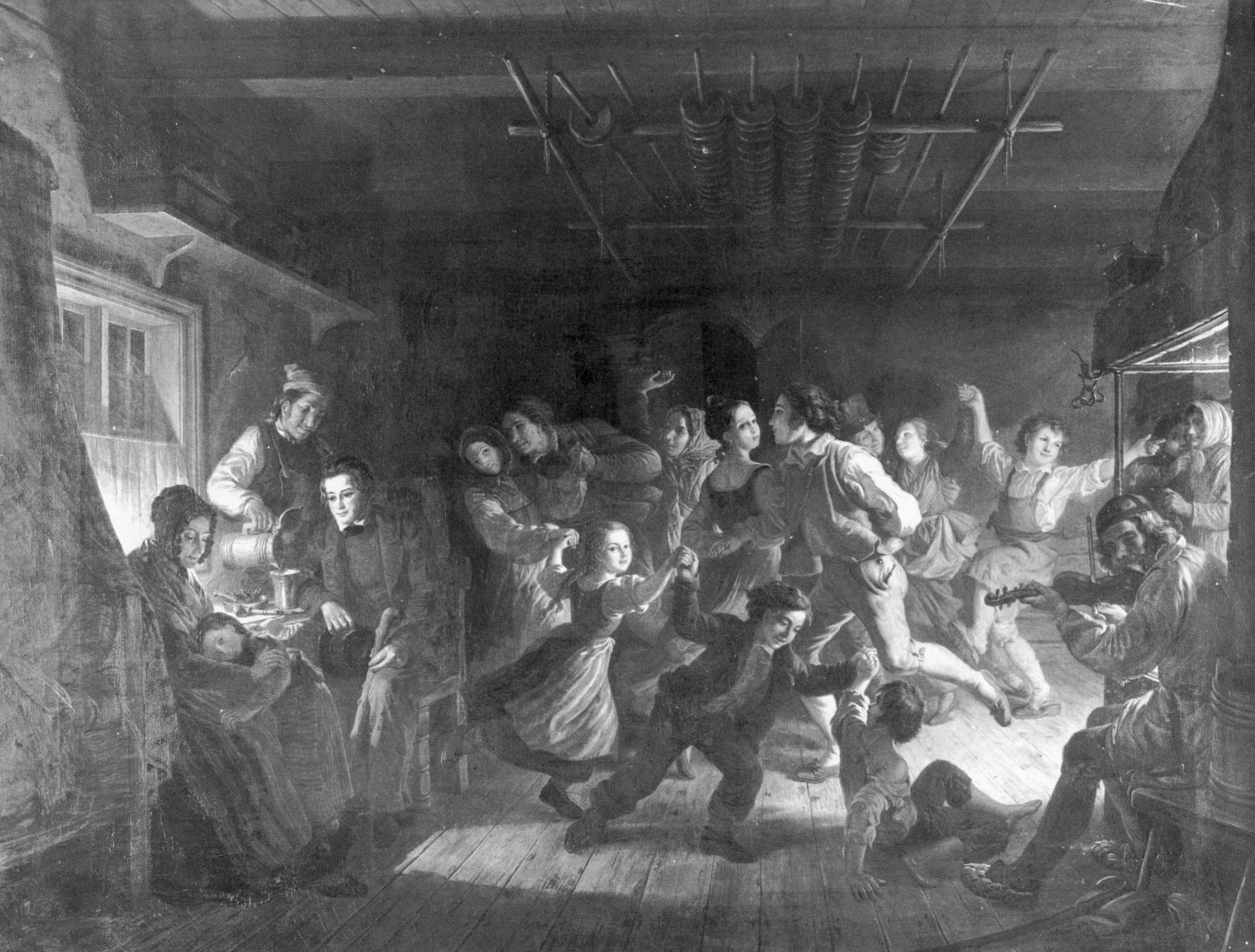
Ekman Bonddans
Robert Wilhelm Ekman
- Medium:
- Oil Painting
- Era:
- Mid 1800s (Polka Era)
- Source:
- Wikimedia Commons
- Rights:
- Public domain — free to use, share and adapt.
- Recorded as:
- Public Domain
This work documents the physical and social reality of folk dance in a specific time and place, capturing movement quality, gathering structure, and communal participation that written records rarely convey. It shows a painter attentive to how bodies actually move in celebration, outside the formal conventions of staged dance. For historians of social dance and folk practice, it is a rare visual record of the lived experience of ordinary people's celebration.
What you are looking at
A crowded interior scene lit by lantern light, depicting what appears to be a rustic communal gathering or celebration. The space is a simple timber-framed structure with a low ceiling hung with dried plants or herbs. A large group of figures—men, women, and children—fill the composition, their bodies animated and clustered densely together. In the foreground, several figures are in active motion: a woman in a dark dress dances with raised arms, and nearby a figure in lighter clothing appears to be in mid-leap or vigorous movement. The crowd around them watches and participates, with many faces turned toward the dancers. The painting is rendered in muted tones—browns, greys, flesh tones—with the lantern providing the primary light source, creating strong contrasts between illuminated faces and shadowed areas. The dress is period and rustic: simple linen, wool, and cotton garments appropriate to rural or working-class life.
The dancing
The central dancers display dynamic, uninhibited movement. The woman with raised arms shows an open upper body position with arms extended upward and outward, a gesture of joy or abandon rather than formal ballroom control. The leaping figure nearby displays explosive vertical movement with limbs spread wide. The surrounding figures are animated but less formally positioned—some clapping, some with arms raised, some watching with rapt attention. The overall impression is of social, participatory movement rather than performed technique; the bodies are loose-limbed and the gathering is convivial rather than staged.
The dance depicted
This depicts a folk celebration or bonddans—a peasant or rural community dance gathering. The energy and compositional density suggest a participatory social dance rather than a staged performance or formal ballroom dance. The uninhibited arm positions, the vertical leaping, and the communal watching-and-joining structure all point to a traditional folk celebration, likely Scandinavian or Baltic given the artist's Finnish background and the catalogue's reference to 'finska folkkulturen' (Finnish folk culture). The painting captures a moment of collective joy and social bonding through movement.
How it was made
This is an oil painting, rendering the scene with atmospheric depth and the capacity to capture varied human expression and light effects in a crowded interior. The oil medium allows for the warm, glowing quality of lamplight and the subtle modeling of flesh and fabric. The technique suggests a work intended for exhibition and study by educated audiences rather than rapid documentary. The scale and detail invite close viewing of the individual figures within the crowd.
About this work
Ekman's *Bonddans* is a high-genre oil painting treating rural folk celebration as a subject worthy of serious artistic attention. Created in the mid-19th century, it records both the movement vocabulary and the social structure of peasant dance in the Nordic region. The work sits at an intersection of Romanticism (which elevated folk culture as authentic and spiritually vital) and social realism (which documented working people's lives). It matters to dance history because it captures a moment when European artists began to view folk celebration not as quaint survival but as legitimate cultural expression. The painting preserves the spatial and bodily qualities of communal dance—the density, the spontaneity, the participatory watching—that official dance records often miss.
How to look at it
Notice the moment Ekman chose: not the beginning of the dance or a moment of rest, but a peak of activity and abandon, with multiple bodies in flight and the crowd most densely engaged. The composition clusters figures tightly, denying the viewer any calm resting point—this formal choice mirrors the energy of the gathering itself. Attend to the faces: many are expressions of pleasure, surprise, or concentration, capturing the emotional temperature of the scene. The lighting, focused on the dancing bodies and the nearest faces, draws attention to the human drama rather than the architectural setting. Ekman's technique here is to make the viewer feel present in the crowd, not observing from a safe distance.
The artist
Robert Wilhelm Ekman (1808–1873) was a Finnish painter who spent much of his career in Åbo (Turku) and became known for historical and cultural subjects drawn from Finnish life. He was trained in the academic tradition but devoted significant effort to documenting and elevating Finnish folk culture at a moment when Finland was asserting cultural identity within the Russian Empire. The series to which *Bonddans* belongs—described in the record as 'Idealbilden av den finska folkkulturen' (Ideal Images of Finnish Folk Culture)—reflects a broader 19th-century Romantic project of recording and aestheticizing peasant life as a source of national character.
The period
The mid-19th century saw a surge of artistic and scholarly interest in folk culture across Europe, driven by Romanticism and emerging nationalisms. In Scandinavia and the Baltic, this coincided with political and cultural independence movements. Simultaneously, industrialization and urbanization were perceived as threats to traditional rural life, lending urgency to its documentation. In art, painters moved away from pure history painting toward ethnographic and social subjects. The period also saw the rise of folklore studies as a discipline. Ekman's work participates in this moment when folk dance and celebration were being rescued from dismissal and elevated to subjects fit for serious painting.
Where it lives
The catalogue record indicates this work is held in Åbo (Turku) konstmuseum (Museum of Art), though the holding institution is not explicitly confirmed in the source data provided. The work is dated to the period 1859–1870, suggesting either a long period of work or a date range reflecting uncertainty.
Dance in this work
Questions about this work
Is this a real event or an imagined scene?
The catalogue describes it as an 'idealbild' (ideal image), suggesting Ekman composed a generalized representation of Finnish folk celebration rather than documenting a specific event. However, the vivid specificity of dress, setting, and body language suggests he drew on observed reality, even as he synthesized it into a composed work.
What is bonddans?
Bonddans is a Scandinavian term for peasant or rural communal dancing, particularly the informal social gatherings where people danced together for celebration and courtship. It is not a specific choreography but rather a social context for dance.
What dance forms are shown here?
The specific forms are not labeled and are difficult to identify from the painting alone. The movement suggests participatory folk celebration—likely including couple dances and group reels or circles—rather than any single formal dance type. The raised arms, leaping, and communal structure are consistent with Nordic folk dance traditions.
Why is this painting lit by lantern rather than showing a daylight scene?
Evening light allowed Ekman to emphasize the warmth and intimacy of the gathered crowd and to create dramatic contrasts between lit and shadowed figures. Candlelit or lamplight gatherings were also the traditional time for rural celebration and courting, so the lighting carries cultural meaning.
More dance artwork