30 works in this view — arrow keys or swipe to move between them.
Dance in Art · 1949
Ernest Biéler les bacchantes
Ernest Bieler
- Medium:
- Oil Painting
- Era:
- 1920-1950 (Swing Era)
- Source:
- Wikimedia Commons
- Rights:
- Public domain — free to use, share and adapt.
- Recorded as:
- Public Domain
For dance historians, this image captures an influential moment when the bacchante became a modernist emblem: not a historical or ethnographic subject, but a fantasy of liberated movement that shaped how artists and choreographers imagined ecstatic and non-ballroom forms of dance. The work also documents the continued grip of Dionysian imagery on European culture in the early 20th century, a fascination that influenced early modern dance pioneers seeking authenticity and emotional truth beyond academic ballet.
What you are looking at
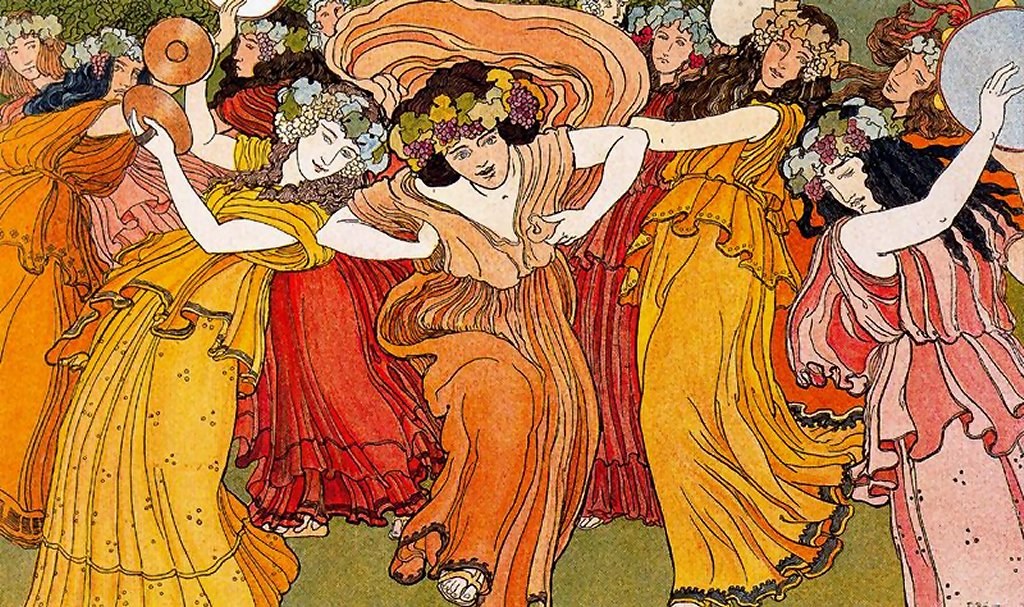
A crowded, celebratory dance scene rendered in vibrant, jewel-toned colors and sinuous Art Nouveau line work. At the center, a woman with reddish-gold hair and bare shoulders dances in a flowing red garment, her body curved in an ecstatic pose with one arm raised and extended. She is surrounded by a crush of other dancers—some identifiable, others merging into the decorative background—wearing flowing draperies in gold, orange, cream, and deep jewel tones. The figures are densely packed across the composition with little spatial recession; their bodies interpenetrate and their garments billow and fold in exaggerated curves that echo the ornamental vegetation—grapes, vines, flowers—scattered throughout. The palette of warm ochres, oranges, and reds against darker accents creates a sense of revelry and bacchic abandon. The setting appears to be neither indoors nor outdoors but rather a festive, timeless space defined by the rhythm of the bodies and draperies rather than architectural elements.
The dancing
The bodies are loosely arranged rather than in formal partnership or line. The central dancer displays a characteristic Dionysian abandon—torso arched backward, arms lifted in an open, ecstatic frame. Others around her adopt similar loose, flowing poses: some with arms raised or extended, some with weight shifted in spiraling contrapposto, none locked into any ballroom or formal social dance frame. The limbs are extended, sinuous, and individuated rather than coordinated as couples. Footwork cannot be clearly discerned beneath the heavy draperies, but the overall movement vocabulary is one of emotional expressiveness and fluid, unstructured motion.
The dance depicted
This is a representation of Bacchic or Dionysian dance—the ecstatic ritual dancing of Bacchus's followers in classical antiquity. The central figure embodies the maenad or bacchante, the female devotee seized by divine frenzy in worship of Dionysus. The image does not depict a codified dance form but rather a mythological ideal of release, abandonment, and spiritual transport through movement. The visual language emphasizes emotional and physical ecstasy over technique. Such imagery was popular in late 19th- and early 20th-century art and theater as a counterpoint to contemporary social dance and classical ballet—an imagined ancient freedom and sensuality.
How it was made
The work is listed as an oil painting dated 1949. The execution shows characteristics of Art Nouveau and early Modernist painting: strong linear definition, flattened spatial composition, bold color relationships, and decorative patterning. The heavy black or dark brown outlines around forms are typical of Post-Impressionist and Symbolist practice adapted to 20th-century idiom. The technique allows for rich surface color, thick gestural brushwork, and the creation of decorative unity across disparate forms—all of which serve the celebratory, non-naturalistic mood.
About this work
This is Ernest Biéler's *Les Bacchantes*, an early twentieth-century interpretation of ancient Dionysian revelry rendered in the coloristic and decorative language of Post-Impressionism and Art Nouveau. The work belongs to a long tradition of European artists revisiting classical antiquity through the lens of contemporary aesthetics—using the figure of the bacchante as a symbol of ecstatic freedom, sensuality, and the transgression of social restraint. In the context of early modernism, such imagery often functioned as a critique of bourgeois order and an expression of primitivist and primordial ideals. The painting demonstrates how dance—particularly its imagined ancient forms—served as both a subject matter and a formal language for artists seeking alternatives to realism.
How to look at it
Notice the density of the composition and the way individual bodies are subsumed into a decorative, almost abstract pattern of color and line. Observe the central dancer's arched torso and uplifted arms—a pose of ecstatic surrender that anchors the entire scene. The viewer should attend to the contrast between the representational individuation of the foreground figures and the way bodies dissolve into drapery and ornament as they recede. The artist has chosen a moment not of coordinated social dancing but of collective, simultaneous individual rapture—a painterly expression of the idea that Dionysian dancing is about the dissolution of social order into transcendent experience.
The artist
Ernest Biéler (1863–1948) was a Swiss painter associated with Post-Impressionism and Symbolism. He was known for historical and mythological subjects rendered in decorative, coloristically rich styles that blended Impressionist brushwork with flattened composition and ornamental line. His work exemplifies the late 19th- and early 20th-century European engagement with classical and mythological themes as a means of expressing contemporary aesthetic and philosophical preoccupations. Biéler was active across the transition from Symbolism to early Modernism.
The period
The early to mid-twentieth century saw renewed interest in Dionysian and bacchic imagery across European art and theater, partly as a reaction against Belle Époque artificiality and partly under the influence of Nietzsche's philosophical rehabilitation of Dionysus. This period also witnessed the emergence of modern dance pioneers—Isadora Duncan, Ruth St. Denis, and others—who drew on Greco-Roman imagery and ideals of 'natural' or 'free' movement as alternatives to classical ballet. Biéler's 1949 painting participates in this cultural conversation, offering a vision of ancient ecstatic dance that would have resonated with both modernist formalism and primitivist currents in the art world.
Where it lives
The work is recorded in the catalogue as an oil painting by Ernest Biéler, dated 1949. The current holding collection is not specified in the available record. The image is sourced from Wikimedia Commons.
Dance in this work
Questions about this work
What are bacchantes and why did artists keep painting them?
Bacchantes (or maenads) were the female followers of Dionysus in ancient Greek religion and mythology, depicted as seized by divine ecstasy and dancing in wild abandon. From the Renaissance onward, European artists returned repeatedly to this subject as a symbol of freedom from social constraint, sensuality, and the power of art and ritual to transform the body. In the early twentieth century, the bacchante became a modernist icon—an imagined ancient form of liberated movement that served both aesthetic and philosophical purposes.
Is this painting documenting a real historical dance or is it invented?
This is an imagined, idealized vision rather than a historical reconstruction. While ancient Greek and Roman sources describe bacchic rituals and ecstatic dancing, artists like Biéler were creating a fantasy of ancient freedom filtered through contemporary aesthetic values—Post-Impressionist color and form, Art Nouveau decoration, and early modernist ideals of authenticity. The painting is a product of 1949 European culture, not a window onto antiquity.
How does this relate to modern dance?
Symbolically and historically, quite closely. Modern dance pioneers in the early twentieth century (Isadora Duncan especially) looked to Greco-Roman imagery and ideals of natural, ecstatic movement as a counterpoint to academic ballet. They too imagined the bacchante as an emblem of authentic, emotionally liberated dance. Works like Biéler's painting reflect the same cultural moment and aesthetic preoccupations that gave rise to modern dance itself.
Why is there so much drapery and so little clear footwork?
The heavy, flowing garments serve multiple purposes: they create visual rhythm and decorative unity across the composition, they suggest the 'timeless' or mythological rather than contemporary setting, and they convey the idea that this is about intoxicated, ecstatic movement rather than technically disciplined dancing. The artist is more interested in the emotional and formal qualities of abandon than in depicting specific steps.
More dance artwork