43 works in this view — arrow keys or swipe to move between them.
Dance in Art · 1950
José Clemente Orozco, La cucaracha III
José Clemente Orozco
- Medium:
- Oil Painting
- Era:
- 1920-1950 (Swing Era)
- Source:
- Wikimedia Commons
- Rights:
- Public domain — free to use, share and adapt.
- Recorded as:
- Public Domain
This work documents a living social dance practice in Mexican popular culture at a specific historical moment, preserving visual evidence of how *La cucaracha* was actually danced by communities. For art historians, it demonstrates how Mexican modernist muralists and visual artists of the mid-twentieth century engaged with dance as a subject for serious artistic attention, using the energy and collectivity of dance to represent the post-revolutionary Mexican nation.
What you are looking at
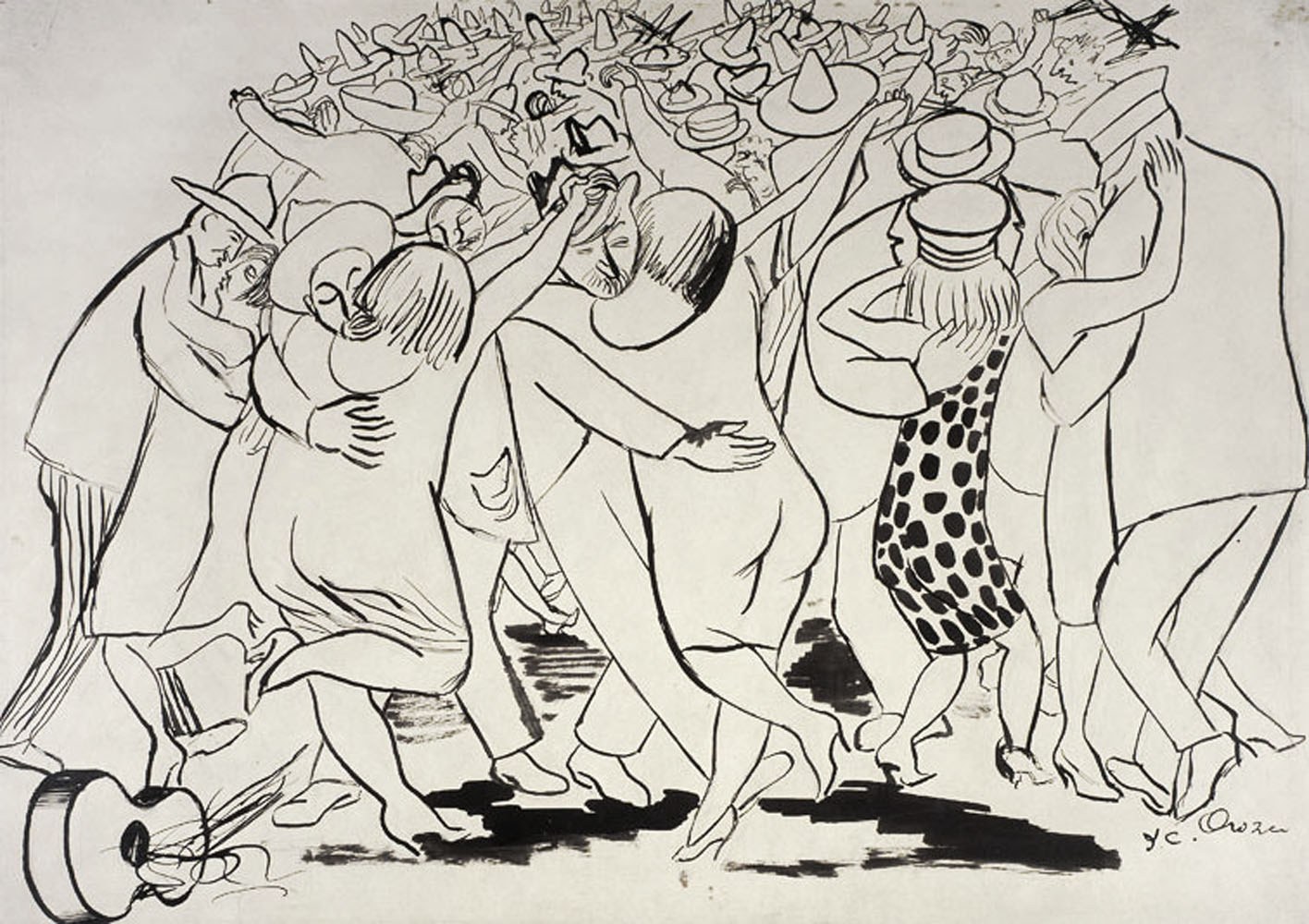
A crowded carnival or fiesta scene rendered in bold line drawing with selective ink wash. Dozens of figures in light clothing pack the composition, most wearing wide-brimmed hats typical of Mexican dress. The crowd fills the entire frame from foreground to a dense background of heads and hats. Individual figures emerge from the press: in the left foreground a couple in an embrace or dance position; center-right a woman in a patterned dress (filled with bold dotting); scattered throughout, figures gesture, embrace, and move in the loose, social patterns of street celebration. The artist has used heavy black ink washes to anchor certain figures and ground the composition, creating visual weight amid the linear chaos. The mood is one of density, movement, and collective joy—bodies overlapping, hats tilted, arms extended in social engagement.
The dancing
The bodies are drawn with fluid, expressive line work that captures movement without anatomical precision. Most figures are upright or slightly leaning into one another, suggesting close social proximity rather than structured dance holds. Arms are extended, some raised, indicating gesture, greeting, or balance in the crowd. The couple at left appears to be in a loose embrace or partnered movement. There is no visible footwork detail; weight distribution suggests standing, swaying, or walking rather than turning or traveling steps. The drawing style prioritizes the collective movement of the crowd over individual technical detail.
The dance depicted
This is a depiction of popular Mexican carnival or fiesta dancing, most likely in the vernacular social dance tradition of Mexico's working and rural communities. The title *La cucaracha* suggests the famous Mexican folk song and associated social dance, which was typically performed at street celebrations, fiestas, and informal gatherings. The image captures the social, participatory nature of the dance rather than any structured choreography—dancers in street dress, outdoors or in public space, moving together in celebration. The style and density of the crowd reflect how *La cucaracha* was danced: as a flexible, inclusive social activity where many could participate simultaneously without formal training or codified positions.
How it was made
This is a pen-and-ink drawing with selective application of heavy black ink wash. The combination of linear pen work with areas of solid black creates strong visual contrast and suggests the work was made for reproduction or as a study for a larger work. The fluency of the line and the economical use of ink wash indicate a practiced hand working quickly to capture movement and atmosphere rather than detail. The technique is well suited to capturing crowd energy and social movement—precise line work would have been counterproductive.
About this work
This drawing documents a moment of Mexican popular culture and social dance at the moment of the Mexican Revolution and its aftermath (the work is dated 1950, but the style and subject suggest a work engaged with revolutionary themes of the people and collective life). *La cucaracha* was both a revolutionary corrido and a social dance, and Orozco's image captures the dance in its most democratic form: not a staged performance but a street celebration involving dozens of ordinary people. The work sits within the broader corpus of twentieth-century Mexican art that elevated vernacular culture and indigenous and popular practices to the status of serious subject matter for visual art. For dancers, it offers evidence of how this iconic Mexican social form actually looked when danced by communities rather than on concert stages.
How to look at it
Pay attention to how the artist has used line and mass to suggest the energy of the crowd rather than the detail of individual dancers. The overlapping figures, the density of hats and heads, and the variation in line weight all work to suggest movement and collective participation. Notice how the artist has picked out a few figures with darker ink wash—particularly the couple at left and the woman in the patterned dress—to create focal points within the chaos. The work asks you to read crowd energy and social movement rather than individual technique, which is itself a statement about the nature of this dance: it is a social, participatory form, not a spectacle performed by virtuosos.
The artist
José Clemente Orozco (1883–1949) was one of the three great Mexican muralists of the twentieth century, alongside Diego Rivera and David Alfaro Siqueiros. Orozco was known for his expressionist line work, his engagement with themes of labor, revolution, and the Mexican people, and his monumental public commissions. His drawing style—energetic, economical with line, capable of capturing movement and emotion without naturalism—made him a natural interpreter of social and popular subjects. By 1950, when this work was made, Orozco had already completed major mural cycles in Mexico and the United States and was one of the most influential artists of the Americas.
The period
This work was made in 1950, five years after the end of World War II and in the context of post-revolutionary Mexico. The Mexican Revolution (1910–1920) had elevated indigenous and popular culture to the status of national patrimony, and by the 1930s–1950s, Mexican muralism and visual arts were engaged in representing the life and practices of the Mexican people as central to national identity. Social dance, particularly forms like *La cucaracha* that involved working-class and rural participation, was an important symbol of this democratic, collective culture. At the same time, in the broader art world, expressionism and modernism were moving away from naturalistic representation toward gestural, energetic drawing—Orozco's technique was aligned with these movements even as his subject was rooted in Mexican popular life.
Where it lives
The work is listed as sourced from Wikimedia Commons and the holding collection is not recorded. The medium is recorded as oil painting, which contradicts the visual evidence of the work being a pen-and-ink drawing with wash, suggesting possible cataloguing error.
Dance in this work
Questions about this work
Is this a real historical scene or an imagined one?
The work is an artistic interpretation rather than documentation of a specific historical moment. However, it captures the authentic visual character of Mexican popular fiesta culture and the social dance of *La cucaracha* as it was actually practiced in communities. Orozco was known for his fidelity to the lived experience of the Mexican people, even in works that were not literal records of specific events.
What is *La cucaracha*?
*La cucaracha* is a famous Mexican corrido (narrative song) that became a folk standard, often associated with the Mexican Revolution. As a social dance, it was performed at fiestas and street celebrations and allowed many people to participate simultaneously without formal training. The song is about a cockroach, and the dance has many regional and family variations.
Why did Orozco paint social dance?
For Orozco and other Mexican muralists, popular and indigenous culture were central to the identity of post-revolutionary Mexico. Dance, especially social dance involving ordinary people, was a powerful symbol of collective life and national culture. By making it the subject of serious art, Orozco elevated it from entertainment to a matter of cultural and political significance.
More dance artwork