46 works in this view — arrow keys or swipe to move between them.
Dance in Art · 1925
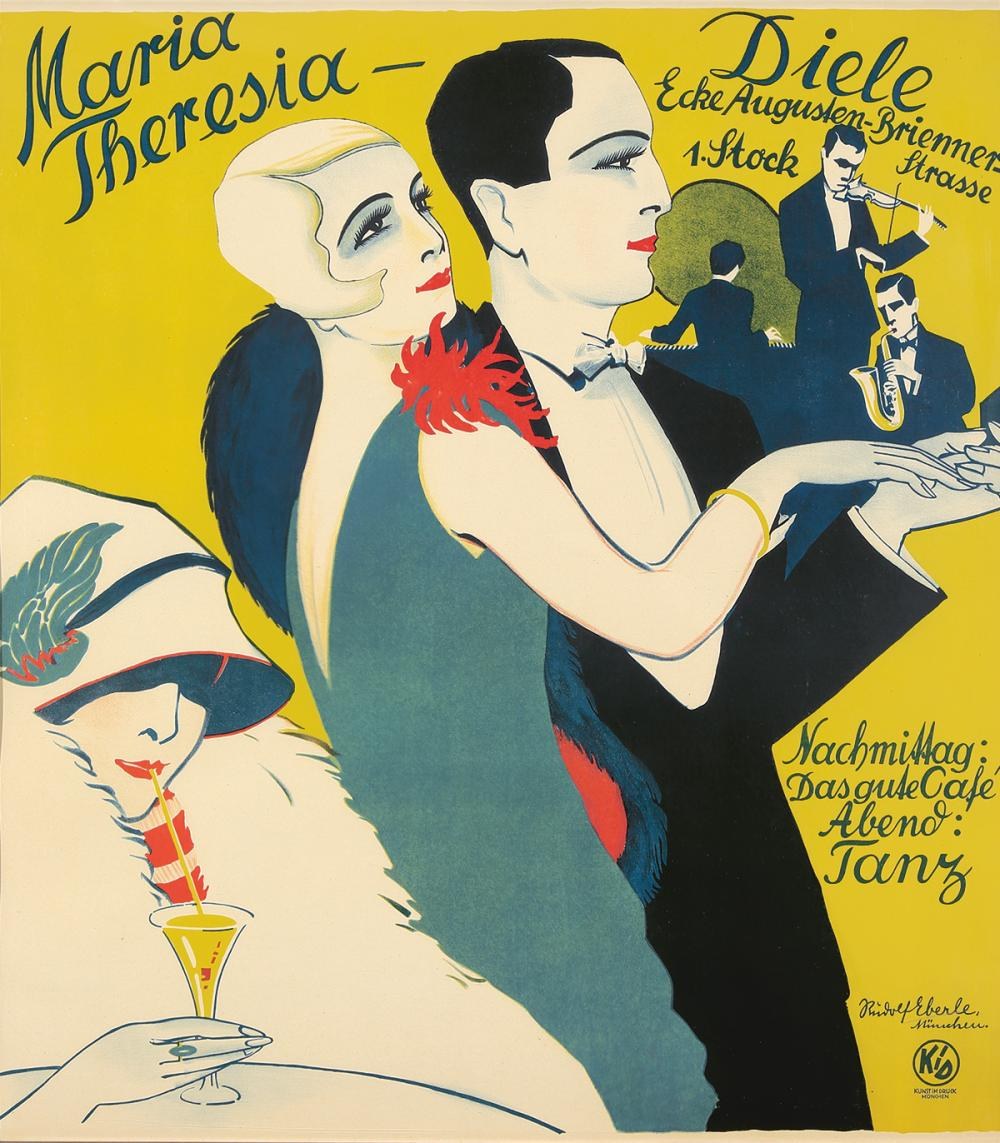
Rudolf Eberle Maria-Theresia-Diele ca. 1925
Rudolf Eberle
- Medium:
- Oil Painting
- Era:
- 1920-1950 (Swing Era)
- Source:
- Wikimedia Commons
- Rights:
- Public domain — free to use, share and adapt.
- Recorded as:
- Public Domain
This poster is a rare surviving artifact of the commercial infrastructure that supported social dancing in the Jazz Age, showing how venues marketed themselves to urban audiences through visual fantasy and aspirational imagery. For historians of dance and design, it demonstrates how Art Deco graphic language was mobilized to sell nightlife and modern leisure to the cosmopolitan public of Weimar Germany.
What you are looking at
A poster advertising an entertainment venue in 1920s Munich, dominated by two elegantly dressed figures in profile against a bright yellow background. The foreground shows a woman in a teal-green dress with a striking red feathered corsage, her head tilted back in a pose of pleasure or abandon; beside her stands a man in formal black evening dress with white shirt front and bow tie, his profile severe and composed. Both figures are rendered in an Art Deco style with sharp, graphic outlines and minimal modeling. In the middle distance, a green topiary or decorative arch frames three musicians—a saxophonist, violinist, and what appears to be a pianist or accordionist—in dark suits, suggesting the live entertainment on offer. At the bottom left, a hand holds a cocktail glass with a decorative pick garnish. The composition is theatrical and designed to catch the eye from a distance, with large German text announcing the venue name, location (Ecke Augusten-Brienner Strasse), and the promise of 'Nachmittag: Das gute Café. Abend: Tanz' (Afternoon: The good café. Evening: Dancing).
The dancing
The two principal figures are posed static rather than in active movement, their bodies turned toward the viewer in profile to display fashionable silhouettes. The woman's posture suggests relaxation or flirtation—her head thrown back, her body leaning slightly—while the man maintains an upright, formal stance. Neither figure is in a dance position or hold; they are presented as patrons rather than dancers. The musicians in the background are more schematically rendered and occupy a supporting role. There is no depiction of actual dancing technique, footwork, or dance partnership.
The dance depicted
This is not an image of dance in progress, but rather a nightclub or cabaret advertisement promising dancing as an evening attraction. The venue is a café that transforms in the evening into a dance hall (Tanzlokal). The formal attire, cocktail service, and live band suggest ballroom dancing in the context of 1920s urban nightlife—likely swing, foxtrot, or tango dances popular in German dance halls of the era. The image captures the fantasy and social allure of the venue rather than documenting any specific dance style or technique.
How it was made
This is a color lithographic poster, a mass-produced commercial medium ideal for street display and indoor promotion in the 1920s. The existing catalogue record correctly identifies this as created around 1925 and states the printing was done by Kunst im Druck (Art in Print) in Munich. Lithography allowed the artist Rudolf Eberle to achieve the bold, flat planes of color and graphic line quality characteristic of Art Deco design, with the striking yellow background and limited but vivid palette (teal, red, black, white) designed to be eye-catching and memorable. The medium implied a broad urban audience—the general public of a cosmopolitan city—rather than collectors or specialists.
About this work
This is a commercial poster for the Maria-Theresia-Diele, a Munich nightclub or cabaret in the 1920s, rendered in Art Deco style by the graphic designer Rudolf Eberle. It advertises an establishment that offered café service by day and dancing by night, with live jazz or dance-band music. The poster does not depict dance itself, but uses the promise of dancing—and the glamorous social world it represented—as a selling point to patrons of the Weimar Republic's thriving urban nightlife. It belongs in a dance gallery not because it shows dancing technique, but because it documents the social context, venues, and cultural moment in which ballroom and jazz-age dancing flourished in 1920s Germany.
How to look at it
Look at the poster as an advertisement designed to work from across a room or on a street: the bold yellow background, the large silhouettes of the two fashionable figures, and the legible text work together to signal 'modern,' 'glamorous,' 'nightlife.' The artist has chosen not to show people dancing, but rather to show the fashionable people and social promise of the venue—elegance, cocktails, live music. Notice the contrast between the static, almost aloof poses of the main figures and the more animated, schematic rendering of the musicians, suggesting that the performers serve the pleasure of the patrons. The poster uses visual codes of 1920s modernity: the profile view, the flattened space, the limited palette, the geometric clarity—all signals that this is a modern, fashionable place.
The artist
Rudolf Eberle was a Munich-based graphic designer and poster artist working in the Art Deco and Neue Sachlichkeit (New Objectivity) styles during the 1920s. He specialized in commercial design for entertainment venues and consumer products, combining sharp graphic forms, sophisticated color sense, and psychological sophistication in his advertising work. His posters capture the visual language of Weimar-era urban glamour and the jazz-influenced entertainment culture of the period.
The period
In the mid-1920s, Germany—and Munich in particular—was enjoying a cultural renaissance after the post-war economic and political turbulence of the early 1920s. Jazz, American popular music, and modern social dances like the foxtrot, tango, and Charleston had become fashionable among urban, middle-class Germans, and dance halls and cabarets proliferated in major cities. This was the era of the Goldene Zwanziger (Golden Twenties), when nightlife, modern design, and cosmopolitan entertainment culture thrived before the economic collapse of 1929. In visual art, the sharp, geometric aesthetic of Art Deco and the cooler, more objective approach of Neue Sachlichkeit had become the dominant commercial and fine-art languages, reflecting modern urban experience and consumer culture.
Where it lives
This is a commercial lithographic poster created for local circulation in Munich and reproduced in the Wikimedia Commons collection. It is part of the historical record of Weimar-era entertainment and design, though its current institutional holding is not recorded.
Questions about this work
Is this poster showing dancing?
No. The figures in the foreground are posed as patrons, not dancers, and there is no depiction of dance movement or technique. However, the text promises 'Tanz' (dancing) as an evening attraction at this venue. The poster is an advertisement for a place where dancing happened, not a documentation of dance itself.
What kind of dancing would have happened at this venue?
Based on the date (1925), the presence of a jazz band (saxophone and violin visible), and the formal evening attire, the dancing would likely have been ballroom social dances popular in German dance halls: foxtrot, tango, waltz, and possibly Charleston or other jazz-age dances. The live band setup suggests syncopated, rhythmic music typical of 1920s dance-hall entertainment.
Who was Rudolf Eberle?
Eberle was a Munich graphic designer and poster artist of the 1920s, working in the Art Deco and Neue Sachlichkeit styles. He created commercial designs for entertainment venues and consumer products. This poster is typical of his commercial work: sophisticated in color and form, designed to appeal to urban, cosmopolitan audiences.
What does 'Nachmittag: Das gute Café. Abend: Tanz' mean?
It translates as 'Afternoon: The good café. Evening: Dancing.' The venue offered respectable daytime café service and transformed in the evening into a dance hall with live music. This dual-purpose model was common in Weimar-era entertainment venues.
More dance artwork