34 works in this view — arrow keys or swipe to move between them.
Dance in Art · 1936
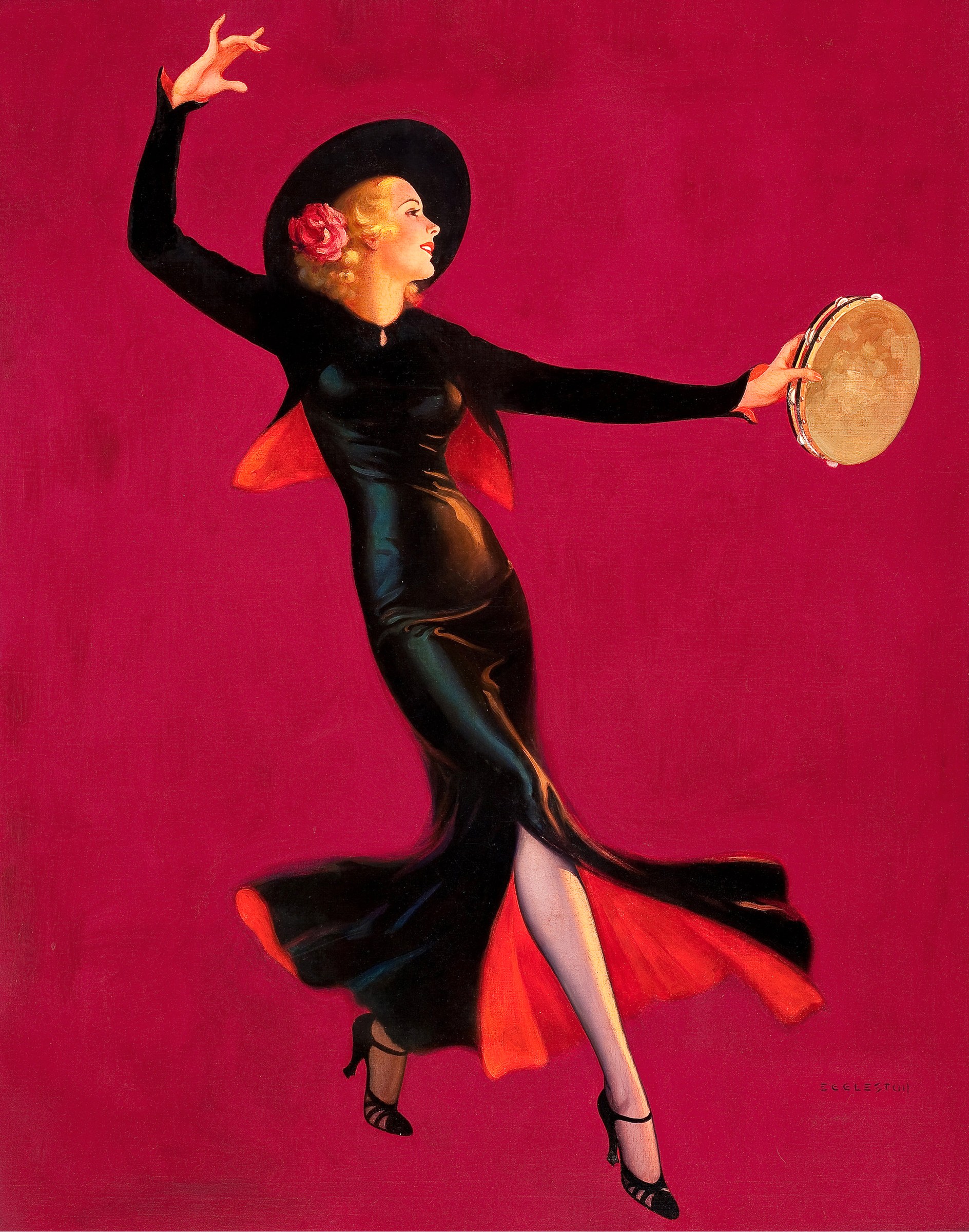
In the Spotlight by Edward Mason Eggleston (1882-1941)
Edward Mason Eggleston
- Medium:
- Oil On Canvas
- Era:
- 1920-1950 (Swing Era)
- Source:
- Wikimedia Commons
- Rights:
- Public domain — free to use, share and adapt.
- Recorded as:
- Public Domain
This painting documents the aesthetics and energy of commercial stage dance in the 1930s, when jazz-era entertainment was reshaping American performance culture. For historians of dance, it offers visual evidence of how professional dancers were dressed, posed, and marketed; for visual artists, it exemplifies how movement could be frozen in paint to suggest ongoing action. The work reminds us that dance history is not only recorded in notation and choreography, but in the images performers and artists left behind.
What you are looking at
A single female dancer dominates the composition against a vivid crimson background, her body captured in a moment of theatrical exuberance. She wears a sleek black long-sleeved bodysuit with a dramatic voluminous skirt in red and black that sweeps across her legs, creating a strong silhouette. A small red rose is pinned in her golden hair, which is crowned with a wide-brimmed black hat. Her left arm extends upward in an expressive gesture, while her right hand holds a large round tambourine or similar percussion instrument at hip height. Her pose is weightless and buoyant—she appears to be either in mid-leap or suspended in a moment of joyful movement, one leg extended and the other driving the action. The strappy black heeled shoes anchor her to the stage. The painting's saturated color, stylized anatomy, and theatrical staging suggest this is a performer in the spotlight—the work's title made literal through composition.
The dancing
The dancer's frame is open and expansive, with the raised arm creating a diagonal line from hip to fingertips that conveys upward momentum and celebratory energy. The torso twists slightly, allowing the hip to shift and the skirt to flare. The weight appears to be on the driving leg, with the other extended in space, creating the illusion of flight or suspension—a technique drawn from theatrical or classical training but deployed here with abandon. The percussion instrument (likely a tambourine, given its size and circular form) is held actively, suggesting it is part of the performance and not merely a costume prop. The single figure occupies the entire composition, making their physical gesture and spatial freedom paramount.
The dance depicted
The specific dance style is difficult to identify with certainty from the image alone. The theatrical costume—the fitted bodysuit, voluminous skirt, heeled shoes, and hat—suggests vaudeville, musical theatre, or commercial stage entertainment of the 1920s–1930s era rather than classical ballet or a specific vernacular form. The exuberant pose and the active use of a percussion instrument are consistent with jazz-era performance, where dancers often combined acrobatic or eccentric movements with rhythmic accompaniment. The energy and abandon suggest specialty swing or early theatrical jazz styles, though the artist may have been depicting a more general 'spotlight' performer rather than a codified dance form. The tambourine and the hat are not typical of ballet vocabulary and suggest a more playful, improvisatory, or music-hall tradition.
How it was made
The work is oil on canvas, a medium that allowed Eggleston to build rich color and create a luminous quality in the figure's skin tones and the costume details. The artist has rendered the dancer with a stylized, slightly elongated form that emphasizes elegance and movement. The background is a flat, saturated crimson that makes the figure pop forward and creates an almost abstract theatrical space—no stage floor or wings are indicated, suggesting the focus is entirely on the performer's gesture. This approach to abstraction and color saturation is consistent with commercial illustration and theatrical portraiture of the early-to-mid 20th century, where clarity of silhouette and emotional punch were priorities for works intended to advertise performances or capture the spirit of an entertainment.
About this work
This is a portrait of a performer in the moment of a theatrical turn or leap, painted in oil by Edward Mason Eggleston in 1936. The work celebrates the energy and sensuality of stage entertainment during the Swing Era, when dance and music were central to American popular culture. The painting is a vivid snapshot of professional entertainment—a spotlight moment—rather than a documentary of a specific choreography. It belongs in a dance art gallery as an example of how visual artists of the period memorialized live performance, capturing not technique but the emotional and kinetic experience of watching a dancer in full command of a stage. The work shows how dancers and their images circulated in American culture as symbols of modernity, freedom, and professional artistry.
How to look at it
Attend to the moment of suspension Eggleston has chosen: the dancer is not shown at rest or in a codified step, but in the apex of a jump or turn, when the body is momentarily weightless. This choice conveys the dynamism and danger of live performance. Notice how the artist has used the simple device of a solid red background to make the figure read clearly and to create a sense of theatrical artifice—we are looking at a performer under lights, isolated in a spotlight. The hat and the tambourine are key to understanding this as entertainment rather than concert dance: they mark this as music-hall or vaudeville tradition, where personality and visual charm were as important as technical skill. The scale of the figure in the composition (life-size or larger) suggests this was meant to be seen as a portrait of a star, not a crowd scene.
The artist
Edward Mason Eggleston (1882–1941) was an American painter and illustrator known for portraiture and genre scenes. He worked during a period when theatrical and commercial art were closely intertwined, and his output includes many works celebrating American entertainment, performers, and popular leisure. His painting style is characterized by clean line, bold color, and a slight stylization of form that sits between realism and decorative art—a vocabulary well-suited to both fine art audiences and commercial reproduction. The specificity with which he rendered this performer suggests either direct observation or a commission related to the entertainment industry.
The period
In 1936, American dance was experiencing a flowering of styles and venues. Jazz dance, theatrical tap, and ballroom were thriving in musical theatre, nightclubs, and vaudeville. Professional dancers were celebrities, and their images appeared in magazines, on theatre posters, and in fine art exhibitions. The visual culture of the period celebrated women performers in particular as symbols of modernity, sexuality, and professional achievement. Simultaneously, American painters were engaging with commercial illustration and entertainment subjects as worthy of fine art attention—a democratization of subject matter that reflected the period's interest in vernacular and popular culture. The painting's formal boldness and its choice of subject sit at the intersection of these currents.
Where it lives
The work is recorded in the catalogue as oil on canvas, 38.25 × 30.25 inches, with a date of 1936. The current holding collection is not recorded. The source for this catalogue entry is Wikimedia Commons, which typically hosts works in the public domain or those released by institutions and artists for open access.
Dance in this work
Questions about this work
What dance is this performer doing?
The specific dance style is not identifiable from the image alone. The costume, pose, and percussion instrument suggest theatrical or jazz-era commercial entertainment—possibly vaudeville, early musical theatre, or specialty swing—rather than classical ballet or a codified folk form. The artist has prioritized the energy and personality of the performer over the precise vocabulary of any single dance tradition.
Why is she holding a tambourine?
The tambourine indicates this is a performer in a music-hall or vaudeville tradition, where dancers often provided or accompanied their own percussion. It may have been part of the choreography, or it may be a prop that signals the performer's connection to music and rhythm-making—a visual shorthand for entertainment.
Is this a real dancer or an invented figure?
The painting is rendered with enough specificity to suggest it may have been based on a real performer or a photograph, but the catalogue record does not identify who the subject was. It may also be a composite or a generalized portrait of a 'spotlight performer' rather than a specific individual.
Why did Eggleston paint this?
The work may have been a commission from a theatre or entertainment venue, a portrait of a performer Eggleston knew or admired, or an example of his broader interest in American entertainment subjects. The painting's commercial clarity and the precision of its costume details suggest it was made with an understanding of and interest in performance culture.
More dance artwork