43 works in this view — arrow keys or swipe to move between them.
Dance in Art · 1943
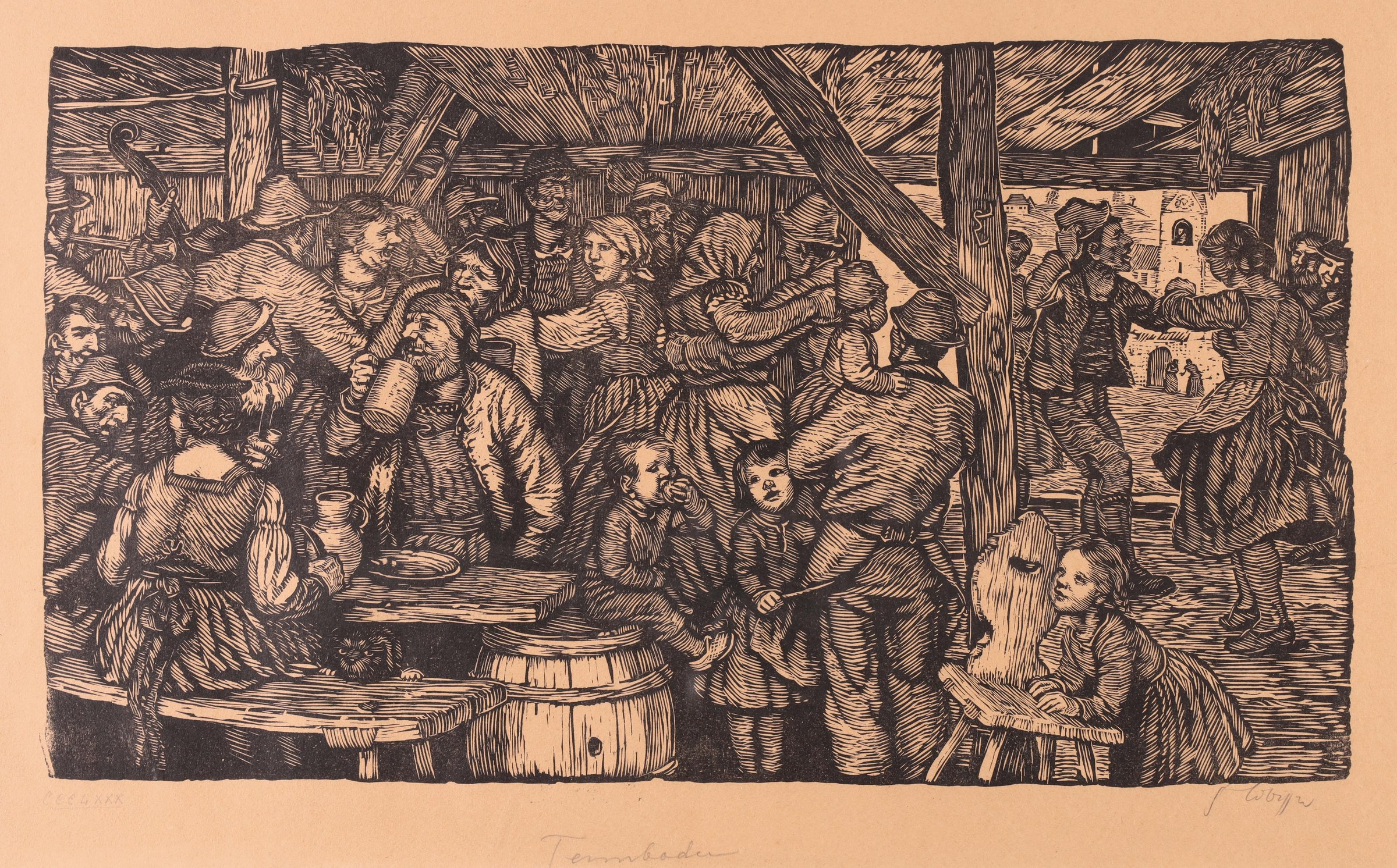
Switbert Lobisser Tennboden
Switbert Lobisser
- Medium:
- Oil Painting
- Dance:
- Folk/Country
- Era:
- 1920-1950 (Swing Era)
- Source:
- Wikimedia Commons
- Rights:
- Public domain — free to use, share and adapt.
- Recorded as:
- Public Domain
The Tennboden represents a form of communal folk dance that structured Alpine social and economic life, and Lobisser's image is a rare detailed visual record of the tradition's character and social composition. For dance historians, it documents how folk dancing functioned as community bonding in a non-theatrical, participatory setting, and shows the kinds of figures and spaces that hosted dance outside courts and concert halls. The work also exemplifies the role of modern printmaking in preserving and valorizing folk culture during a period of rapid social change.
What you are looking at
A crowded indoor gathering depicted in dense woodcut style, set within a timber-framed building with exposed beams and posts. The scene captures what appears to be a community festival or celebration, with figures of varying ages clustered throughout the composition. In the left foreground, seated figures in dark clothing observe the action. The center and right of the composition teem with standing and moving figures, many in period dress with long skirts and fitted bodices for the women, simple breeches and jackets for the men. Several figures appear to be actively dancing or in animated conversation, their bodies leaning and turning. In the background, a doorway or window with architectural detail suggests the building extends deeper. The wooden barrels or large vessels visible in the foreground—one prominently placed left of center—suggest a communal space for feasting or celebration, typical of Alpine or Central European folk festivals. The artist has rendered the crowd with remarkable specificity despite the medium's constraints, distinguishing individual figures and their gestures even amid the density.
The dancing
The dancers' bodies show relatively simple, upright posture without the formalized frame of court dance. Several figures in the center display animated arm gestures and turned torsos characteristic of folk movement—one woman appears to be in a turning motion with her skirt flared, while nearby figures show the kind of loose, spirited movement typical of partner or group dancing in a casual setting. Children weave between adults, and the overall composition suggests movement in multiple directions rather than the synchronized lines of formal dance. The positioning is naturalistic: some figures overlap, some are partially obscured by the architectural elements, and the weight distribution suggests standing, walking, and dancing figures captured mid-action rather than in a posed tableau.
The dance depicted
This depicts a Tennboden, a traditional Alpine (specifically Bavarian and Tyrolean) communal dance and celebration. The Tennboden was a seasonal gathering held on the threshing floor (tennboden literally means "threshing floor") where communities came together for music, dancing, and socializing, typically in autumn after the harvest. The image captures the informal, participatory nature of the tradition—both men and women of different ages, the mixture of dancing and social gathering, the prominent role of the community space itself. The dress and setting (timber construction, the casual arrangement of figures) confirm an early modern Alpine setting. The woodcut medium and artist's attention to documentary detail suggest Lobisser was recording a folk tradition that may have been disappearing or changing during the early 20th century.
How it was made
This is a woodcut (Holzschnitt), as confirmed by the catalogue record's reference to "Stockgröße" (block size) of 28.5 × 51 cm and the artist's monogram SL in the block. The medium is evident from the bold, linear hatching and the high contrast between black lines and uncut paper creating the beige tone visible here. Woodcut's linear vocabulary perfectly suits the rendering of timber-framed architecture and period dress, and the technique's directness supports the documentary quality of the composition. The relatively large block size and signed edition number (op. 380) indicate this was a carefully considered, publishable work meant for circulation beyond the artist's immediate circle—characteristic of early 20th-century print culture in German-speaking regions where woodcut experienced a revival among artists interested in folk traditions and social documentation.
About this work
Switbert Lobisser's woodcut depicts a Tennboden, a traditional Alpine communal gathering centered on dancing and celebration, recorded with documentary precision and social sympathy. The work captures a specific cultural practice in a moment of transition, using the woodcut medium's graphic power to render both architectural detail and the animated movement of a diverse crowd. It belongs in a dance gallery both as evidence of a folk tradition and as an artifact of early 20th-century artistic practice—a moment when European artists began systematically documenting disappearing or endangered folk practices through print media.
How to look at it
Attend first to the architecture: the timber framing and doorway establish the specific Alpine setting and the communal nature of the space. Then follow the movement: notice which figures are clearly dancing, which are standing and talking, which are watching—the painting captures a moment of simultaneous activity rather than a choreographed performance. Observe the dress closely, particularly the women's long skirts and the men's simple jackets, which anchor the image in a specific cultural and temporal moment. The woodcut's linear hatching creates rhythm and movement through the density of lines, mirroring the crowded, energetic social space. Finally, consider what is not shown: no musicians are visible, no clear hierarchy or stage—this is horizontal, community-centered sociability recorded from within the crowd rather than from a theatrical distance.
The artist
Switbert Lobisser (1894–1945) was an Austrian woodcut artist and printmaker based in Tyrol, deeply engaged with documenting Alpine folk traditions and rural life. His practice was part of a broader early 20th-century movement in German-speaking Europe toward artistic recovery of folk arts and peasant culture, often motivated by anxiety about modernization and cultural loss. Lobisser worked in woodcut throughout his career, a medium he chose for its directness and its associations with folk art and social realism. The numbering of this print as op. 380 suggests a prolific output focused on similar subjects.
The period
This work dates to 1943, the final year of Lobisser's life and the closing year of World War II in Europe. By this date, the Tennboden and similar Alpine folk practices had already undergone significant change due to urbanization, electrification, and cultural modernization in the interwar period. Lobisser's interest in documenting the tradition fits within a longer tradition of European folk-cultural preservation that had intensified from the late 19th century onward. In the visual arts of the 1930s–40s, woodcut remained a favored medium for artists interested in folk themes and social realism, though the political context of Nazi Germany—which appropriated folk imagery for nationalist purposes—complicated the meaning of such work. Lobisser's practice appears to belong to an older, more genuinely antiquarian impulse rather than contemporary nationalist ideology.
Where it lives
The work is recorded as a signed woodcut with the artist's monogram in the block, numbered op. 380 in Lobisser's catalogue. The present location is not recorded. The image is known through Wikimedia Commons, suggesting it has been photographed and digitized, likely from a public collection or archive.
Dance in this work
Questions about this work
What is a Tennboden?
A Tennboden was a traditional Alpine (especially Tyrolean and Bavarian) communal celebration held on the threshing floor (tennboden) after harvest, featuring music, dancing, eating, and socializing. It functioned as both a practical gathering and a major social occasion, bringing together people of all ages and classes in a shared space. The tradition was particularly important in rural communities where such gatherings structured the social calendar and reinforced community bonds.
How does Lobisser show the dancing?
Rather than isolating dancers or staging them formally, Lobisser embeds the dancing figures within a crowd of people in various states of activity. Several figures clearly show turned torsos, animated arm gestures, and the kind of loose, spirited movement typical of participatory folk dancing. The artist captures the dance as a social practice rather than a performance—something embedded in and inseparable from the broader gathering.
Why use woodcut for this subject?
Woodcut's bold linear language suited both the documentary aim and the folk subject matter. The medium's directness and its historical associations with folk art and social realism made it ideologically and aesthetically appropriate for recording a disappearing tradition. The technique also allowed Lobisser to render fine architectural detail alongside animated human figures.
Is this a historical record or an artistic interpretation?
Both. Lobisser clearly aimed at documenting a real tradition with specificity—the architecture, dress, and social composition all appear carefully observed. But the composition, the selective framing, and the expressive linear technique are artistic choices that shape how we read the scene. It is the kind of historically grounded yet artistically mediated document typical of early 20th-century cultural preservation efforts.
More Folk/Country artwork