37 works in this view — arrow keys or swipe to move between them.
Dance in Art · 1950
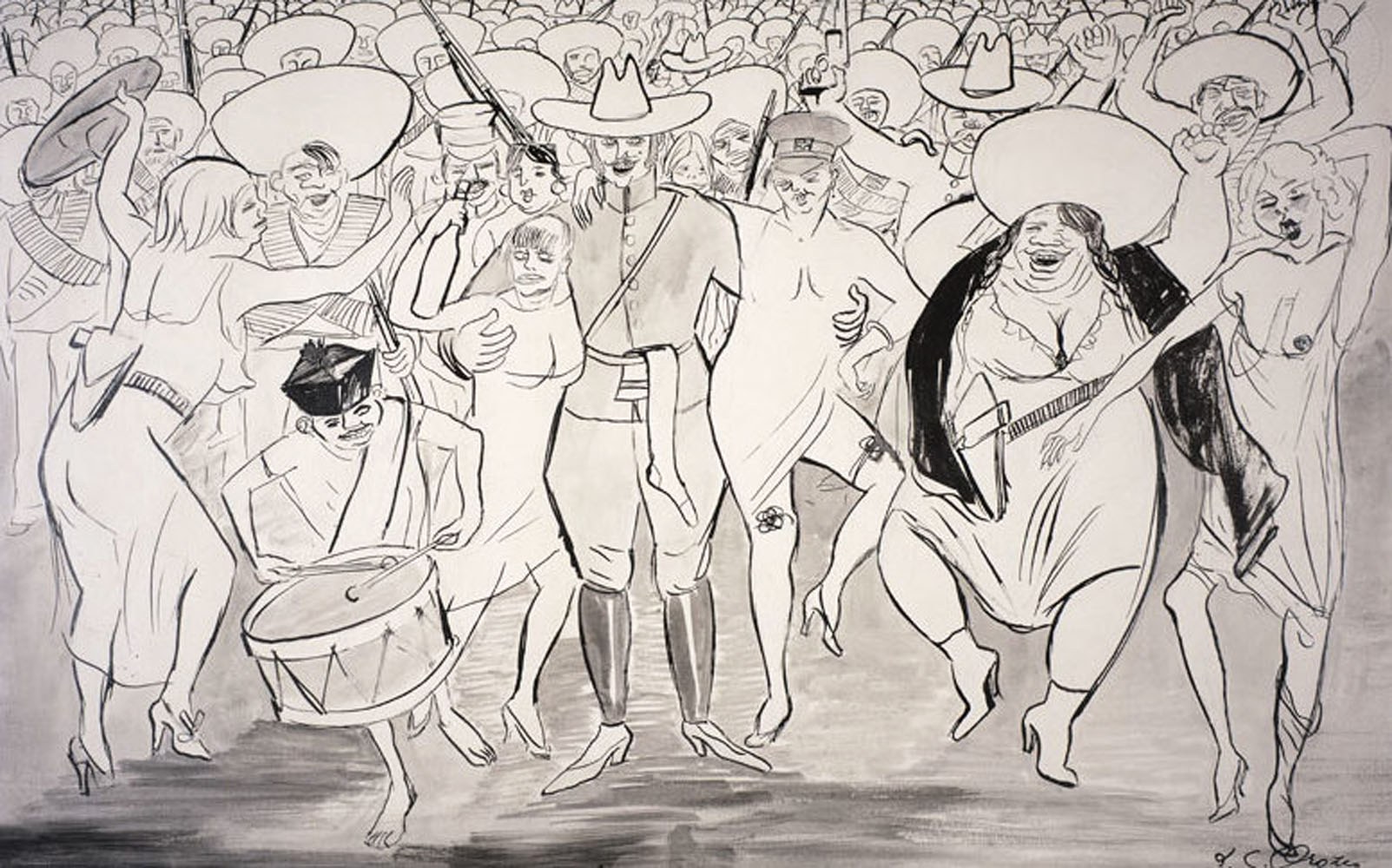
José Clemente Orozco, La cucaracha I
José Clemente Orozco
- Medium:
- Oil Painting
- Era:
- 1920-1950 (Swing Era)
- Source:
- Wikimedia Commons
- Rights:
- Public domain — free to use, share and adapt.
- Recorded as:
- Public Domain
This work provides visual evidence of how Mexican revolutionary-era folk celebration was understood and depicted by a major modernist artist. It demonstrates that Orozco, known primarily for his monumental murals and historical compositions, engaged with popular dance as a subject worthy of artistic attention—and that he rendered such subjects with a visual language that honored their vernacular, uninhibited character rather than 'elevating' them into academic convention.
What you are looking at
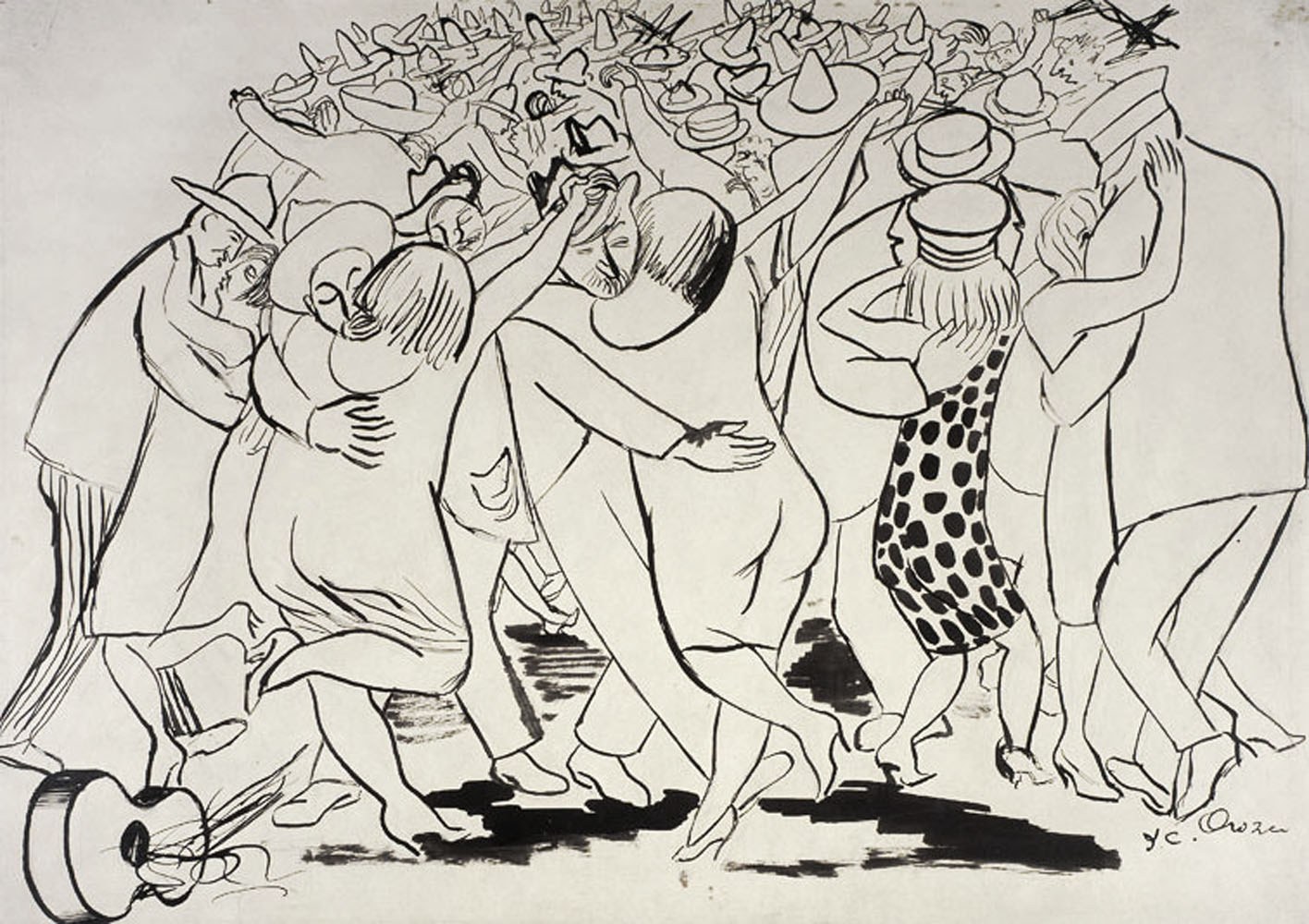
A raucous gathering of figures in a pen-and-ink drawing rendered in loose, gestural linework. The composition is densely packed, almost chaotic, with overlapping bodies rendered in varying degrees of finish—some are fully detailed, others merely suggested by quick strokes. At the center stand several figures in wide-brimmed cowboy hats and what appears to be Mexican dress, including women with bare or partially bare breasts displayed unselfconsciously. Around them cluster numerous other figures, many also partially or fully nude, engaged in music-making and dance. A figure to the left plays what may be a drum or percussion instrument; another holds what looks like a stringed instrument. The setting is ambiguous—there is a suggestion of water or ground at the base, and the background is filled with small, repeated head outlines that suggest either a crowd or a decorative wallpaper effect. The overall tone is ribald and celebratory, with exaggerated facial expressions suggesting laughter, song, and festivity. The drawing style is deliberately crude and caricatural, with heavy emphasis on belly, breast, and sexual anatomy rendered in an almost carnival-like manner.
The dancing
The figures are drawn with minimal anatomical refinement and maximum sexual explicitness. Bodies are shown in loose, unsupported stances—hips thrust forward, torsos bent, limbs akimbo. There is no evidence of ballroom hold or formal frame; instead, bodies occupy space without apparent contact, suggesting informal, social movement. A number of figures appear to be in mid-stride or mid-gesture, with arms raised. The repeated motif of bare-breasted and nude figures suggests uninhibited movement rather than constrained, codified choreography. Facial expressions are uniformly animated—open mouths suggesting song or laughter rather than the composed, blank expressions of formal dance.
The dance depicted
This appears to document *La Cucaracha*, a Mexican folk dance and popular song that became widely known in the early 20th century, particularly during and after the Mexican Revolution. The title, which translates to 'the cockroach,' refers to a satirical corrido (narrative song) often associated with revolutionary sentiment and working-class celebration. The image depicts not formal, staged dance but popular, communal celebration—the kind of gathering where the song would be sung and danced by ordinary people rather than trained performers. The presence of the wide-brimmed hats, the percussion instruments, the nude or semi-clothed figures, and the overall rowdy, sexualized tone suggests documentation of a folk celebration or carnival rather than theatrical performance. The dance itself, based on the gestural evidence, appears to involve free, unstructured movement without prescribed steps or positions.
How it was made
This is pen and ink on paper, executed in a deliberately rough, gestural style that emphasizes expressive line over anatomical accuracy. The artist has used variable line weight and density—some areas are heavily cross-hatched or darkened (particularly clothing and the repeated background heads), while others are left as bare outline or suggestion. The technique allows for rapid execution and captures movement through abbreviated form rather than detailed modeling. The loose, almost graffiti-like quality suggests this may have been drawn from life or from memory, or executed with deliberate artificiality to evoke folk or popular aesthetics rather than academic or fine-art conventions.
About this work
This drawing depicts a scene of popular Mexican celebration centered on *La Cucaracha*, a revolutionary-era folk song and dance. Orozco renders the scene with deliberate crudity and sexual explicitness, emphasizing the communal, carnivalesque nature of the gathering over formal choreographic structure. The work sits within Orozco's broader interest in Mexican popular culture and revolutionary sentiment, captured through a visual language that privileges expressive distortion and caricature. It is a document of folk culture rather than theatrical dance, yet one executed by a major figure in early 20th-century Mexican art.
How to look at it
Attend to the deliberate crudity of the linework and the absence of conventional perspective or spatial logic. Orozco has chosen not to render a staged, theatrical moment but a chaotic, overlapping gathering—the viewer's eye is forced to move across the surface without a clear focal point, mimicking the sensory chaos of a crowded celebration. Notice how the repeated heads in the background create a wallpaper effect that suggests either an actual dense crowd or a decorative, almost abstract treatment of the idea of 'the people.' The sexual explicitness and ribald tone are central to the work's meaning—this is not a sanitized or 'civilized' representation of dance, but one that insists on the body, pleasure, and transgression as central to popular celebration.
The artist
José Clemente Orozco (1883–1949) was a Mexican muralist and painter central to the Mexican muralist movement of the early-to-mid 20th century. Alongside Diego Rivera and David Alfaro Siqueiros, he created large-scale public works addressing Mexican history, revolution, labor, and indigenous culture. Orozco was known for a more expressionist, sometimes grotesque visual language than his contemporaries—his figures are often distorted, his palettes sombre, his subjects violent or tragic. His works combine modernist formal innovation with explicit political content and engagement with Mexican vernacular culture. This drawing reflects his interest in popular celebration and revolutionary themes, rendered in the caricatural, expressive style characteristic of his work on paper.
The period
This work dates to 1950, near the end of Orozco's life, during a period when Mexican modernism and the revolutionary muralist movement had become institutionalized. By this date, *La Cucaracha* had long since entered international popular culture—it was sung during the Mexican Revolution (1910–1920), became a symbol of Mexican identity, and had been recorded, published, and performed internationally throughout the 1930s and 1940s. Orozco's engagement with this subject reflects both the historical weight the song had accumulated and the continued artistic interest in capturing Mexican popular culture during a period of cultural consolidation and nation-building. The drawing sits at the intersection of folk documentation and modernist artistic practice.
Where it lives
The work is recorded as an oil painting in the catalogue, but the visual evidence strongly suggests pen and ink on paper. It is held in an unrecorded collection according to the available record, and the source is listed as Wikimedia Commons, which typically hosts works in the public domain or with open licensing.
Dance in this work
Questions about this work
What is La Cucaracha and why does it appear in art?
*La Cucaracha* is a Mexican folk song and dance that rose to prominence during the Mexican Revolution (1910–1920). It became a symbol of Mexican national identity and popular resistance. The song entered international culture and has been depicted by artists as emblematic of Mexican popular celebration. For Orozco and other Mexican modernists, it represented authentic Mexican culture worth capturing and elevating to the level of fine art.
Why are the figures so crude and exaggerated?
Orozco's expressionist style deliberately distorts and caricatures the human figure to convey emotional and political meaning rather than anatomical accuracy. The exaggeration and crudity here emphasize the transgressive, uninhibited character of popular celebration—this is not restrained ballroom dance but rowdy, sexualized, communal festivity. The style also reflects modernist rejection of academic convention.
Is this a record of actual dance or an invented scene?
The image depicts the general character of *La Cucaracha* as a popular, communal dance-and-song celebration rather than a choreographed theatrical piece. Whether Orozco drew from direct observation, memory, or imagination is unclear, but the work documents the cultural understanding of the dance as uninhibited, sexualized, and communal rather than formally structured. It is a representation of the idea and feeling of the gathering rather than a documentary record.
More dance artwork