31 works in this view — arrow keys or swipe to move between them.
Dance in Art · 1924
Franz von Bayros Sinnlicher Reigen
Franz von Bayros
- Medium:
- Oil Painting
- Era:
- 1920-1950 (Swing Era)
- Source:
- Wikimedia Commons
- Rights:
- Public domain — free to use, share and adapt.
- Recorded as:
- Public Domain
The work demonstrates how early twentieth-century European art used dance as a language for expressing intoxication, desire, and the transgression of social boundaries—not through the depiction of actual movement, but through the invocation of dance as an idea. For historians interested in how dance functioned as cultural symbol and fantasy, this is primary evidence of dance's power to evoke sensation and transgression even in static form.
What you are looking at
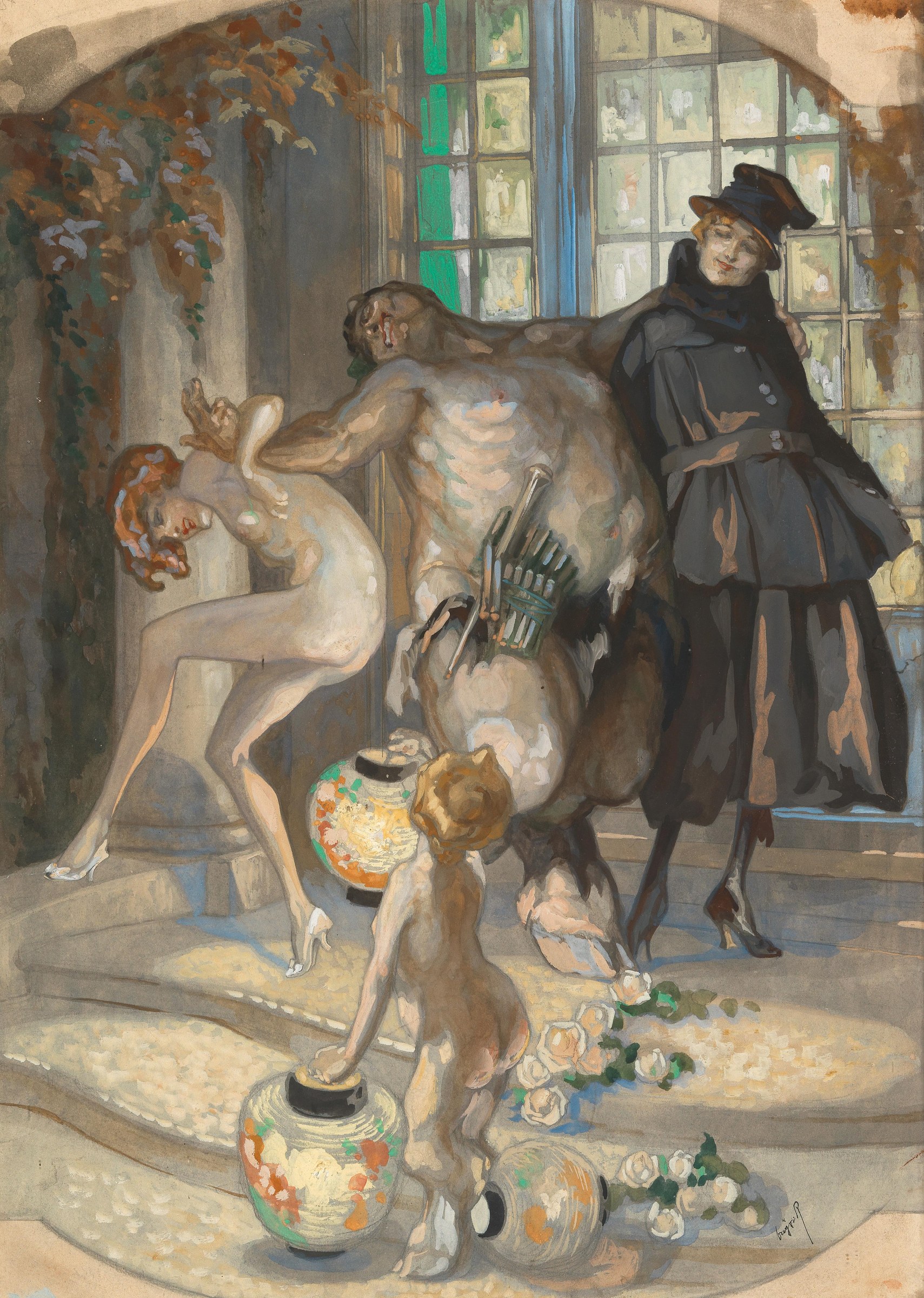
A woman in classical drapery reclines across an enormous male nude figure in an architectural setting—a vaulted passage with ivy-covered walls and tall multi-paned windows opening onto a cityscape. The man's body serves as a platform or throne; the woman drapes across his torso and legs, her pale skin and golden hair contrasting with his darker, sculpted form. Scattered across the floor are decorative ceramic vessels painted in bright greens, oranges, and gold—some upright, others tipped. A second figure in dark winter dress, wearing a black hat, stands to the right observing the scene, creating a jarring temporal collision: the nude, mythological or allegorical interior and the clothed, modern witness. The composition reads as a studio or gallery interior where the boundary between sculpture, living model, and contemporary viewer has dissolved.
The dancing
The central female figure is entirely passive—a reclining pose with limbs arranged across the male body, her weight supported entirely by his form. Her posture suggests languor or unconsciousness rather than movement. The male figure, though depicted as flesh rather than stone, is immobile and monumental, his musculature defined with academic precision. The clothed observer stands upright and still, creating a stark contrast in bodily state and temporal placement. No choreography or weight transfer is visible; the only movement suggested is the twisted torso and extended limbs of the reclining woman, which reads as sculptural arrangement rather than dance motion.
The dance depicted
This is not a depiction of dance in any conventional sense. The work represents an allegory or fantasy—possibly of sensuality, intoxication, or artistic consumption ('Sinnlicher Reigen' translates as 'Sensual Round Dance' or 'Sensual Whirl', a term that evokes the spinning or circular movement of social dance, yet the image shows no actual choreography or group interaction). The title invokes dance but the visual evidence shows static, sculptural figures arranged for contemplation. The work belongs more properly to the tradition of erotic or allegorical art than to dance documentation or illustration.
How it was made
The catalogue record lists the medium as watercolor and gouache (opaque white) on cardboard. The technique is evident in the soft modeling of flesh tones, the luminous quality of the pale female figure, and the precise architectural framing. The combination of watercolor and gouache allows for both translucent and opaque passages—the semi-transparent drapery of the woman's garment and the solid rendering of the dark-clad observer. This is a work of fine art rather than popular illustration, likely intended for a limited audience of collectors rather than mass circulation.
About this work
This is a fin-de-siècle or early twentieth-century allegorical composition by Franz von Bayros, a Viennese painter and illustrator known for erotic and fantastical subject matter. The work plays with the idea of dance—the title references a 'sensual round'—but stages instead a frozen moment of sculptural arrangement and erotic reverie, observed by a modern witness. It belongs in a gallery of dance in art not because it depicts actual choreography, but because it engages with dance as metaphor and desire: the title summons the whirling, intoxicating movement of social dance while the image arrests all motion in marble-like stasis. The work is a sophisticated interrogation of the distance between the promise of dance (sensuality, abandon, movement) and the still image.
How to look at it
Attend to the temporal and spatial collision: the classical male nude and the reclining woman belong to the language of Old Master painting and allegorical tradition, while the observer in modern dress and the contemporary architectural setting locate the scene in the artist's own time. The scattered decorative vessels suggest both opulence and disorder—beauty degraded or scattered. The title invokes movement and dance, yet every figure is arrested. This frozen state, despite the title's promise of whirling, is the point: the work explores the gap between the fantasy of sensual abandon (evoked by the dance reference) and its representation in still form.
The artist
Franz von Bayros (1866–1924) was an Austrian painter, illustrator, and printmaker based in Vienna, known for erotic, allegorical, and fantastical works. He worked in watercolor, oil, and etching, and his practice spanned illustration for literary and theatrical works alongside fine art compositions. His work is characteristic of Austro-German Symbolism and the decadent aesthetic currents of the late nineteenth and early twentieth centuries. Bayros's œuvre frequently depicted mythology, eros, and the female form, often in richly ornamented or architecturally framed interiors.
The period
The early twentieth century saw intense fascination with dance as a vehicle for expressing modernity, primitivism, and erotic liberation. The rise of Isadora Duncan and the Ballets Russes (founded 1909) meant that dance had become a legitimate subject for serious artistic inquiry. Simultaneously, in Central European Symbolism and decadent art circles, dance was invoked as metaphor for transgression, abandonment, and the dissolution of bourgeois propriety. Bayros's work sits within this moment: the title gestures toward the liberatory promise of dance while the static composition suggests the impossibility or artificiality of that freedom. The presence of the modern observer in dark winter dress anchors the fantasy in contemporary reality, a device common in early twentieth-century Symbolist art.
Where it lives
The work is recorded from Wikimedia Commons with minimal provenance data. The catalogue record identifies it as watercolor and gouache on cardboard, dimensions 50 × 35 cm, and dates it to 1924, the year of Bayros's death. No holding collection is recorded.
Questions about this work
What does 'Sinnlicher Reigen' mean?
'Sinnlicher Reigen' translates from German as 'Sensual Round Dance' or 'Sensual Whirl'—a title that evokes the spinning, circular movement of social and theatrical dance. The title is ironic: it promises dance and movement, yet the image depicts frozen, sculptural figures in complete stasis.
Is this actually a dance scene?
No. The work uses dance as a poetic or metaphorical title but stages instead an erotic allegory with static figures arranged as if in sculpture or painting. The female figure's body is arranged across the male figure, but there is no choreography, weight transfer, or actual movement depicted.
Who is the clothed figure observing the scene?
The identity is not specified. The figure represents the modern viewer—a contemporary witness to the scene of allegorical or erotic fantasy. This contrast between the timeless mythological interior and the clothed modern observer was a common device in Symbolist art, highlighting the distance between fantasy and reality.
What is the significance of the scattered ceramics?
The decorative vessels—painted in bright, ornamental colors and strewn across the floor—suggest both artistic richness and disorder or waste. They may reference sensual excess or the aftermath of intoxication, reinforcing the erotic and transgressive content implied by the title and composition.
More dance artwork