49 works in this view — arrow keys or swipe to move between them.
Dance in Art
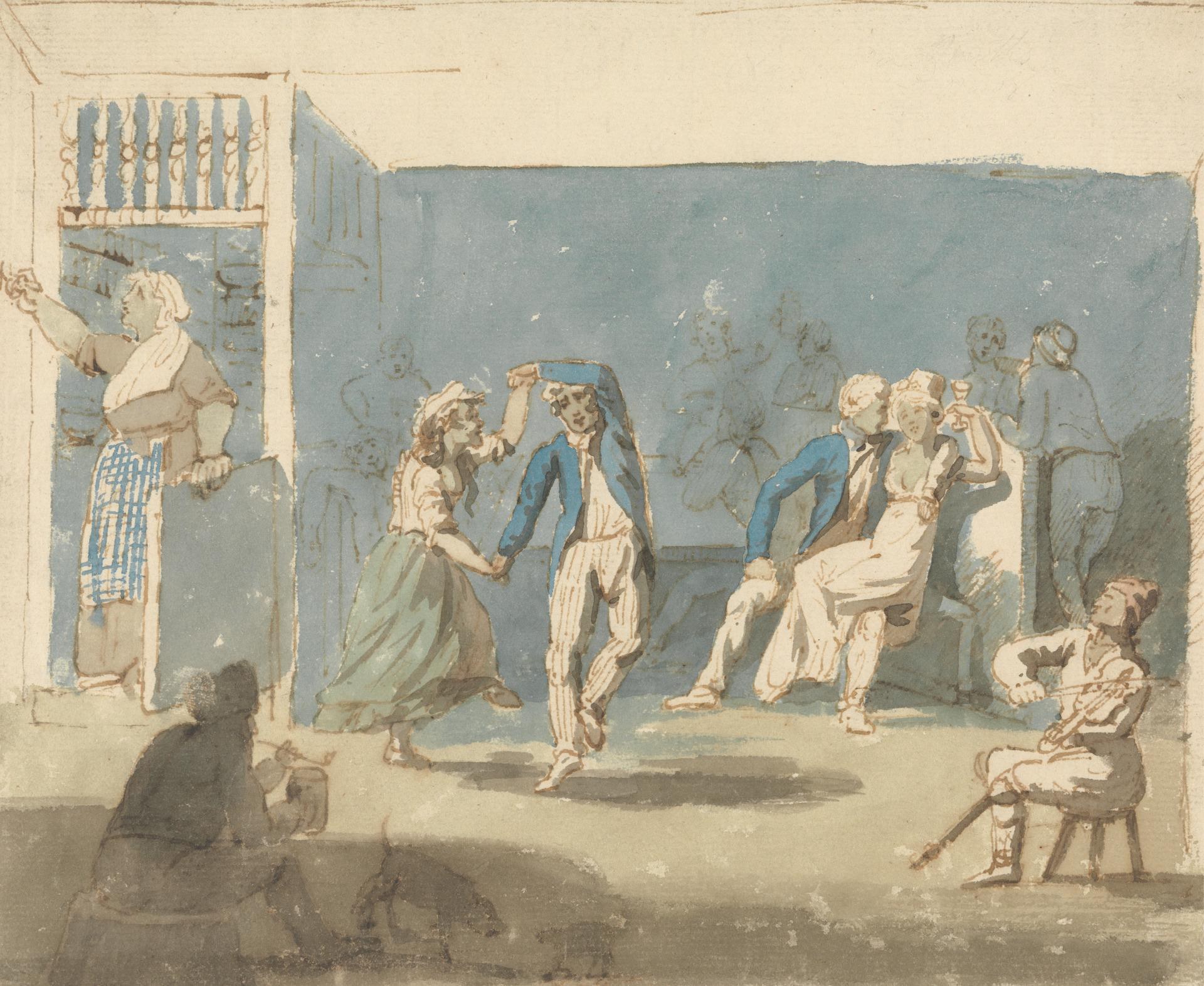
George Shepherd - An Evening Ashore - B1977.14.5356 - Yale Center for British Art
George Shepherd
- Medium:
- Oil Painting
- Source:
- Wikimedia Commons
- Rights:
- Public domain — free to use, share and adapt.
- Recorded as:
- CC0
The work provides direct visual evidence of how popular social dancing was actually performed and experienced in late 18th-century England, outside the formal ballroom or court tradition. It shows dance not as codified technique but as spontaneous, joyful social practice—a valuable corrective to the assumption that only formal dances merit historical attention.
What you are looking at
A lively domestic or tavern scene in which figures in late 18th-century dress are gathered around a central couple engaged in energetic movement. The setting appears to be an interior space with blue-grey walls and a barred window or door visible on the left; a figure stands in or near a doorway watching the scene. The composition is animated: the central dancers are mid-motion, their bodies twisted and limbs extended in exuberant poses. Other figures—some seated, some standing—watch and react around the perimeter. The palette is muted: cream, blue-grey, and ochre tones, with touches of blue in clothing. The light is even and flat, suggesting daylight filtering into the room. The overall mood is one of spontaneous merriment: this is not a formal ballroom but a moment of popular social dancing, captured in the midst of movement and pleasure.
The dancing
The two central figures are in rapid, sprightly motion with extended limbs and twisted torsos—the male dancer leans forward dynamically while the female figure beside him moves with corresponding energy and lift. Neither is in a closed ballroom hold; their movement is looser and more playful, with limbs free and gestures emphatic. The onlookers—seated and standing around the space—are angled inward and engaged, their own bodies and gazes oriented toward the dancers. The overall posture is that of vernacular social dancing rather than codified technique: the dancers appear to be moving with joy and abandon rather than strict form.
The dance depicted
This appears to be a scene of English popular dancing, most likely a country dance or folk reel of the late 18th century—the period of George Shepherd's practice. The dynamism, the mixed-gender pairing, the informal setting, and the responsive audience all point to social dancing among working or middling people rather than aristocratic court dance or formal ballroom practice. The absence of stiffness or classical posture suggests the looser, more vigorous movement characteristic of country dancing and reels. The setting—interior, crowded, convivial—is typical of how such dancing was depicted in the period: an evening ashore, perhaps in a public house or informal gathering space.
How it was made
The work is executed in watercolour or oil on paper with pen underdrawing, evident in the visible linear framework and the fluid, luminous wash of the blue-grey background. The technique shows Shepherd's hand as a narrative illustrator: the composition is sketchy and economical, with careful attention to gesture and expression but loose handling of drapery and background. The style and medium suggest this was made for circulation as a finished work or as a preparatory study, typical of Shepherd's practice as a prolific illustrator of English social scenes in the late 18th and early 19th centuries.
About this work
This is a lively genre scene of English social dancing in an informal interior setting, executed in watercolour or mixed media by George Shepherd, a prolific late 18th-century illustrator of London life and popular amusements. The work captures a moment of vernacular social dancing—a country reel or similar folk dance—with evident energy and pleasure, showing how such dancing was practiced and witnessed in working and middling-class settings. The composition and style are characteristic of Shepherd's documentary approach to English social customs and entertainments.
How to look at it
Attend to the moment of maximum energy: the artist has frozen the dancers at the height of their motion, with limbs extended and bodies twisted, not at a moment of repose or formal posture. Notice the onlookers' faces and postures—engaged, animated, watching intently—which tells us as much about the social meaning of the dance as the dancers' movement itself. The loose, sketchy handling of the background and the precise, careful rendering of the figures' gestures shows where Shepherd's interest truly lay: in human action and expression, not architectural setting.
The artist
George Shepherd (1784–1862) was an English watercolourist and illustrator best known for his prolific documentation of London life, street scenes, public amusements, and social gatherings. He produced thousands of finished watercolours and drawings, many of which were engraved for publication as prints. His work is notable for its observational accuracy, narrative detail, and democratic interest in the life of ordinary Londoners—street vendors, entertainments, public houses, and social customs—rather than elite subjects.
The period
In the late 18th and early 19th centuries, English social dancing encompassed both formal ballroom culture (quadrilles, cotillions, minuets) and vigorous vernacular forms (reels, country dances, jigs) that crossed class lines. Shepherd's period saw growing interest among artists and illustrators in documenting popular life and amusements as subjects worthy of artistic attention. This democratisation of subject matter—treating a tavern dance with the same observational seriousness as a court scene—was a significant shift in artistic values and cultural awareness.
Where it lives
The work is held in the Yale Center for British Art (B1977.14.5356) and was sourced through Wikimedia Commons. It is a finished watercolour or oil study, characteristic of Shepherd's working method as an illustrator producing both autonomous works and source material for prints.
Dance in this work
Questions about this work
What kind of dance is this?
Most likely a country reel or English country dance of the late 18th century. The energetic, loosely-held movement, the informal setting, and the mixed-gender pairing are all consistent with popular social dances of the period. These dances were vigorous and playful, very different from the formal ballroom dances of the same era.
Who would have danced like this?
Working and middling-class people—servants, apprentices, artisans, publicans, and their companions. This was not elite entertainment but the social dancing of ordinary Londoners in public houses, assembly rooms, and informal gatherings. Shepherd's interest in documenting such scenes was itself significant: he treated popular amusements as worthy subjects.
Is this a real scene or an invented one?
Shepherd worked from observation and likely witnessed scenes like this in London taverns and public spaces. His approach was documentary and anecdotal: he sketched real life, though the specific gathering may be a composite or idealisation rather than a portrait of a particular event. The naturalness of the gesture suggests close observation rather than pure invention.
What was 'an evening ashore'?
The title suggests a scene involving sailors or people associated with the sea enjoying a night of leisure and entertainment on land—a common subject in 18th-century popular art and literature. Such evenings typically involved drinking, dancing, and socialising in public houses near ports or in working-class neighbourhoods.
More dance artwork