49 works in this view — arrow keys or swipe to move between them.
Dance in Art · 1798
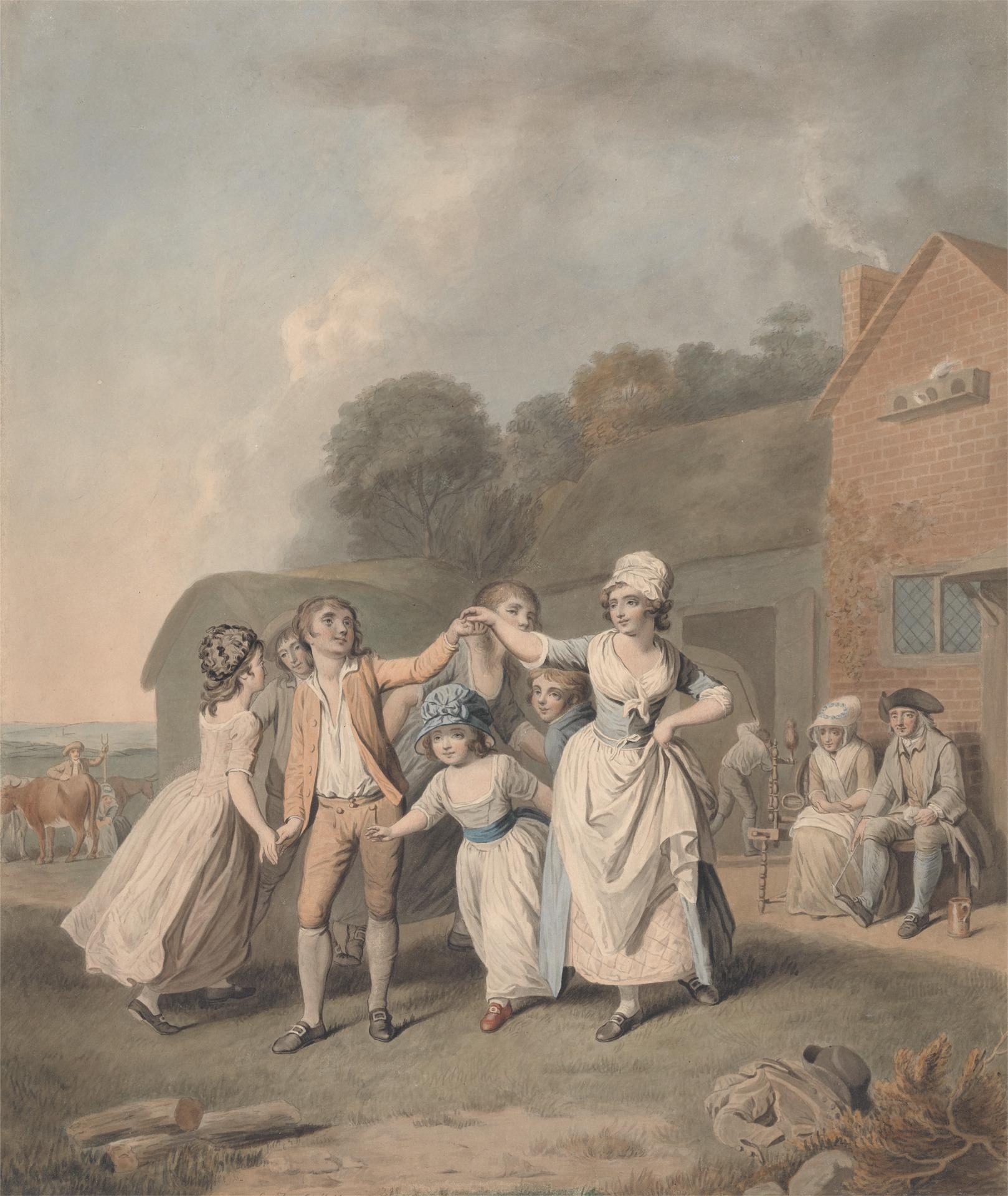
George Townly Stubbs - Children Dancing - B1975.4.1959 - Yale Center for British Art
George Townly Stubbs
- Medium:
- Oil Painting
- Era:
- 1700s (Enlightenment/Minuet Era)
- Source:
- Wikimedia Commons
- Rights:
- Public domain — free to use, share and adapt.
- Recorded as:
- CC0
This work documents what children's dance and courtship play actually looked like in late 18th-century rural England—not the minuet or quadrille, but the improvised amusement of young people at work and leisure on a farm. For historians of childhood, gender, and rural culture, it provides specific visual evidence of dress, spatial arrangement, and the mingling of play, courtship, and social supervision. For dance history, it represents a category of practice—uncodified, mixed-age, outdoor, socially permissive—that rarely appears in formal dance documentation and yet was widespread.
What you are looking at
An outdoor rural scene centered on a group of children and young people in light, high-waisted muslin dresses and breeches, arranged in an informal dance or play formation in front of a brick farmhouse. The composition is balanced: on the left, children in translucent white dresses cluster around a central boy in tan breeches and white shirt, one girl reaching upward while others look on; on the right, two seated men in working clothes observe from chairs placed near the cottage door. The background shows gently rolling fields under a grey-white sky, with mature trees rising behind the building. The light is diffuse and cool, typical of northern European weather, and the scene appears to capture a moment of spontaneous recreation—the children's gestures suggest play, courtship, or an improvised dance, while the adults' distant positioning establishes this as children's amusement rather than formal entertainment.
The dancing
The central group shows loose, playful positioning rather than formal dance hold. The tallest girl on the right wears a white high-waisted gown with a colored sash and cap; her posture is upright and her gaze directed toward the action. A boy in tan breeches stands at the group's heart with his arm raised, as though leading or catching attention. Around him, smaller children in white shift their weight and reach—one girl's arm extends upward in what could be a gesture of joy or the start of a lifted movement. The seated men are entirely still, detached observers. The overall impression is of youth, lightness, and uninstructed movement—nothing disciplined or trained.
The dance depicted
This appears to record children's play-dancing or rural courtship games rather than any codified dance form. The informal grouping, the ages of the participants, and the outdoor farm setting suggest the recreation of children and young servants at a working property. The raised arms and reaching gestures are too incidental to indicate a specific dance style; they belong instead to play—the kind of improvised, socially sanctioned amusement that mingled flirtation, athletic play, and music in rural communities of the period. No musical instruments are visible, and no formal figure or formation is apparent.
How it was made
The catalogue record identifies this as oil painting. The work shows the finish, subtle tonal gradation, and layered glazing characteristic of late 18th-century oil on canvas. The soft rendering of the sky and distant foliage, the precise naturalistic detail in the figures' dress and faces, and the warm golden light on the cottage walls are all achieved through oil's capacity for transparent color and blending. The technique served an educated audience and was expensive enough to mark this as a commissioned record of a specific place and social moment—not a quick sketch or mass-produced print.
About this work
This is a domestic genre scene from the 1790s, recording a moment of informal dancing or play among children and young people at a rural English property. The painting observes the boundary between work and recreation, adult propriety and childhood freedom, formality and play. It belongs to a substantial tradition of 18th-century painting that used rural subjects and childhood innocence to explore themes of natural feeling and social grace—ideas central to Romantic sensibility. The work captures the visual and social codes of children's amusement in the period: the high-waisted muslin dresses and breeches mark fashion of the 1790s; the seated observers signify gentle supervision; the outdoor setting asserts the rural as a space of freedom and authenticity. The painting is neither moralizing nor sentimental in a heavy-handed way, but it is consciously composed to balance charm, narrative interest, and a certain restrained social commentary.
How to look at it
Notice the suspended moment the artist has chosen: not the height of an action, but the gathering and anticipation before movement crystallizes into form. The raised arm, the turned heads, the girl's reaching gesture all suggest something about to happen rather than something fully articulated. Attend also to the painting's composition of space: the adults are literally seated and removed, establishing a boundary between their authority and the children's play. The outdoor setting and the soft, cool light give permission for this kind of unsupervised amusement. Finally, look at the dress: the high-waisted muslin gowns and simple shifts are not court dress or formal attire, but the working and semi-formal wear of a country family of some means—marking both their rank and their participation in current fashion.
The artist
George Townly Stubbs (c. 1756–1815) was the son of the celebrated animal painter George Stubbs and himself a competent painter of horses, rural scenes, and domestic subjects. He worked in a period when rural and domestic genre scenes were increasingly fashionable among the English gentry, and he appears to have specialized in precisely this kind of scene: the picturesque properties of farming families, their leisure moments, and their children at play. His work is characterized by naturalistic observation, careful attention to fabric and fashion, and a gentle, non-judgmental interest in rural life. He exhibited at the Royal Academy and maintained a professional practice, but remains less well-known than his father and many contemporaries.
The period
In the 1790s, childhood was being reimagined in British culture. Enlightenment and early Romantic thought elevated children's play and natural feeling as educational and morally formative. Simultaneously, muslin dresses and simplified silhouettes—influenced by French revolutionary ideals of natural simplicity—were replacing rigid stays and brocades for women and girls. The rural setting reflects the period's growing investment in landscape, countryside life, and the pastoral as spaces of authenticity and freedom. In dance specifically, the minuet was becoming old-fashioned among the young, while the quadrille and cotillion were gaining ground; but for working people and rural communities, such formal dances coexisted with uncodified play-dances and games that combined music, courtship, and recreation. This painting sits between formal and informal, supervised and spontaneous, town and country.
Where it lives
The work is held at the Yale Center for British Art under accession number B1975.4.1959. It was sourced to LODance via Wikimedia Commons and represents the kind of domestic and genre scene that Yale collects as evidence of 18th-century English social life and cultural values.
Dance in this work
Questions about this work
Is this a formal dance?
No. The grouping is too loose, the setting too informal, and the participants too young and mixed in age for this to be a codified dance like a minuet or quadrille. It records improvised play and courtship amusement—what children and young servants actually did for recreation on a farm.
Who is dancing and who is watching?
The children and young people in the center—roughly ages 6 to 18—are playing or dancing together. The two men seated by the cottage door are adults, likely farmers or family members, supervising from a distance. This arrangement was typical: children's amusement was permitted and even encouraged, but within sight of responsible adults.
What do the clothes tell us?
The high-waisted muslin gowns and simple linen shifts are fashionable dress for the 1790s, influenced by ideals of natural simplicity and comfort. They mark the family as having some wealth and awareness of current fashion, but not aristocratic. The men's working breeches and coats place them as country people, not servants in livery.
Is there music?
No instruments are visible in the painting, though dancing and play of this kind almost always occurred with music—a fiddle, pipes, or singing. The artist may have chosen to omit musicians to focus attention on the children, or music may have been present but out of frame.
More dance artwork