49 works in this view — arrow keys or swipe to move between them.
Dance in Art · 1900
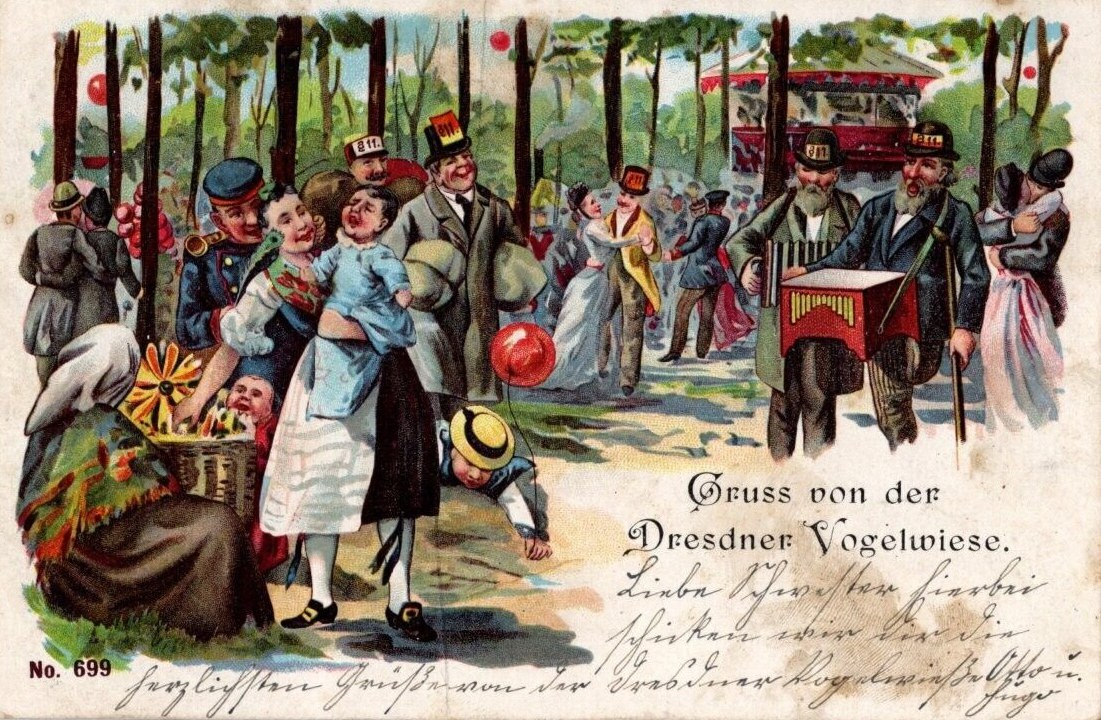
Gruss von der Dresdner Vogelwiese AK 1900
Unknown
- Medium:
- Oil Painting
- Era:
- 1900-1920 (Ragtime/Early Jazz)
- Source:
- Wikimedia Commons
- Rights:
- Public domain — free to use, share and adapt.
- Recorded as:
- Public Domain
This postcard is a primary source for understanding early-20th-century popular leisure and the social geography of dance. It shows that street musicians and mechanical organs were central to public dancing, and that fairs and parks were where social dancing occurred outside formal ballrooms—a history often absent from traditional dance scholarship focused on theatrical performance.
What you are looking at
This postcard depicts a festive gathering at the Dresdner Vogelwiese (Dresden Bird Meadow), a popular public fair or festival ground. The scene is densely populated with well-dressed figures in Edwardian-era clothing spread across a tree-lined park or garden. In the foreground, a woman in a white apron (possibly a vendor or server) stands near baskets of goods. Central to the composition is a group of men wearing distinctive hats marked with what appears to be "§11," suggesting some form of organized group or association. At the right, a mechanical organ player (Drehorgelspieler) in a hat stands beside his instrument, which features red decorative panels—a common street entertainment device of the period. Musicians and accordion players are visible throughout, indicating this is a musical and social celebration. The setting is bright and cheerful, with colored balloons (red and yellow) strung between the trees, creating a festive atmosphere. The crowd includes men in bowlers and straw hats, women in long skirts and elaborate hats, and children, all mingling and socializing in the open air. The brushwork suggests this is a hand-colored lithograph or similar print, with naturalistic rendering of the sunny forest setting.
The dancing
The figures are dressed formally in the fashion of 1900: men wear tailored jackets and various hats (bowlers, straw hats, top hats); women wear long skirts, high-necked blouses, and elaborate bonnets. The postures are relaxed and social rather than formally composed—people stand in loose groups, chat, and gesture casually toward one another. Several figures appear to be in conversation or mild flirtation. The overall impression is of promenade and social interaction rather than structured partnered dancing; bodies are vertical and loosely arranged rather than in closed holds or choreographed formation.
The dance depicted
While this is primarily a social gathering scene rather than a focused depiction of dance, the presence of street musicians—particularly the mechanical organ and accordion players—suggests that dancing may have been part of the entertainment, as these were common sources of music for informal public dancing in late-19th-century Central European fairs. However, no couples are shown in an actual dance hold or recognizable dance posture. The scene captures the social context in which popular dancing would occur: a public fair with musicians, mixed-gender social gathering, and festive mood. This is social documentation rather than dance documentation.
How it was made
The work is executed as a hand-colored chromolithograph or similar color printing process, indicated by the printed text ("Gruss von der Dresdner Vogelwiese") and the characteristic flat color zones visible in trees, clothing, and balloons. The image was clearly produced as a mass-market postcard (Ansichtskarte), as evidenced by its format, the text block reserved for address and message at lower right, and its origin as a postcard sent from Dresden to Niederbobritzsch in 1900. The catalogue record identifies it as oil painting, but the visual evidence (printed text, chromatic registration, composition) indicates it is a color print. Hand coloring may have been applied to select copies.
About this work
This is a color-printed postcard documenting a public festival scene at one of Dresden's most popular leisure destinations around 1900. The Vogelwiese was a famous outdoor amusement ground known for music, dancing, and social gathering, and this image captures the diverse crowd, the musicians providing entertainment, and the festive decoration of the grounds. It represents a moment of urban popular culture in Edwardian Germany—the emergence of public, mixed-gender social spaces centered on music and entertainment. For dance historians, it is valuable not as a depiction of choreography or technique, but as evidence of where and how ordinary people danced, who provided the music, and what the social context of popular dancing looked like.
How to look at it
Read this as social documentation rather than dance instruction. Notice the stationary, conversational postures of the figures—this is a moment of social interaction before or between dances, not a performance of dance itself. Attend to the musicians: the mechanical organ and accordion players visible in the crowd are the actual dance makers, their instruments more important to the scene than any individual dancer. The colorful balloons and festive decoration frame music-making as entertainment for the whole community, not a specialized skill.
The artist
The postcard is credited as unknown. It was produced as a commercial postcard, likely by a Dresden printing house specializing in color lithographs for the tourist and local market. Such postcards were mass-produced items, often with hand-coloring applied after printing.
The period
In 1900, the Dresdner Vogelwiese was one of the most celebrated public pleasure grounds in Germany, drawing visitors of mixed social classes for recreation, music, and social mixing. This was an era of rapid urbanization and the expansion of commercial leisure, when public parks and fair grounds replaced some of the functions of aristocratic balls for ordinary people. Street musicians and mechanical organs were ubiquitous entertainers in such spaces. The Edwardian dress shown here—the elaborate hats, long skirts, and formal jackets—reflects the period's strict gender conventions even in nominally informal settings. Dancing at such fairs would have been polka, waltz, or other ballroom forms, though the dancers themselves came from working and middle classes rather than the nobility.
Where it lives
This is a commercial color postcard (Ansichtskarte) produced in Germany around 1900, from the Wikimedia Commons collection. The example shown was actually sent through the mail from Dresden to Niederbobritzsch in 1900, as indicated by the handwritten message and postal markings.
Dance in this work
Questions about this work
What is the Dresdner Vogelwiese?
The Vogelwiese was a large public garden and amusement ground in Dresden, Germany, famous in the 19th and early 20th centuries as a place for dancing, music, and social gathering. It functioned as a major leisure destination for people of various social classes, with seasonal attractions including mechanical organs, street musicians, and informal dancing.
Why is there a group of men wearing hats marked with §11?
The §11 marking likely refers to a specific organization, club, or association—possibly a cycling club, workers' association, or other civic group. Organizing group outings to public fairs was common among such organizations in Germany at this time, and distinctive badges or marked hats helped members stay together in crowds.
Are these people actually dancing?
Not visibly. The scene shows the social gathering that surrounded dancing, with musicians (especially the mechanical organ player) providing music for entertainment, but no figures are captured in an actual dance embrace or posture. The image documents the context of popular dancing rather than the dancing itself.
What does a postcard like this tell us about dance history?
It reveals that ordinary people danced in public parks and fair grounds, that street musicians and mechanical organs were central to popular music-making, and that dancing was integrated into mixed-gender social recreation. This evidence of vernacular leisure dance contrasts with the formal ballet and ballroom instruction documented in other artworks.
More dance artwork