49 works in this view — arrow keys or swipe to move between them.
Dance in Art · 1720
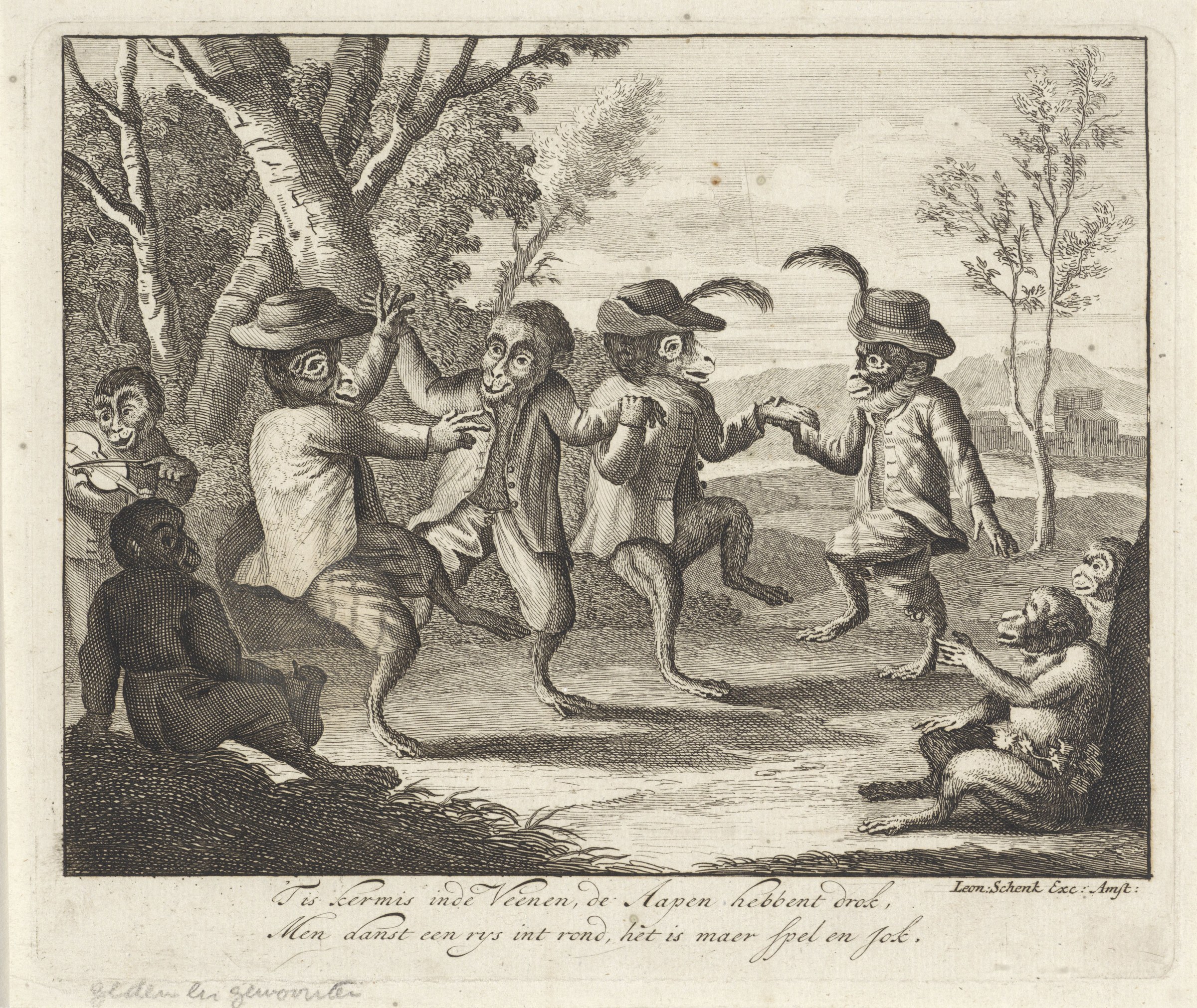
Dansende apen Apenspel in de wereld (serietitel) 't Aapenspel in de Werelt (serietitel), RP-P-1907-4130
Unknown (Rijksmuseum collection)
- Medium:
- Oil Painting
- Era:
- 1700s (Enlightenment/Minuet Era)
- Source:
- Wikimedia Commons
- Rights:
- Public domain — free to use, share and adapt.
- Recorded as:
- CC0
For dance historians, this work is valuable not for what it records about actual dance, but for what it reveals about how 17th- and 18th-century print culture visualized human movement and social performance. The engraver chose to represent human gathering and celebration through raised arms, bent postures, and gestural animation—a visual language that tells us what the era considered recognizable signifiers of human social activity. The series also documents the taste for satirical animal imagery and the circulation of popular prints in this period.
What you are looking at
This is an engraved satirical scene of anthropomorphic apes dressed as humans, engaged in what appears to be a social gathering or dance in a wooded landscape. In the foreground, several apes wearing hats and formal garments gesture animatedly toward one another; some stand with raised arms and bent postures suggesting active movement or performance. At left, partially obscured beneath a large tree, additional apes observe the scene. The composition is crowded and theatrical, with figures distributed across the middle ground, their bodies angled and overlapping to suggest lively interaction. The background shows a distant landscape with trees and water, rendered in lighter tones that recede into pale sky. The print is carefully cross-hatched throughout, typical of 17th- or early-18th-century engraving technique, and carries a Dutch inscription below identifying this as part of a larger series on monkey antics ("'t Aapenspel in de Werelt").
The dancing
The apes are depicted with exaggerated human posture—upright stance, bent knees, raised arms, and tilted heads that suggest gestural communication or dance-like movement. Several figures have their arms raised or extended in ways that suggest pointing, beckoning, or celebratory gestures rather than any ballroom hold. The bodies are loosely grouped rather than arranged in couples or lines; there is no evidence of formalized partnering or the closed holds typical of European social dance. The weight distribution suggests active, possibly mock-serious movement—the kind of performative physicality that would appeal to the satirical intent of depicting apes aping human behaviour.
The dance depicted
This is not a depiction of actual dance but rather a satirical print showing apes performing human social behaviour, including what might be a gathering, celebration, or mock-formal assembly. The engraver has not attempted to represent any specific dance form; rather, the raised arms, gestures, and active postures are used as shorthand for theatrical human activity. The title refers to a series about "the monkey play in the world," indicating that the humour lies in observing how these creatures mimic civilization. Any movement present is incidental to the satirical agenda—the point is not to document how people actually danced, but to mock how apes might comically interpret human social rituals.
How it was made
This is an engraving, recognizable from the fine parallel hatching used to build tone and texture throughout, the linear quality of the outline, and the characteristic pale paper ground. The technique allowed for precise detail in the apes' facial expressions and garments, and the composition could be printed multiple times from the plate, making it accessible to a broad audience. The date (1720) and Dutch inscription suggest this was a print intended for popular circulation in the Netherlands, where satirical animal prints were a recognized genre of entertainment and social commentary. Engravings of this period required significant skill and capital investment, indicating that the series had commercial viability.
About this work
This engraving belongs to an early-18th-century Dutch print series satirizing human behaviour by depicting apes who dress and behave like people. The specific scene shows a gathering of these dressed apes in a landscape, engaged in animated gestures and what might loosely be called performative movement. While not a documentation of actual dance, the work uses bodily gesture and theatrical posture—including raised arms and active, gestural movement—as part of its satirical vocabulary. The print circulated widely and represents a sustained artistic tradition in which animal satire served as commentary on human social pretension.
How to look at it
Observe how the engraver has used raised arms, bent knees, and turned-out postures to suggest that the apes are attempting human social performance. The crowded, overlapping composition and the variety of gestures convey liveliness and chaos rather than order—a contrast to the formality and symmetry of actual ballroom dance. The landscape setting and the partial concealment of some figures under the tree create spatial depth and anecdotal interest, inviting the viewer to read the scene as a narrative moment (a gathering, perhaps a performance or assembly) rather than a frozen dance step. The satirical intent becomes clear when you recognize that the apes are trying—and failing—to enact human refinement.
The artist
The engraving is attributed to "Lem. Schenk Exc. Amst." (Lemuel Schenk, engraver and publisher in Amsterdam), indicating a professional print workshop. The series was commercial; multiple prints of this type allowed for affordable distribution. Schenk was one of many Dutch printmakers producing satirical, allegorical, and genre scenes for the local market. The quality of execution suggests an experienced hand, and the inclusion of the series title and publication mark indicates that this was part of a branded suite of works.
The period
The early 18th century saw a flourishing of satirical animal prints in the Dutch republic, a genre with roots in earlier Renaissance and baroque tradition. These prints often used animals to comment on human folly, social hierarchy, and pretension—a form of social critique that was acceptable because it was ostensibly about animals. During this period, European social dance was becoming increasingly codified and formalized (the minuet was dominant in elite circles), making the contrast between refined human behaviour and crude animal mimicry a ready source of humour. The print reflects an age of growing middle-class literacy and print consumption, when such works were affordable entertainment.
Where it lives
The work is held in the Rijksmuseum (Amsterdam), accession RP-P-1907-4130, and is identified in the Rijksmuseum collection as part of the series "'t Aapenspel in de Werelt" ("The Monkey Play in the World"). It exists as an engraved print, one of multiple impressions likely made from the copper plate. The designation "Lugt 2228" refers to the Frits Lugt collection mark, indicating it was part of that noted collector's holdings.
Questions about this work
Is this actually depicting a dance?
Not in the technical sense. This is a satirical print showing apes mimicking human social behaviour, including what might be a formal gathering or celebration. The raised arms and active postures are used to convey human-like activity and theatricality, but there is no evidence of formalized dance steps, partnering, or the hold typical of European social dance. The engraver's interest is in mockery, not documentation.
What is the series this belongs to?
This is part of "'t Aapenspel in de Werelt" ("The Monkey Play in the World"), an early-18th-century Dutch print series by Lemuel Schenk showing apes acting out various human scenes and social situations. The series was commercially produced and circulated in the Netherlands, appealing to the taste for satirical animal imagery and social commentary.
Why were prints like this made?
Satirical animal prints served as a form of social critique and entertainment. By depicting animals in human dress and situations, artists could comment on human folly, pretension, and social hierarchy in a way that was acceptable because it was ostensibly humorous and about animals rather than people directly. They were affordable and widely circulated, making them accessible to a broad audience.
What can this tell us about how people danced in 1720?
This work does not document actual dance steps or technique. However, the way the engraver represents human social gathering—through raised arms, animated gestures, and active postures—reflects what the era considered recognizable signifiers of human celebration and performance. It suggests that raised arms and gestural movement were understood as markers of social activity and liveliness.
More dance artwork