41 works in this view — arrow keys or swipe to move between them.
Dance in Art · 1848
HallingdansDardel
Fritz von Dardel
- Medium:
- Oil Painting
- Era:
- Mid 1800s (Polka Era)
- Source:
- Wikimedia Commons
- Rights:
- Public domain — free to use, share and adapt.
- Recorded as:
- Public Domain
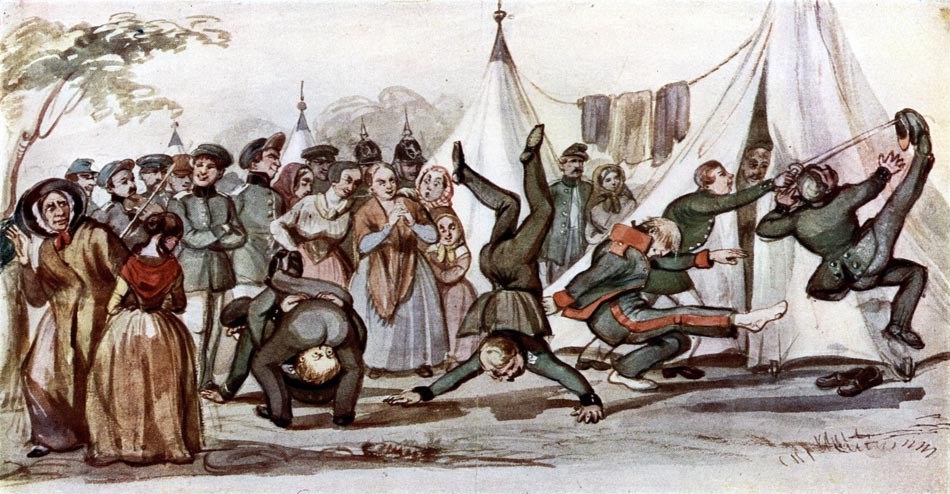
This is one of the earliest visual records of the halling in performance, and one of the few to document it outside of Norway, at a politically charged moment. The image demonstrates that the acrobatic vocabulary of the halling—the extreme kicks, backbends, and inversions—was not a modern invention but a core feature of the dance at least to 1848, making it essential evidence for the history of this form.
What you are looking at
A crowded outdoor scene, likely a military or refugee camp, depicts Norwegian soldiers and civilians gathered around to watch acrobatic and gymnastic demonstrations. The composition is anchored by a large canvas tent in the background, with church spires visible beyond it, establishing this as a temporary settlement. In the foreground, multiple figures perform dramatic feats: one man executes a high kick or flip with legs extended vertically, another arches backward in an extreme backbend, and a third performs what appears to be a handstand or inverted position. The performers wear dark military uniforms or civilian clothes, while spectators—men, women, and children in period dress including bonnets and long coats—form an animated semicircle around them. The artist has captured the moment with energetic brushwork and warm earth tones, emphasizing the contrast between the disciplined, athletic bodies of the performers and the amazed postures of the crowd.
The dancing
The dancers display remarkable bodily control in positions that defy easy description: one figure extends both legs vertically upward while his torso remains inverted, suggesting either a leg-lock hold or an acrobatic inversion; another arches so extremely that his spine forms nearly a complete circle; a third appears to be in a jumping or kicking position with one leg driven high. These are not figures in a social dance hold but individuals moving through space with explosive, vertical energy. The spectators lean forward, point, and gesture with the exaggerated enthusiasm of people witnessing something genuinely surprising—the physical vocabulary is that of acrobatics and gymnastics, not courtship or social bonding.
The dance depicted
This work documents the halling, a Norwegian folk dance of extraordinary athletic demand, performed here at what the catalogue identifies as the Norwegian camp in Malmö in 1848. The halling is a male competitive dance featuring high kicks, jumps, and acrobatic feats, performed individually or in small groups, typically without musical accompaniment beyond a rhythmic cry or clap. The image captures the essence of the form: the dancers perform not in formation with partners but as solo athletes, each pushing the limits of what the body can achieve in a vertical plane. The spectators' amazement confirms that this is being presented as a display of skill and daring rather than a participatory social event. The 1848 date and military setting suggest this may document a gathering of Swedish and Norwegian forces or a nationalist demonstration during a period of Scandinavian political tension.
How it was made
The work is catalogued as an oil painting, though the linework, color palette, and surface texture suggest it may be a watercolor or mixed medium; the precise technique should be verified. The loose, gestural brushwork and warm, limited palette of browns, greens, and flesh tones create a sketch-like immediacy rather than a finished academic composition. This approach allows the artist to emphasize movement and spontaneous action over architectural precision or decorative detail. The informality of the medium and execution suggest this may have been made as a record or study rather than a formal exhibition piece.
About this work
Fritz von Dardel's depiction of halling at the Norwegian camp in Malmö preserves a rare visual record of this demanding folk dance at a specific historical moment. The halling is among the most acrobatic of European traditional dances, and this image captures both the extreme athleticism of the form and the cultural context in which it was performed—a gathering of Scandinavian peoples during a period of emerging national consciousness. The work sits at the intersection of ethnographic documentation, nationalist celebration, and artistic fascination with the human body in motion. For dancers and historians, it is evidence that the high-flying, gravity-defying character of the halling as performed today has deep historical roots, and that the dance was consciously deployed as a marker of Norwegian identity in the mid-19th century.
How to look at it
Attend first to the moment of extreme exertion each figure has been frozen in: the artist has not chosen a moment of rest but the apex of effort—the highest point of the kick, the deepest arch of the backbend. This choice emphasizes the dance as a test of physical prowess. Notice also the composition: rather than a symmetrical or staged arrangement, the figures are scattered and overlapping, creating an impression of spontaneous, simultaneous action. The crowd's gestures—pointing, leaning, heads thrown back in laughter or amazement—tell you that this is being experienced as spectacle, not participation. The artist understood that the halling is not a dance for partners or for the collective body, but a stage on which individual male bodies compete and amaze.
The artist
Fritz von Dardel (1817–1901) was a Swedish painter and illustrator known for historical scenes, landscapes, and genre works depicting Scandinavian life and military subjects. His work often captured moments of collective action and emotion, and he was drawn to themes of national identity and cultural tradition. This painting sits within a broader 19th-century European practice of documenting folk customs, regional types, and national character through art.
The period
The 1848 date places this work in a moment of nationalist ferment across Europe and Scandinavia. The Dano-German War (First Schleswig War) was ongoing, and Norway and Sweden were navigating their relationship both to Denmark and to each other; the presence of a Norwegian military camp in Sweden suggests participation in or observation of these conflicts. Simultaneously, Romantic-era artists and intellectuals across Europe were collecting and celebrating folk traditions as expressions of national spirit and authenticity. The halling, as a form of bodily expression unique to Norway, would have held strong symbolic value in this context. The painting reflects both the artistic interest in capturing vernacular life and the political stakes attached to it.
Where it lives
The work is listed in the catalogue as oil painting, held in an unrecorded collection, and sourced from Wikimedia Commons. Its current location and ownership are unknown.
Dance in this work
Questions about this work
What exactly is the halling?
The halling is a traditional Norwegian solo or small-group male dance featuring spectacular high kicks, jumps, and acrobatic feats. It is typically performed competitively, with dancers attempting increasingly difficult jumps and inversions. The dance has roots in rural Norwegian culture and became a symbol of national identity in the 19th century. It requires significant strength, flexibility, and spatial awareness and continues to be performed and competed in Norway and among diaspora communities today.
Why were Norwegians dancing in Malmö in 1848?
The presence of Norwegian military personnel in Sweden in 1848 likely reflects the complex political situation in Scandinavia during the Dano-German War. Norway and Sweden were in union at this time, and the war created diplomatic and military involvement across the region. The gathering may have been a military or diplomatic assembly, or a demonstration of solidarity among Scandinavian peoples. The halling performance suggests that Norwegian cultural identity and tradition were being actively asserted and celebrated in this context.
Is this a realistic depiction of the halling?
Yes, with important caveats. The positions shown—extreme kicks, backbends, and inversions—are genuine features of the halling as performed today and as documented in later photographs and video. However, the artist has compressed multiple movements or multiple dancers into a single composition for dramatic effect. The actual halling is performed sequentially, with one dancer at a time taking the floor, rather than all at once as shown here. The painting thus captures the spirit and technical vocabulary of the dance while taking compositional liberties with its real-world presentation.
More dance artwork