49 works in this view — arrow keys or swipe to move between them.
Dance in Art · 1891
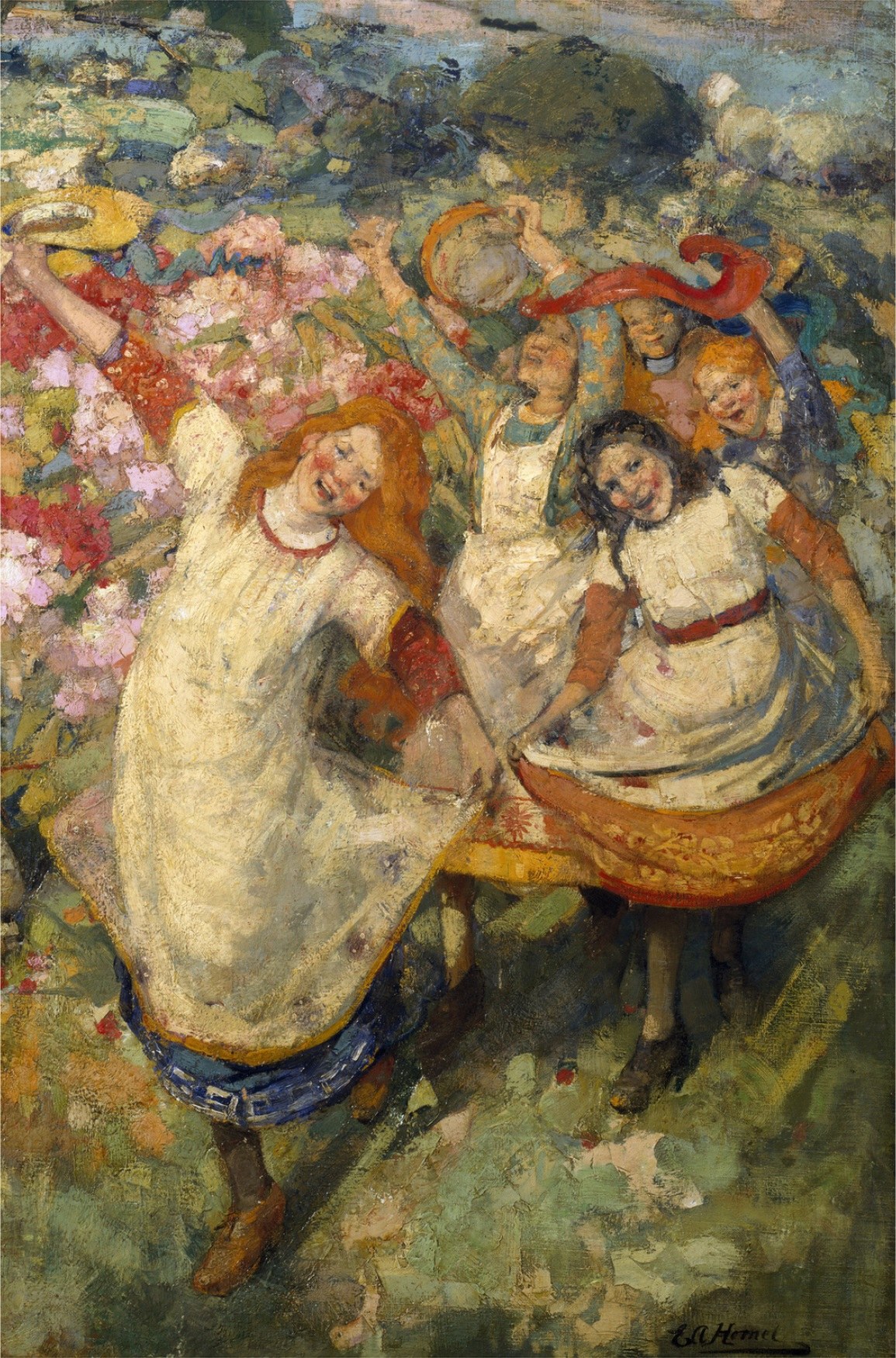
Edward Atkinson Hornel - The Dance of Spring (c.1891)
Edward Atkinson Hornel
- Medium:
- Oil Painting
- Era:
- Late 1800s (Victorian Ballroom)
- Source:
- Wikimedia Commons
- Rights:
- Public domain — free to use, share and adapt.
- Recorded as:
- Public Domain
The painting is a key document of how dance functioned in late Victorian visual culture not as a technical accomplishment but as a symbol of liberation, joy, and the natural world. It demonstrates the persistence of allegorical and poetic modes of representing the body in motion even as ballroom dance was becoming increasingly codified and professionalized; understanding this work helps contextualize the gap between the dance of high society and the dance of imagination.
What you are looking at
Five young women in pale cream and white dresses with colorful trim gather in a sunlit garden abundant with pink and red flowers. They are arranged in a loose, informal group, their bodies angled toward one another in attitudes of pleasure and abandon. The woman on the left reclines or leans back dramatically, her reddish-brown hair visible beneath her cap; the others cluster toward the right, some with arms raised, heads tilted back in what appears to be laughter or exuberance. The setting is pastoral and dreamlike—the figures occupy a green sward dotted with flowering plants rendered in soft greens and earth tones. The composition is suffused with warm light that catches the pale fabric of the dresses and the varied hues of the vegetation. The overall effect is one of youthful joy and freedom, a celebration of spring and sensuality rendered in the soft, jewel-like palette characteristic of late 19th-century decorative painting.
The dancing
The five figures are arranged informally rather than in any formal dance configuration. Several have their arms raised or extended—one woman's arm sweeps upward, another holds her arm across her body. The bodies are predominantly upright or slightly reclined, with weight distributed casually rather than in the centered, controlled stance of trained dancers. The heads are thrown back or tilted, suggesting emotional expression—joy, abandon, or reverie—rather than the focused concentration of performers executing steps. There is no evidence of closed or open ballroom hold, no parallel lines of movement, and no suggestion of rhythmic coordination. The women appear to be moving or gesturing individually, united more by proximity and mood than by the structured partnership that ballroom or folk dance would demand.
The dance depicted
This is not a depiction of a recognizable social dance form. The title *The Dance of Spring* suggests an allegorical or poetic subject rather than a documentary one: these appear to be idealized figures—possibly nymphs, maidens, or personifications of the season—enacting a generalized expression of spring's vital energy rather than performing any specific dance. The casual, emotional postures and the absence of any dance hold or formation make it unlikely the artist was depicting ballroom, folk, or theatrical dance technique. Instead, the work engages with a Romantic and Symbolist tradition of painting figures in attitudes of natural grace and abandon, where 'dance' functions as a metaphor for freedom, youth, and the renewal of nature rather than as a technical practice.
How it was made
This is an oil painting, executed in a technique that emphasizes luminous color and soft modeling of form. The artist has built up richly textured passages—particularly in the rendering of flowers and drapery—and used a palette of earth pigments, pale tints, and warm greens that suggest the influence of late 19th-century Symbolism and the aesthetic interest in decoration and pattern. The freely handled brushwork and the layering of translucent glazes create an effect of immediacy and intimacy suited to the small, precious scale the work likely occupies. The technique supports the painting's function as a jewel-like cabinet work, probably intended for a collector's study or salon rather than institutional display.
About this work
Edward Atkinson Hornel's *The Dance of Spring* (c.1891) is a lyrical composition depicting five young women in a flower-filled garden, rendered in the soft, jewel-toned palette and decorative manner characteristic of late Victorian Symbolism. Rather than representing a social or theatrical dance, the work employs the figure of dance as a metaphor for spring's awakening, youth, and the liberation of natural feeling. The painting belongs to a tradition of allegorical and poetic figure painting that flourished in Britain and Europe in the 1880s and 1890s, when artists increasingly turned away from narrative clarity toward mood, decoration, and the suggestion of intangible emotional states. For viewers encountering it in the context of dance imagery, the work offers a crucial reminder that 'dance' in art history encompasses not only technique and social practice but also the representation of movement, grace, and bodily freedom as expressions of ideas and feeling.
How to look at it
Attend first to the composition's looseness and asymmetry, which contrasts sharply with the ordered formations of ballroom dance or the geometric precision of folk performance. Notice how the artist captures a moment not of synchronized movement but of individual gesture and emotional expression—the raised arms, the tilted heads, the recumbent figure. The rendering of fabric and light is crucial: watch how the pale dresses catch and reflect the warm sunlight, and how the flowers anchor the figures in a natural rather than social setting. The soft, almost dreamlike quality of the painting—achieved through color harmony and loose brushwork—signals that this is not a record of an actual social event but a poetic meditation on the idea of spring, youth, and movement.
The artist
Edward Atkinson Hornel (1864–1933) was a Scottish painter associated with the Glasgow Boys, a loose collective of artists known for their interest in color, light, and Scottish subject matter. Hornel spent significant time in Japan in the late 1880s and early 1890s, and his work from this period shows the influence of Japanese woodblock prints in its bold color, flattened perspective, and decorative approach to composition. He specialized in paintings of children and young women in landscapes or interiors, often with a romantic or allegorical inflection. His work was highly popular with collectors during his lifetime and has been understood as part of the broader late Victorian turn toward Symbolism, aestheticism, and the dissolution of strict academic boundaries between fine art and decoration.
The period
In the 1890s, social dance in Britain was undergoing rapid professionalization and codification. Ballroom dancing was becoming standardized through instruction manuals and dance academies; the waltz, quadrille, and emerging ragtime-based dances were increasingly regulated by rules of posture and partnership. Simultaneously, the visual arts were moving toward Symbolism and aesthetic decoration, with artists like Hornel exploring mood, color, and symbolic content rather than narrative clarity. Theatrical dance remained the domain of music halls and pantomime, with ballet still struggling for legitimacy outside Continental Europe. Against this context, Hornel's painting represents a deliberately anti-technical vision of dance—one aligned with Romantic idealism and the cult of nature rather than with the emerging modern dance professions.
Where it lives
The work is known from Wikimedia Commons, indicating it has entered the public photographic record, though the specific institutional holding is not recorded in the available catalogue data.
Questions about this work
Is this painting showing a real social dance or a made-up one?
Neither. The title *The Dance of Spring* is allegorical: these are idealized figures—likely nymphs or personifications of the season—enacting a poetic rather than practical vision of dance. The absence of any recognizable dance hold, formation, or technique, combined with the mythological garden setting and the focus on emotional expression, indicates that the artist was not depicting an actual social or theatrical dance but using the figure of dance as a metaphor for natural vitality and the joy of spring.
What dance style is this?
This is not a recognizable dance style in the technical sense. While the painting is titled with the word 'dance,' the figures are not executing steps or maintaining the postures that would indicate ballet, ballroom, folk, or any other codified form. The painting belongs instead to a tradition of allegorical and poetic art in which the human figure in motion serves as a symbol rather than as a performer of specific techniques.
Why is this in a dance gallery?
The painting is included because it is a significant document of how dance functioned in visual culture beyond the ballroom and theater—as a symbol of freedom, youth, and the natural world. It also illustrates the gap between technical social dance and the artistic imagination; understanding works like this helps explain why 'dance in art' is broader than 'depictions of dancers executing steps.'
What is the artist trying to say?
The painting celebrates the arrival of spring as a renewal of life, joy, and sensual freedom. The informal, uncontrolled postures and the abundance of flowers suggest nature as a source of vitality that stands in contrast to the constraint and regulation of social convention. The 'dance' is both literal—a joyful physical expression—and metaphorical, representing a liberation into feeling and bodily freedom.
More dance artwork