49 works in this view — arrow keys or swipe to move between them.
Dance in Art · 1891
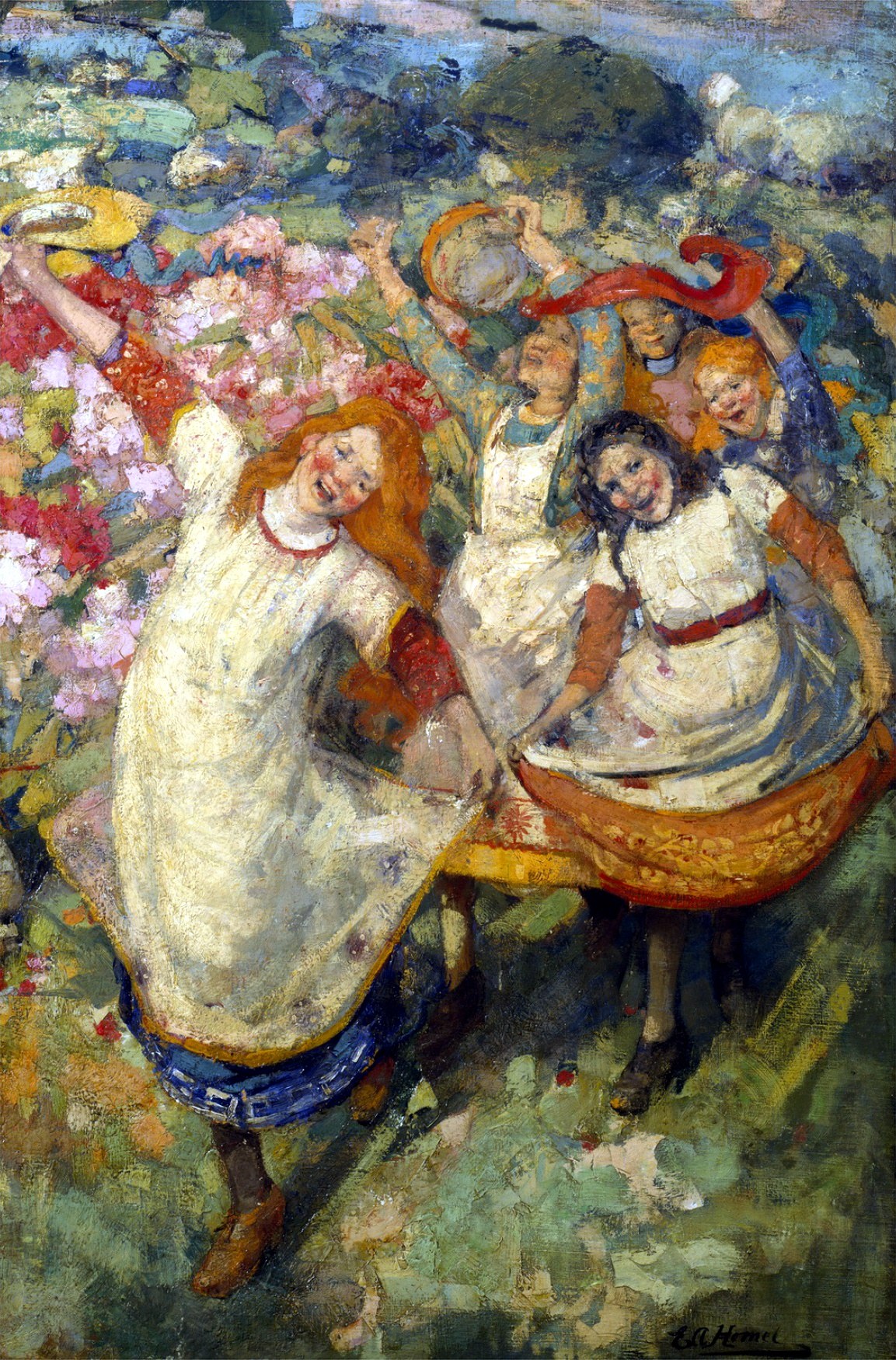
Edward Atkinson Hornel - The Dance of Spring (c.1891, improved)
Edward Atkinson Hornel
- Medium:
- Oil Painting
- Era:
- Late 1800s (Victorian Ballroom)
- Source:
- Wikimedia Commons
- Rights:
- Public domain — free to use, share and adapt.
- Recorded as:
- Public Domain
This work documents how late-Victorian artists visualized dance not as technique but as ecstatic collective release. The physical intimacy and abandon of the figures—unusual in ballroom contexts—shows how turn-of-the-century painters drew on folklore and fantasy to reimagine what women's dancing could be.
What you are looking at
A garden scene alive with young women and children in white or pale summer dresses, caught in a moment of spring celebration and movement. The composition is divided between a lush backdrop of blooming flowers—pinks, reds, and yellows dominate the upper left—and a grassy foreground where figures dance and play. In the right foreground, a group of three or four women cluster in close embrace or linked formation, their bodies inclined toward one another, faces tilted back in apparent joy or abandon. A woman in the far left wears a red dress and gestures expansively. The painting's light is soft and diffuse, characteristic of late afternoon or overcast daylight filtered through leaves. The whole scene suggests an outdoor festival or garden party, rendered in Hornel's decorative style with rich impasto and jewel-like color; the figures are somewhat stylised, almost flattened against the decorative profusion of botanical forms.
The dancing
The central group shows women in close physical contact—bodies leaning in, arms linked or around shoulders, heads back. The poses suggest circular or spiral movement rather than the rigid frames of ballroom dance. Weight appears to shift between figures; there is a sense of swaying or turning together rather than stepped progression. The woman on the left reaches outward with one arm extended. All the women wear simple, high-waisted white or cream dresses with loose sleeves, allowing freedom of movement. The composition favours vertical lift and a sense of weightless celebration rather than grounded, controlled partnering.
The dance depicted
This appears to depict a folk or social spring celebration rather than a formalized ballroom dance, though the era label identifies it as Victorian Ballroom. The figures' embrace, outdoor garden setting, and the floral profusion suggest a May Day, midsummer, or spring festival tradition—possibly a variant of English country dance, maypole celebration, or a romanticized folk circle dance. The grouping and physical intimacy suggest something closer to historic-gilded-age folk traditions than to contemporary ballroom technique. The painting is a record of Hornel's imagination of spring festivity and youth rather than of a specific documented dance.
How it was made
Oil on canvas, executed with thick, gestural brushwork and rich colour saturation. Hornel built the composition in layers of paint, visible in the impasto; the flowers and foliage are rendered almost as abstract colour masses rather than botanical detail. This technique—close to Impressionist method in its broken brushwork but more decorative in its overall effect—allows the artist to suggest movement and light without precise definition. The painting's scale and finish indicate it was a major studio work, not a sketch, intended for exhibition and sale to collectors of contemporary art.
About this work
Hornel's *The Dance of Spring* is a fin-de-siècle celebration of youth, nature, and movement, painted around 1891 during the artist's most decorative period. The work blends landscape, figure painting, and dance into a single romantic vision. It belongs in a gallery of dance in art because it records not a specific historical dance form but the symbolic association between spring, feminine youth, and movement in the aesthetic imagination of the 1890s. The painting was made in a moment when Symbolist and aesthetic movements were redefining what it meant to paint the human body in motion.
How to look at it
Attend first to the physical contact: notice how the figures in the centre embrace and tilt together, not facing forward but clustered inward. The artist has chosen a moment of collective turning or swaying rather than a discrete step. Look also at the relationship between figure and ground: Hornel has made the women and flowers nearly equal in visual weight, as if the human body is itself a form of natural growth. The flattened perspective and absence of spatial recession push all forms forward onto the picture plane, creating a decorative frieze effect that emphasizes pattern and colour over naturalism.
The artist
Edward Atkinson Hornel (1864–1933) was a Scottish painter associated with the Glasgow School and the Symbolist movement. He was known for decorative, jewel-toned compositions featuring figures in nature, often young women and children. Hornel travelled to Japan and the East, and this experience influenced his flattened perspective and decorative patterning. His work sits between fine art and design, and was collected by patrons of modern aestheticism. He was a contemporary of the Art Nouveau movement, though his style remained more rooted in landscape and figure tradition.
The period
In the 1890s, ballroom dance in Britain was at a peak of refinement and rigidity under the influence of Latin and Viennese waltz tradition. Simultaneously, a counter-current of aesthetic and folk revivalism celebrated 'natural' or 'primitive' movement as an antidote to industrial modernity. This painting sits in that revivalist space: it rejects the precise, measured partnering of the ballroom in favour of a fantasy of spring fertility and circle dancing. The composition also reflects contemporary fin-de-siècle interest in women's bodies in motion, though filtered through a decorative, somewhat infantilizing gaze.
Where it lives
The work is recorded as an oil painting c. 1891 and sourced from Wikimedia Commons. No current holding institution is recorded in the catalogue data.
Dance in this work
Questions about this work
Is this Victorian Ballroom dance?
The catalogue labels it as such, but the image shows something different from the waltz or quadrille. The outdoor setting, floral abundance, close embrace, and apparent circular or swaying motion suggest a folk or spring festival tradition, or a romantic reimagining of one. Hornel has painted fantasy and celebration rather than a formalized ballroom technique.
What is the dance these women are doing?
The painting does not represent a specific named dance. Instead, it embodies a turn-of-the-century aesthetic fantasy: the idea of spring, youth, and women's bodies as naturally inclined to rhythmic, ecstatic movement. It may reference English country dancing, May Day customs, or circle dances, but it is an artist's invention rather than a documentary record.
Why are the women dressed so simply?
The white, high-waisted dresses with loose sleeves suggest both late-Victorian fashion and a deliberate simplification toward an imagined 'natural' or 'innocent' state. This was a common strategy in late-nineteenth-century art and design: plain dress signalled authenticity and freedom from artifice, even when the composition itself was highly artificial.
More dance artwork