32 works in this view — arrow keys or swipe to move between them.
Dance in Art · 1928
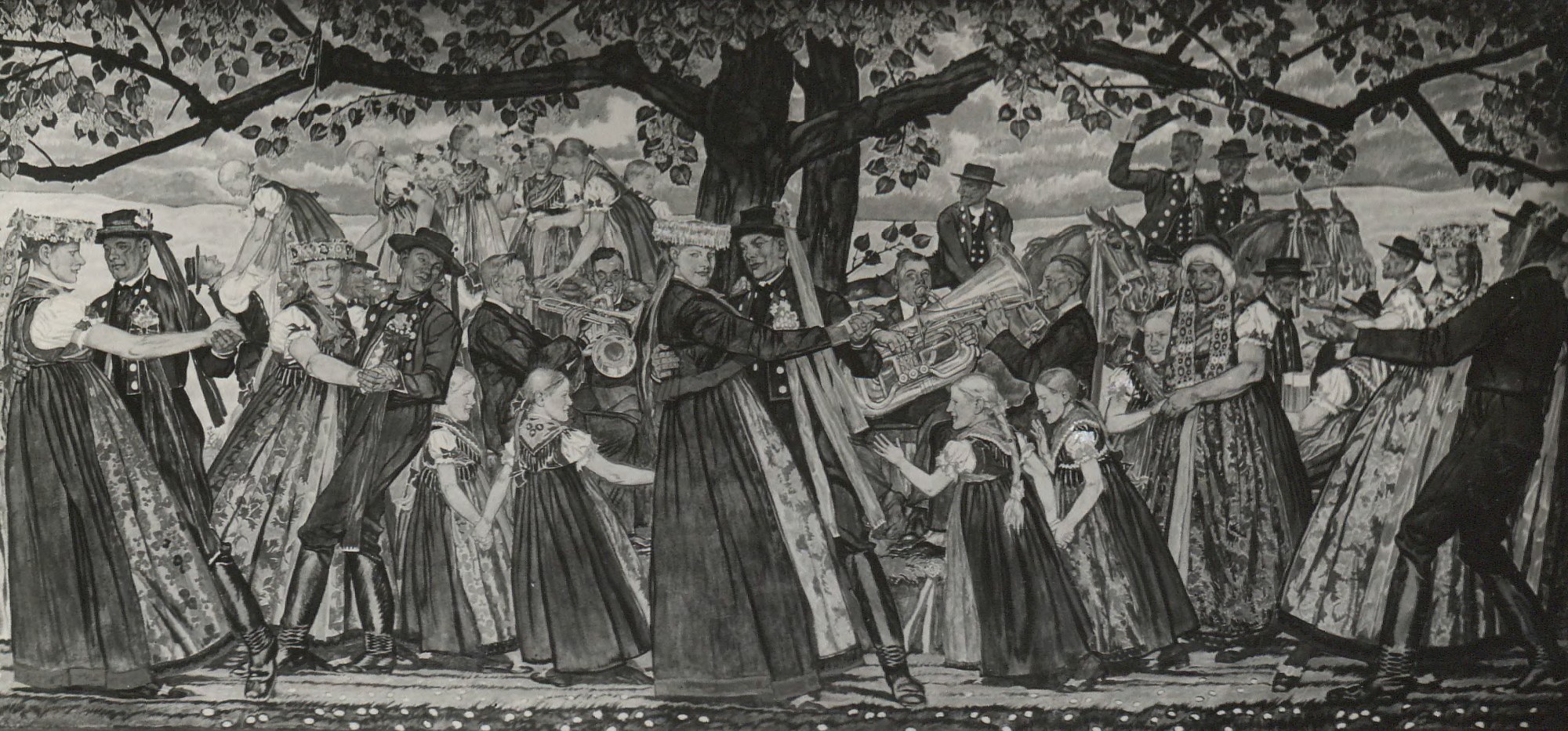
Haus Oberschlesien Der Tanz Münzer
Adolph Münzer
- Medium:
- Oil Painting
- Era:
- 1920-1950 (Swing Era)
- Source:
- Wikimedia Commons
- Rights:
- Public domain — free to use, share and adapt.
- Recorded as:
- Public Domain
This work records a specific regional wedding dance tradition at a moment when such customs were beginning to disappear or be codified. For dancers and historians, it provides visual evidence of costume, scale, social arrangement, and the integration of music and dance in early 20th-century Silesian folk practice. The work also demonstrates how serious visual artists of the period treated folk dance not as quaint or primitive, but as worthy of the same formal composition and technical skill applied to historical or mythological subjects.
What you are looking at
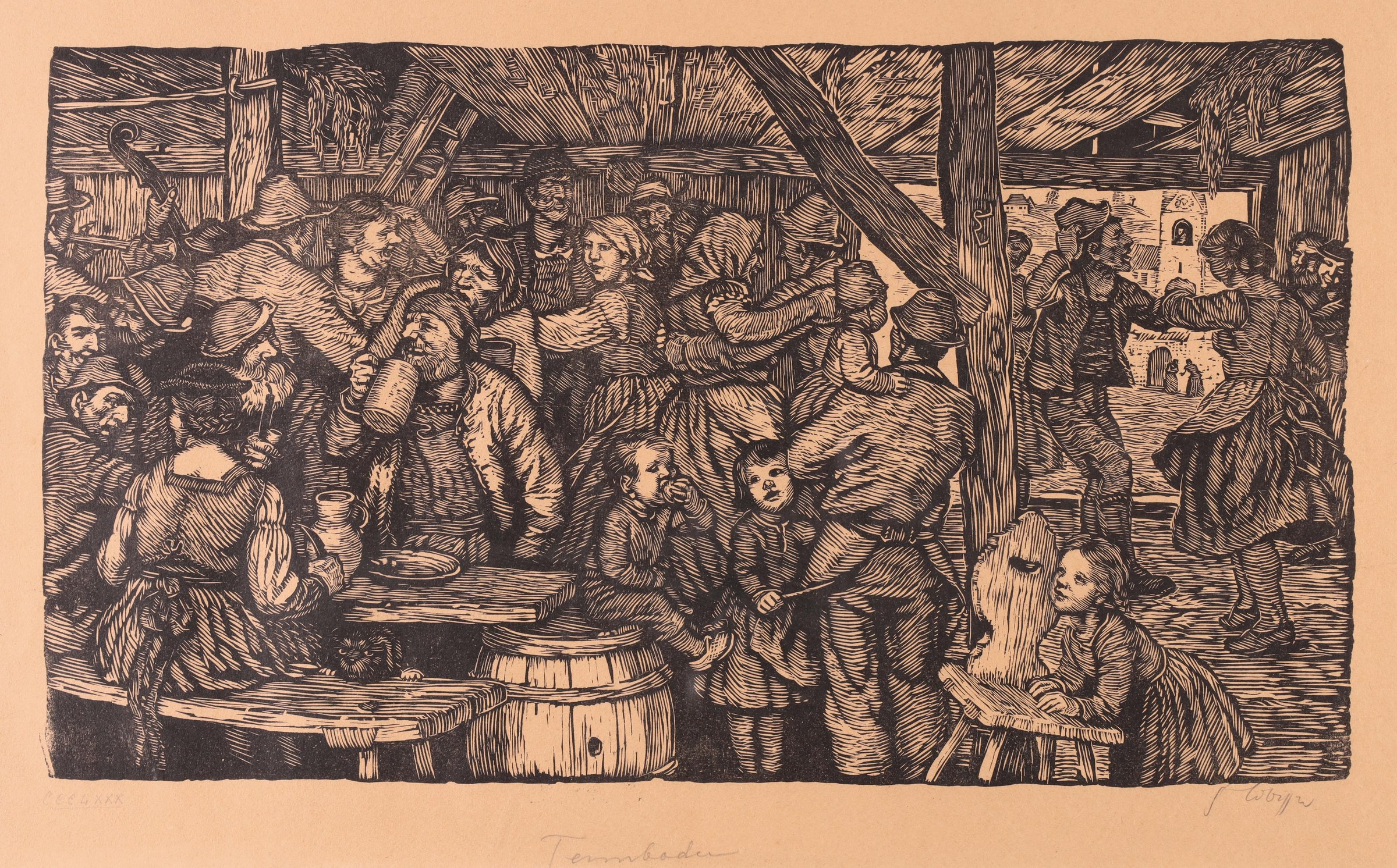
A large formal gathering beneath an ancient gnarled tree celebrates a wedding feast or ceremonial dance. The composition spreads across the width of the frame in a frieze-like arrangement, with figures arranged in loose groups that suggest movement and social interaction rather than formal line dancing. The setting appears pastoral and timeless—a broad meadow with rolling sky and distant landscape. The figures wear richly patterned folk dress: long full skirts with embroidered panels in contrasting colours, dark vests or jackets, ornate headdresses, and striped stockings. Many carry or hold musical instruments—brass horns, bagpipes, stringed instruments. The age and girth of the central tree suggest this is a place of gathering tradition. Light falls evenly across the scene, rendered in a detailed black-and-white medium (engraving or lithograph) that emphasises the intricate patterning of costume and the texture of foliage overhead. The mood is festive but structured: this is not chaos but a socially organised celebration, likely a Silesian or Central European wedding custom.
The dancing
The dancers and celebrants hold themselves with an upright, formal posture typical of early 20th-century folk documentation. Several pairs appear to be holding hands or linked at the arm in the manner of peasant couple dances—arms extended or held at the side with partners facing or moving alongside each other. The women's bodies are largely still, with movement suggested through the volume and pattern of their skirts; the men stand more actively, some with one arm gesturing or raised. Small children and younger celebrants weave between the adults. The overall frame is one of restrained, dignified movement rather than vigorous turning or elevation—bodies moving together in space rather than executing rapid footwork.
The dance depicted
This depicts a Schönwalder wedding celebration (as noted in the existing catalogue description), a traditional wedding dance custom of Upper Silesia. The gathering under the great tree, the coupled arrangement of figures, the mix of musicians and dancers, and the ornate regional costume all point to a folk wedding ritual that likely involved processional movement, couple dances, and communal music-making. The presence of bagpipes and brass instruments suggests this is not a courtly or theatrical dance but a living regional tradition, documented at a moment when such customs were increasingly being recorded by artists and ethnographers. The body language and spacing suggest a dance of social greeting and bonding rather than virtuosic display.
How it was made
This is a black-and-white work rendered with fine linear detail characteristic of an engraving or lithograph, techniques that allow for precise representation of pattern and texture—crucial to showing the embroidered detail of the costumes and the intricate play of light through foliage. The medium's monochromatic nature emphasises line and form over colour, which paradoxically allows the ornate patterning of the regional dress to read clearly. The technique suggests a work intended for circulation and reproduction—suited to art prints, books on folklore, or institutional records of cultural practice. The fine detail and wide composition suggest this is a large work, either a mural study or a substantial print.
About this work
Adolph Münzer's composition documents a Schönwalder wedding celebration, a regional folk custom of Upper Silesia (modern-day Poland), rendered as a formal frieze beneath an ancient tree. The work sits at the intersection of ethnographic documentation and artistic celebration—it is both a record of a living dance tradition and a statement about the beauty and dignity of peasant culture. The composition, costume detail, and carefully arranged figures suggest this was created during a period when European artists and intellectuals were actively collecting and celebrating folk traditions, often in response to industrialisation and cultural change. This piece belongs in a dance gallery because it documents not movement abstracted for aesthetic effect, but a real social practice: how a community danced together to mark a life transition.
How to look at it
Observe how Münzer arranges the figures not in a rigid line but in a loose, breathing composition that suggests the flow of movement and conversation—some pairs clearly coupled and moving together, others standing, children running between adults. Notice the extraordinary detail lavished on the costume: each figure's embroidered panels, striped stockings, and regional headdress are individually rendered. This is not idealised or simplified costume but specific, documented dress. The central tree provides the formal anchor; the figures arrange themselves in relation to it as a gathering place rather than as a backdrop. The artist has chosen the moment of assembly and greeting rather than the climax of vigorous dancing—a choice that emphasises social bonding and ritual over spectacle.
The artist
Adolph Münzer (1870–1953) was an Austrian painter and muralist known for large-scale decorative works celebrating regional folk culture and historical subjects. He worked extensively in Austria and Central Europe during the late 19th and early 20th centuries, a period when folk revival and ethnic identity were central to cultural nationalism. His practice combined academic training with an interest in documenting and celebrating peasant life and regional customs. The inscription 'Haus Oberschlesien Der Tanz Münzer' (Münzer's Dance in the House of Upper Silesia) suggests this may have been created as a mural decoration for a cultural institution or gathering space dedicated to Silesian heritage.
The period
This work dates to 1928, a moment of intense interest in European folk culture. The 1920s saw the rise of ethnographic documentation, folk revival movements, and cultural nationalism across Europe, particularly in Central and Eastern Europe where national identities were newly defined or redefined after World War I. In the visual arts, there was a Romantic fascination with peasant life and traditional costume as repositories of authentic national character. Dance, as a visible marker of regional identity, became a subject for serious artistic attention. At the same time, this documentation was urgent: industrialisation and rural migration were rapidly eroding traditional practices. Münzer's work participates in this project of recording and celebrating folk culture before it vanished.
Where it lives
The work is listed as held in the collection Haus Oberschlesien (House of Upper Silesia), a cultural institution dedicated to Silesian heritage. The inscription suggests it was either commissioned for or acquired by this institution. The source is Wikimedia Commons, indicating the work is in public domain or openly licensed.
Dance in this work
Questions about this work
What is a Schönwalder wedding?
Schönwald is a region in Upper Silesia (Oberschlesien), in the area that is now southern Poland. A Schönwalder wedding would have included specific regional customs: traditional costume, ceremonial dances, and the participation of the whole community. These weddings were important social rituals that reinforced community bonds and transmitted cultural identity. By 1928, such traditions were under pressure from modernisation and were increasingly documented by artists and folklorists.
Is this a painting or a print?
The catalogue record lists it as an oil painting, but the image shows the fine linear detail and monochromatic rendering characteristic of an engraving or lithograph. It may be a painted work based on or in the style of a print, or the medium attribution may be uncertain. The technique visible in the image—the precise parallel lines, the lack of colour, the even tonal values—strongly suggests a print medium, but only examination of the original would confirm this.
Who was Adolph Münzer?
Münzer (1870–1953) was an Austrian painter and muralist who specialised in large decorative schemes celebrating historical and folk subjects. He was active during the late 19th and early 20th centuries, a period when European artists took serious interest in regional folk culture as expressions of national identity. His murals and paintings were commissioned for public and cultural institutions across Austria and Central Europe.
What do the musical instruments tell us?
The presence of bagpipes, brass horns, and what appear to be stringed instruments (possibly violins or violas) indicates that this was a live music event. These instruments are typical of Central European folk music and dance accompaniment. The integration of musicians directly into the dance scene—rather than separated from it—shows that music and dance were inseparable in this tradition. The size and type of the ensemble suggests this was a significant community celebration.
More dance artwork