49 works in this view — arrow keys or swipe to move between them.
Dance in Art · 1911
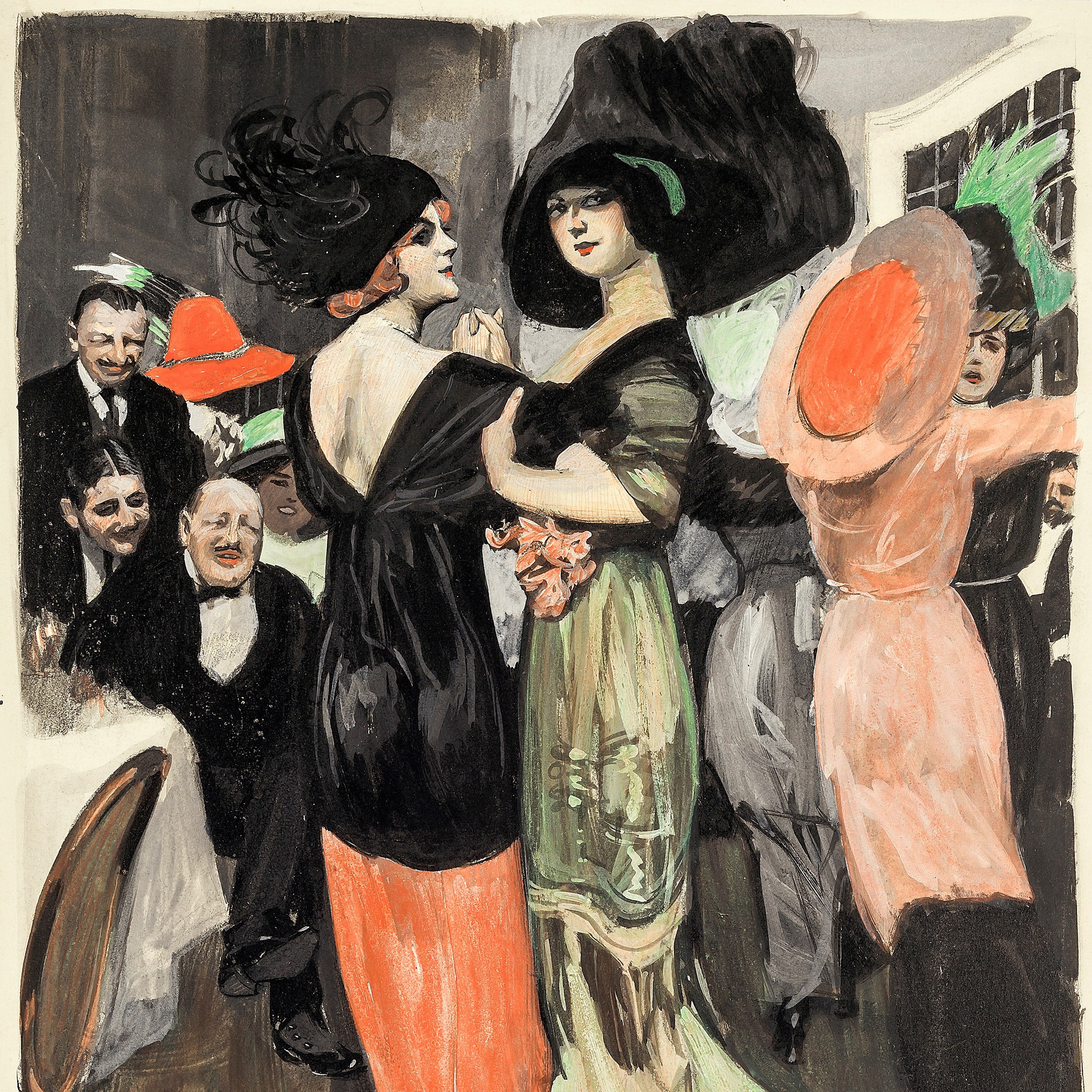
Heilemann Ernst - Berlin s'amuse
Ernst Heilemann
- Medium:
- Oil Painting
- Era:
- 1900-1920 (Ragtime/Early Jazz)
- Source:
- Wikimedia Commons
- Rights:
- Public domain — free to use, share and adapt.
- Recorded as:
- Public Domain
This painting documents the gendered social performance of early twentieth-century urban leisure: women as the object of fashionable display, men as observers, and the nightclub or cabaret as a space of theatrical self-presentation. For dance historians, it reveals how dance venues functioned as sites of social aspiration and gender performance, and how the visual culture of the period represented women's bodies in entertainment spaces—clothed, adorned, and arranged for view rather than in the act of movement.
What you are looking at
A scene of fashionable leisure and social performance in an interior space, rendered in oil paint with bold color accents and sketchy, expressive brushwork characteristic of early twentieth-century illustration. The composition centers on three women in glamorous dress: the leftmost wears a black ensemble with an orange skirt and an extravagant black feathered hat; the center figure stands in profile in a pale bodice with a green skirt; the rightmost, in profile, wears a peach-coral dress with a matching oversized hat. All three are elaborately coiffed with dark hair and stylized makeup. Around them, at least five men in dark suits and bowler hats observe or converse, positioned at middle distance and background right. Large windows behind them suggest an urban interior—possibly a nightclub, cabaret, or sophisticated restaurant. The palette is muted except for accents of orange, coral, and green in the clothing, which draws focus to the fashionable women as the subject. The brushwork is loose and the composition somewhat crowded, suggesting movement and social excitement rather than formal arrangement.
The dancing
The three central women are stationary and posed rather than caught in active dance: they stand upright or in relaxed contrapposto, their bodies oriented toward the viewer or profile-left, their arms at rest or lowered. There is no closed hold, no partnering, and no visible footwork or weight shift that would indicate ballroom technique. The men occupy a social rather than choreographic role, positioned as observers and companions rather than dance partners. The overall body language suggests fashionable display and social interaction rather than structured couple dancing.
The dance depicted
This work does not depict a recognizable dance form. The figures are dressed for and positioned within a social entertainment venue, but they are stationary and posed for social viewing rather than engaged in dance. The context is the fashionable café society, cabaret, or nightclub milieu of early twentieth-century Berlin—a space where dancing could occur—but the image captures a moment of social stillness, fashion display, and flirtation rather than the act of dancing itself.
How it was made
Oil painting on canvas (or possibly paper support). The technique is expressionist and illustrative: broad, gestural brushstrokes, simplified forms, and bold color contrasts rather than meticulous rendering. The drawing is confident and the composition is built for compositional effect and social satire rather than descriptive precision. This approach suggests the work was intended for publication or exhibition as a scene of social commentary, likely reaching a German art audience of the 1910s through exhibition or reproduction.
About this work
Ernst Heilemann's *Berlin s'amuse* (Berlin Amuses Itself) is a social scene painting from 1911 that captures the fashionable leisure culture of Wilhelmine Berlin's entertainment venues. The title signals the subject: not a dance lesson or formal ballroom, but the self-conscious pleasure-seeking and display that characterized the city's modern nightlife. The work belongs in a gallery about dance not because dance is shown in action, but because it documents the social spaces and codes of dress, gender, and spectatorship that framed dance as public entertainment in this period. It is a record of the culture that danced.
How to look at it
Attend to the stillness: the artist has chosen not a moment of movement but a moment of social display and anticipation. Notice how the women's bodies are arranged for view rather than positioned in a dance frame. Observe the exaggeration of dress, makeup, and coiffure—these are not naturalistic portraits but social types, satirized through fashion. The sketchy, expressive brushwork and bold color accents suggest the excitement and artifice of the scene itself, inviting the viewer to read the painting as a commentary on fashionable society and its rituals of display rather than as a direct representation of dancing.
The artist
Ernst Heilemann (1870–1932) was a German illustrator, painter, and commercial artist known for satirical scenes of urban society, fashion, and nightlife. He worked primarily in oil and was associated with the commercial and popular art of Berlin during the Wilhelmine and Weimar periods. His style—loose, gestural, attentive to fashion and social type—was well suited to both exhibition painting and magazine illustration, and his works often captured the social and moral anxieties of modern German urban life with a blend of sympathy and satire.
The period
In 1911, Berlin's entertainment culture was booming: the city's cabarets, dance halls, and fashionable restaurants had become sites of artistic experimentation, social transgression, and modern leisure. This was the era of the Lustspielhaus and the rise of modern dance venues where both classical ballroom dancing and newer, more expressive forms coexisted. Simultaneously, German Expressionism and modern illustration were developing new visual languages for depicting movement, fashion, and urban modernity. Heilemann's approach—satirical, fashion-conscious, interested in social type—reflects the visual culture of this moment.
Where it lives
The work is recorded as an oil painting in the Wikimedia Commons catalogue. The holding collection is not specified in the current record.
Questions about this work
Is this a dance scene?
It is a scene set in a social venue where dancing could occur, but the figures shown are not dancing. They are posed, fashionably dressed, and arranged for social display. The work documents the culture and spaces of public dance rather than depicting dance in action.
What does the title 'Berlin s'amuse' tell us?
The title—partly in French, the language of fashion and cosmopolitanism—signals that this is a painting of fashionable leisure and social pleasure-seeking. 'S'amuse' (amuses itself) is slightly satirical: it suggests both enjoyment and a kind of self-conscious performance. The painting is about how Berlin's modern leisure class entertained itself through display and social ritual.
Why are the women the visual focus?
The three women are centrally positioned, more brightly lit, and more elaborately costumed than the men around them. They are clearly the objects of social display and attention. This reflects the gendered structure of cabaret and nightclub culture, where women's bodies were a primary attraction and male spectators occupied a viewing position. The painting reflects this social reality.
What kind of venue is this?
The interior setting with windows, the fashionable dress, the presence of both women and men in a social (not domestic) space, and the title all suggest a cabaret, nightclub, or fashionable restaurant—venues central to Berlin's modern entertainment culture. These were the primary spaces where commercial dance, theatrical performance, and social leisure intersected.
More dance artwork