49 works in this view — arrow keys or swipe to move between them.
Dance in Art · 1873
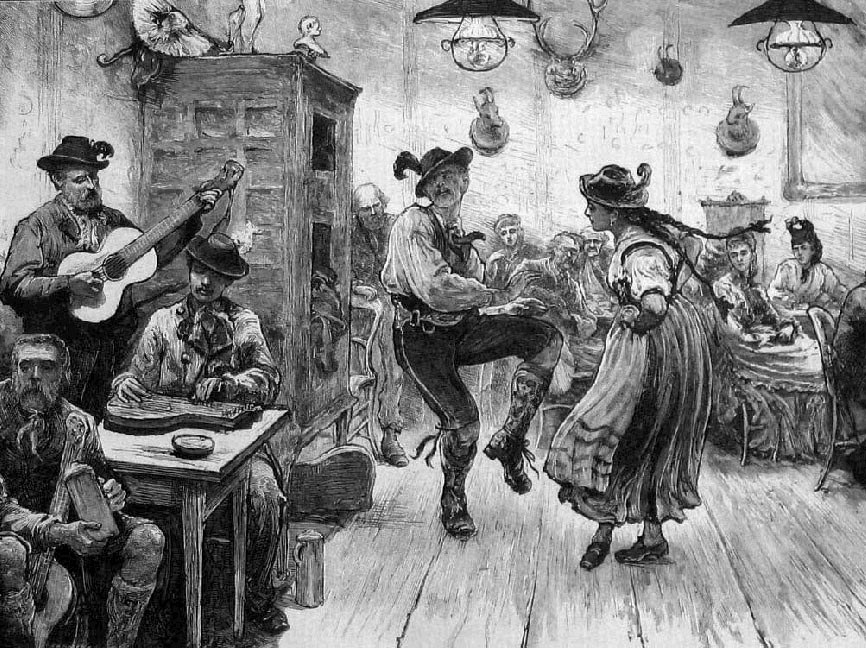
Hubert von Herkomer 1873 - The 'Schuhplattl' Dance (The Graphic)
Hubert von Herkomer
- Medium:
- Oil Painting
- Era:
- Late 1800s (Victorian Ballroom)
- Source:
- Wikimedia Commons
- Rights:
- Public domain — free to use, share and adapt.
- Recorded as:
- Public Domain
This work preserves visual evidence of Schuhplattler in its living 19th-century practice, before it was formalized and staged for tourism and concert performance. It also exemplifies how illustrated journalism and fine printmaking served as the primary means by which educated urban audiences encountered folk dance from distant regions—a visual tradition that shaped European perceptions of 'authentic' peasant culture and contributed to both the preservation and stylization of regional traditions.
What you are looking at
A crowded interior tavern or inn during an energetic folk celebration, rendered in detailed black-and-white engraving. The scene captures the peak of activity: at left, a bearded man in traditional Alpine dress plays a stringed instrument (likely a zither) while seated; in the center, a man in lederhosen and hat performs an exuberant jumping step, his body caught mid-leap with one leg extended high; other dancers in traditional costume—women in dirndls with white blouses, men in breeches and jackets—cluster around or watch from tables. Hanging oil lamps illuminate the wooden-floored interior. The composition draws the eye to the central leaping figure, whose athletic movement is the focal point, while the dense arrangement of spectators and other dancers creates a sense of participatory festivity. The engraving technique renders fine detail in costume and architectural elements, conveying both the specificity of Alpine folk tradition and the informality of a social occasion.
The dancing
The principal dancer executes a vigorous vertical leap with his legs in a wide split or kick, his upper body held upright and arms in motion—this is characteristic footwork of Schuhplattler, in which dancers slap their legs and feet in the air. Surrounding figures are less clearly in motion, some seated at tables, others standing to watch; the musician is stationary. The dance does not involve partner holds or closed positions but rather features the solo performer's individual explosive vertical movement while others provide accompaniment and witness.
The dance depicted
This is Schuhplattler (also Schuhplattl), a Bavarian and Tyrolean folk dance traditionally performed by men, in which the dancer executes vigorous jumps, leg kicks, and slaps to his own legs, feet, and the ground, often to yodeled song or folk instrumentation. The title of the work confirms this identification. The image captures the athletic, acrobatic nature of the dance and its social context—performed in an informal public space (an inn or tavern) with musicians and onlookers rather than in choreographed formation. This is vernacular Alpine folk dance as lived social practice, not staged performance.
How it was made
This is a wood engraving or fine-line engraving, a technique that allows precise cross-hatching and fine detail in rendering cloth texture, the wood floor, and facial features. The medium was well-suited to publication in periodicals and newspapers—the record indicates this appeared in *The Graphic*, a major Victorian illustrated weekly—and would have reached a broad urban British audience curious about continental European folk customs. The fineness of line and narrative density suggest the work was intended for newspaper or magazine reproduction rather than exhibition.
About this work
Hubert von Herkomer's 1873 engraving documents Schuhplattler, an athletic Bavarian folk dance, as performed in an informal inn setting. The work is one of a long tradition of 19th-century European and British artists recording folk customs and peasant life—a phenomenon driven by both Romantic interest in vernacular culture and the rise of illustrated periodicals. Herkomer, a painter and printmaker trained in Munich with ties to both German and British art worlds, was well-positioned to observe and interpret Alpine tradition for a British readership. The image is valuable not as a staged performance piece but as documentary evidence of how this dance was actually practiced in its native social context: vigorous, participatory, and embedded in tavern sociability rather than concert performance.
How to look at it
Attend to the central leaping figure's body position: the high vertical jump, the extended leg or legs, the position of the arms—this is the morphology of Schuhplattler, quite distinct from ballroom or line-dancing forms. Note also the setting and social framing: this is not a stage performance or formal gathering but a tavern scene lit by hanging lamps, with casual spectators and a seated musician, emphasizing the participatory and social nature of the dance. The engraver's decision to freeze the moment at the peak of the jump, with the dancer's body fully extended, conveys the explosive athleticism that defines the style.
The artist
Hubert von Herkomer (1849–1914) was a German-born painter and printmaker trained in Bavaria who later worked extensively in Britain, becoming an influential figure in late Victorian art. He was known for detailed genre scenes, historical subjects, and social realist works, and was a prolific printmaker and illustrator. His engagement with folk subjects reflected both his German origins and the broader Victorian appetite for illustrations of regional European life. He was also a founder of the Herkomer Art School and contributed significantly to illustration work for major periodicals including *The Graphic*.
The period
The 1870s saw a peak of European Romantic interest in folk culture and peasant traditions, spurred partly by nationalist movements and partly by industrial urbanization that made rural life seem increasingly remote and precious. Illustrated periodicals such as *The Graphic* (founded 1869) capitalized on technological advances in wood engraving and photographic reproduction to bring images of distant regions and customs into middle-class homes. At the same time, folk dances were beginning to be collected, codified, and staged for theatrical audiences—a process that would accelerate through the turn of the 20th century. Herkomer's image sits between documentary and romantic interpretation: faithful in costume and movement detail, but framed as a picturesque glimpse of a vanishing world.
Where it lives
The work is recorded as appearing in *The Graphic*, a major British weekly illustrated journal of the period. It was published as a periodical engraving and would have been widely distributed; the current holding collection is not recorded in the source data.
Dance in this work
Questions about this work
Is this a real dance or a Victorian invention?
Schuhplattler is a genuine Bavarian and Tyrolean folk dance with deep roots in Alpine culture, documented in various forms for centuries. However, the 19th century saw increasing interest in collecting, codifying, and sometimes romanticizing folk traditions. This image documents an actual performance context (a tavern) rather than a staged or invented version, though the artist's framing emphasizes the picturesque and exotic aspects of the dance for a British audience.
What is the musician playing?
The instrument appears to be a zither or similar plucked string instrument common to Alpine folk music traditions. The presence of a musician in the scene underscores that Schuhplattler was performed to live music, often with yodeling or folk song, rather than to recorded or abstract accompaniment.
Why was Herkomer illustrating a Bavarian dance for a British magazine?
*The Graphic* built its reputation on bringing images of distant regions, customs, and peoples to British readers. Herkomer's training in Munich and his dual citizenship in German and British art worlds made him an ideal correspondent for documenting Alpine folk culture. European folk traditions were highly fashionable among Victorian intellectuals and aesthetes interested in authenticity and rural life.
Could this image be used to learn the Schuhplattler steps?
Not fully. A single frozen moment, however dynamic, cannot convey the full sequence of movements, rhythms, or weight shifts that make up the dance. It is valuable as evidence of the style's existence and basic character in the 1870s, but learning the dance would require multiple images, notation, or a living teacher. That said, the engraver has captured key features—the vertical leap, the leg extension—that identify the style to anyone familiar with it.
More dance artwork