49 works in this view — arrow keys or swipe to move between them.
Dance in Art · 1884
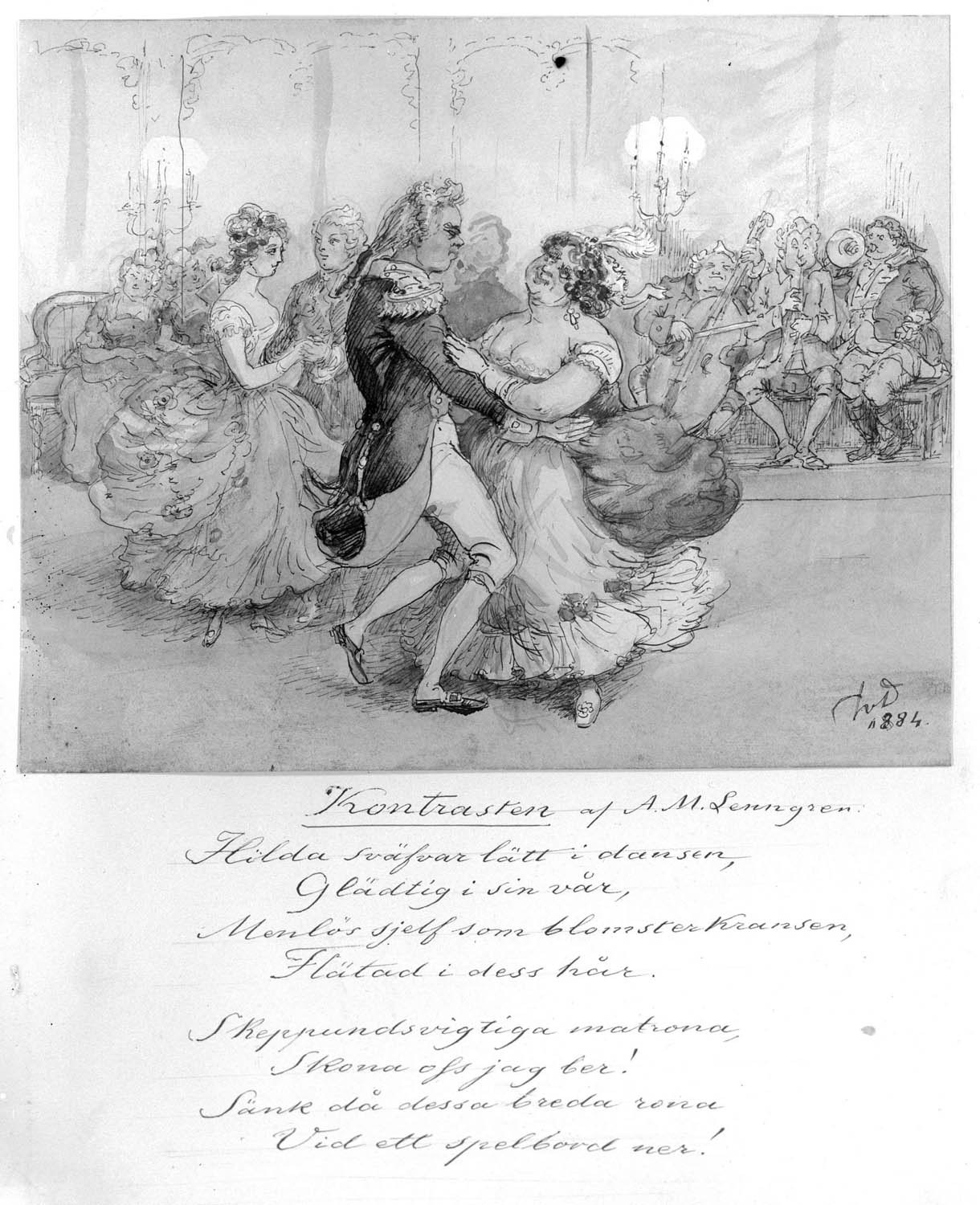
Illustration till Anna-Maria Lenngrens 'Kontrasten', Fritz von Dardel, 1884 - Nordiska Museet - NMA.0035757
Fritz von Dardel
- Medium:
- Illustration
- Era:
- Late 1800s (Victorian Ballroom)
- Source:
- Wikimedia Commons
- Rights:
- Public domain — free to use, share and adapt.
- Recorded as:
- Public Domain
This image documents the waltz as it was danced in Nordic ballrooms of the 1880s, showing the closed hold, the characteristic rotation, and the skirt dynamics that made the waltz visually distinctive and socially significant. It also demonstrates the ballroom waltz as a subject of literary and artistic interest—not merely a social event, but a moment worth illustrating and circulating in print, which tells us how dance functioned in Nordic middle and upper-class culture of this period.
What you are looking at
A crowded ballroom scene rendered in ink with energetic line work and wash. A military officer in dress uniform dominates the center, his dark coat sharply defined against the lighter figures around him. He is caught mid-dance with a woman in a white or pale gown; her skirts billow outward in the dynamic spiral of a turn, while he leans back slightly, their bodies angled in a closed partnership. To the left, two women in evening dress stand or move near a table laden with refreshments. At right, a cluster of onlookers—men in dark coats, women in pale gowns—line the background in the formal arrangement of a ballroom's social hierarchy. Tall candelabra flank the scene, their multiple candles suggested with quick vertical strokes. The composition captures the moment of maximum visual interest: the couple mid-movement, the woman's momentum and skirt creating a living curve, while the surrounding figures register reactions—attention, conversation, the ambient social choreography of the ballroom.
The dancing
The central couple dances in a closed hold, the officer's right arm around the woman's waist, her left arm resting on his shoulder—the standard frame of 19th-century ballroom dance. His posture leans slightly back, counterbalancing her forward progression and the centrifugal force of her turn; her weight is committed to the movement, one leg extended or carrying weight while the other prepares the next step, and her skirts have lifted and spread in the arc characteristic of a fast rotational figure. The surrounding figures are static or pedestrian by contrast: observers in profile, figures at rest or in conversation, establishing the clear distinction between dancers and audience in formal ballroom society.
The dance depicted
The image depicts a waltz or similar rotational couple dance in a 19th-century ballroom setting. The closed position, the woman's elevated and spreading skirts, and the officer's counterbalanced lean all align with Viennese waltz or a related form of the waltz family popular in Nordic and European ballrooms of the 1880s. The inscription on the work references Anna-Maria Lenngren's poem "Kontrasten" (The Contrast), which deals with social observation and likely the tension between individuals and social convention—meaning this illustration may be capturing a moment that embodies that thematic concern, perhaps the contrast between the officer's martial bearing and the delicacy of ballroom movement, or between the couple's absorbed focus and the watching crowd. The work depicts the dance as a socially sanctioned performance within a hierarchical setting, not as a private or intimate act.
How it was made
This is an illustration rendered in ink, employing both line and wash (diluted ink or watercolor) to create tonal variation. The technique is swift and assured: the officer's uniform is rendered with dense, parallel hatching that emphasizes its military cut; the women's gowns are suggested with lighter, more gestural strokes; the background figures and furnishings are sketched with minimal detail, creating atmospheric recession. The fluidity of the medium—ink on paper—allowed the artist to capture movement through directional mark-making: the woman's skirt is defined by curves that suggest motion, the couple's shared axis by the angle of their bodies. This is a work made for reproductive circulation: an illustration to accompany a published poem, likely lithographed or engraved for print. That context shaped the artist's approach—clarity enough for reproduction, but enough expressive line work to convey energy and social observation beyond mere documentation.
About this work
This is an 1884 illustration by Fritz von Dardel accompanying Anna-Maria Lenngren's poem "Kontrasten" (The Contrast), depicting a waltz in a formal Nordic ballroom. The work captures a moment of kinetic energy—a couple mid-rotation, the woman's skirts caught in the lift of the dance, the officer's body angled in counterbalance—set within the ordered social space of the ballroom, with observers and furnishings defining the scene's formal hierarchy. It is a work of social observation as much as dance documentation: the waltz here is the vehicle for Lenngren's thematic interest in social contrast and individual performance within constraint.
The illustration demonstrates how dance functioned in Nordic high culture of the 1880s: as a spectacle that was both personal (the absorbed focus of the dancers) and public (the watching crowd), and as a subject worthy of literary treatment and artistic attention. Von Dardel's line captures the moment of maximum visual and kinetic interest, freezing the ephemeral movement of the dance so that it could be printed, circulated, and read as part of a complete literary work.
How to look at it
Notice the precise moment the artist chose: not the beginning or end of a figure, but the moment of maximum rotation and lift, where the woman's skirts billow outward and the couple's bodies form a clear geometric relationship. This choice conveys both the physical dynamics of the waltz—the centrifugal force, the counterbalance required—and its visual drama. Observe too how the artist used line and wash to create social hierarchy: the couple at the dance is rendered with the most detail and tonal contrast, while background figures are sketched more lightly, establishing them as secondary to the main action. The candelabra and table anchor the scene as a formal ballroom, not an abstract or imaginary space, grounding the social observation in a specific kind of place.
The artist
Fritz von Dardel (1817–1901) was a Swedish painter and illustrator known for his social observation and satirical line drawings. He worked in a tradition of narrative illustration that combined careful observation of contemporary life with expressive, economical draftsmanship. His illustrated works were published in Swedish periodicals and as book illustrations throughout the 19th century, and his style—sketch-based, socially engaged, and technically assured—made him well-suited to interpret literary works that dealt with social dynamics and human character. This illustration sits within his broader practice of capturing moments of social performance and interaction.
The period
The 1880s saw the waltz established as the dominant couple dance in European ballrooms, including those of Scandinavia. The dance had moved far beyond its earlier associations with impropriety and was now the standard for formal dancing in middle- and upper-class society. Simultaneously, the period saw growing literary and artistic interest in the ballroom as a site of social performance and individual expression—a theme that emerges clearly in Lenngren's poetry and in von Dardel's accompanying illustration. The Romantic interest in individual gesture and the realist interest in contemporary social life converged in dance imagery of this period, making the ballroom a productive subject for both literary and visual artists.
Where it lives
This work is held at Nordiska Museet, the Swedish National Museum of Cultural History, as an illustration within their collections of Nordic cultural artifacts and visual documentation. It is an archival illustration—a work made for reproductive circulation as part of a published literary work—and is now preserved as a historical record both of artistic practice and of ballroom dance culture in 1880s Sweden.
Dance in this work
Questions about this work
What dance are they doing?
A waltz, one of the standard couple dances of formal European ballrooms in the 1880s. The closed hold (man's right arm around woman's waist, woman's left arm on his shoulder), the rotation, and the dynamic lift of the woman's skirts are all characteristic of the Viennese waltz as it was danced in this period.
Why is the woman's skirt so prominent?
The skirts of 1880s formal gowns were full and light, and the rotation of the waltz created centrifugal lift that made them billow and spread. The artist has emphasized this visual drama deliberately—the lifted, spiraling skirt is both an accurate observation of how the waltz looked and a way of conveying the energy and kinetic excitement of the dance.
Who was Anna-Maria Lenngren?
Lenngren was an 18th-century Swedish poet whose work was still read and republished in the 19th century. Her poem "Kontrasten" (The Contrast) deals with social observation, irony, and the tensions between individual identity and social convention—themes that von Dardel's illustration captures through the contrast between the absorbed dancers and the watching crowd.
What was von Dardel's role as an illustrator?
Von Dardel was a major Swedish illustrator and painter known for witty, observant drawings of contemporary social life. His role was to create an image that would accompany and interpret Lenngren's poem for readers, capturing its themes visually—in this case, the tension and contrast that the poem explores through the figure of dancers in a formal ballroom.
More dance artwork