43 works in this view — arrow keys or swipe to move between them.
Dance in Art
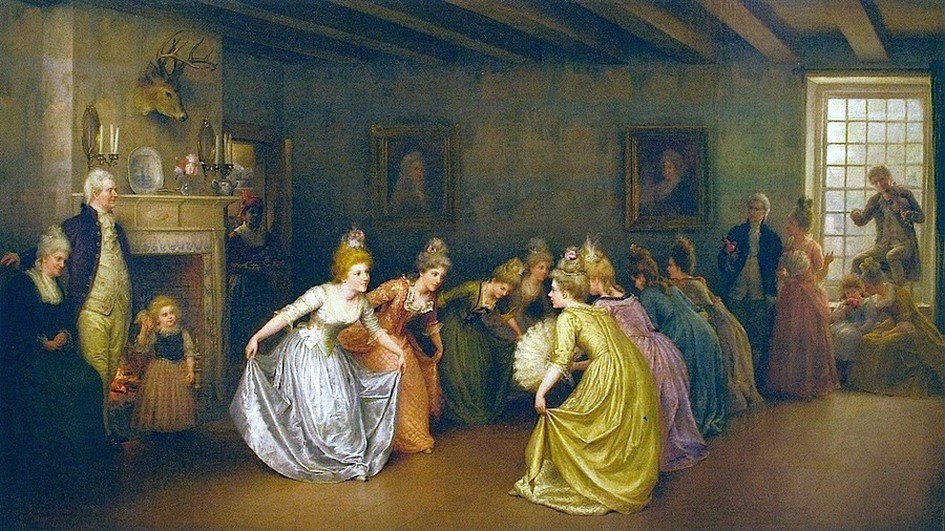
Jennie Augusta Brownscombe Colonial Minuet - Bow to Your Partners s.d
Jennie Augusta Brownscombe (American,1850 - 1936)
- Medium:
- Oil Painting
- Dance:
- Minuet
- Source:
- Wikimedia Commons
- Rights:
- Public domain — free to use, share and adapt.
- Recorded as:
- Public Domain
This painting is one of the primary visual records of how the minuet was remembered in the American nineteenth century—not as a technical dance form but as an emblem of colonial gentility. Dancers and historians working on the minuet, on colonial social practice, or on how historical dances are reconstructed and reinterpreted will find here a case study in how a dance form becomes a historical symbol. The work also documents Brownscombe's engagement with American colonial life and women's domestic worlds during a period when such subjects were gaining cultural weight.
What you are looking at
An oil painting depicting a formal minuet being performed in a colonial-era interior. The scene shows a couple in the center—a woman in a flowing white gown and a man in dark breeches and coat—executing the characteristic bow that opens the dance. They face each other at a respectful distance, the woman's body angled gracefully, the man inclined forward in formal greeting. Around them, a group of onlookers in period dress watches from the sides of the room: some seated, others standing, several women in pastel silks and men in dark coats with knee breeches. The setting is a wood-paneled interior with a fireplace and mantelpiece at the left, portraits on the walls, and a tall multi-paned window on the right admitting cool light. The painting's palette is muted—ochres, greens, browns—with the white of the dancing woman's gown the brightest note. The composition places the dancing couple as the visual and social center, with witnesses arranged in a loose semi-circle that frames and legitimizes the formal moment.
The dancing
The man and woman in the center maintain the characteristic minuet distance and posture: upright carriage, the woman's arm held at shoulder height with hand extended, the man bowing deeply from the hips while keeping his own arm raised in courtly salute. Their bodies do not touch. The supporting figures around them are static—standing or seated, their attention directed toward the dancers. Several women in the group gesture or turn slightly toward the couple, suggesting the social significance of watching a well-executed minuet. The artist has captured the formal restraint of the dance: no exuberance or rapid movement, but deliberate, measured gesture.
The dance depicted
This is unambiguously a minuet, the most formal and codified of eighteenth-century social dances. The painting's title names it directly, and the opening gesture—the bow and curtsy exchange—is the minuet's defining ceremonial moment. The minuet was danced by aristocratic and gentry couples in formal colonial settings, often as a display of breeding and correct deportment. The image shows the minuet not as a learned theatrical form but as a social practice: a public moment within a domestic interior, witnessed and validated by a community. The couple's precise distance and upright frame are consistent with historical descriptions of the minuet's restrained elegance.
How it was made
Oil on canvas, as recorded. The painting's finish and handling suggest a mid-to-late nineteenth-century work: the paint is layered and blended to create volume and light, particularly in the rendering of fabric and flesh tones. The artist has used a warm underpainting to model the figures and architecture, then applied cooler tones to suggest shadow and depth. The technique allows for the subtle gradation of light across the interior space and the nuanced portrayal of gesture—the slight inclination of the man's torso, the curve of the woman's arm. The scale and subject matter (26 x 40 inches, a domestic interior scene) suggest a work made for a middle-class market interested in colonial history and social refinement.
About this work
Jennie Augusta Brownscombe's *Colonial Minuet—Bow to Your Partners* is a historical genre painting depicting the moment of formal greeting in an eighteenth-century minuet. The work captures not the rapid footwork of the dance but its ceremonial opening: the bow, the curtsy, the public acknowledgment of partnership within a watched community. The painting belongs to a nineteenth-century tradition of historical reconstruction painting—a mode that recovered and sentimentalized the domestic life of the colonial past. For viewers of Brownscombe's own time, such works offered a visual argument about the refinement and social order of early American gentry life, accessed through the formalized language of the minuet.
The painting is important to the history of dance imagery because it documents how the minuet was understood and remembered after it had ceased to be practiced: not as a choreography to be learned, but as a symbol of a lost social world. The artist's attention to costume, setting, and the precise geometry of the opening gesture makes this a valuable historical document of how nineteenth-century Americans imagined eighteenth-century social dance.
How to look at it
The painting asks the viewer to witness a social moment—to stand, as it were, among the onlookers. Notice the opening gesture: the man's deep, formal bow and the woman's subtle acknowledgment. This is not a moment of rapid footwork or technical display, but of ceremony and courtship played out under observation. The artist has frozen the dance at its most socially significant instant, when the couple publicly declares their partnership. Attend to the costume and setting: every detail—the fireplace, the portraits, the quality of the fabrics—positions this as a world of refinement and stability. The painting's color and light are deliberately restrained, enhancing the sense of formal propriety.
The artist
Jennie Augusta Brownscombe (1850–1936) was an American painter who specialized in historical genre scenes, particularly scenes of colonial and early American domestic and social life. She studied at the National Academy of Design in New York and was known for meticulous historical detail and warm, sentimental treatments of her subjects. Her work was widely reproduced and circulated through prints and magazines, making her one of the most visible painters of American history for the general public. She often depicted scenes of women's work, education, and social interaction, positioning colonial women as cultured and refined. The minuet painting aligns with her larger body of work celebrating the social sophistication of early America.
The period
Brownscombe was working in the late nineteenth and early twentieth centuries, a period of intense interest in American colonial history and material culture. The minuet itself had been out of regular social practice for nearly a century, having been displaced by the quadrille, polka, and waltz. Yet it retained powerful symbolic value: it was the dance of the Founding generation, associated with restraint, formality, and the social order of the colonial elite. This was also the era of the Colonial Revival movement in American architecture and design, which sought to recover and reimagine colonial aesthetics as a corrective to the perceived excess of the Gilded Age. Brownscombe's painting participates in this broader cultural project of historical nostalgia and reconstruction.
Where it lives
The work is recorded as an oil painting of unknown date, held in a private collection. The source is Wikimedia Commons. No information on the painting's exhibition history, prior ownership, or acquisition is recorded.
Dance in this work
Questions about this work
What is a minuet, and why does it matter?
The minuet was the most formal and prestigious social dance of the eighteenth century, performed by aristocratic and gentry couples as a display of breeding and correct deportment. It was a slow, stately dance with highly codified steps and figures, and the opening moment—a bow and curtsy exchange—was its defining ceremonial gesture. By the nineteenth century, when Brownscombe painted this work, the minuet had fallen out of practice but remained a powerful symbol of refined colonial society.
Is this painting historically accurate?
The costume, setting, and opening gesture of the minuet are consistent with historical records from the colonial period. However, this is a nineteenth-century painter's interpretation of an eighteenth-century dance, made decades or a century after the minuet ceased to be regularly performed. The painting should be read as both a historical document and a sentimental reconstruction—evidence of how Americans understood and valued colonial social life, rather than a direct record of minuet practice.
What is Brownscombe known for?
Jennie Augusta Brownscombe (1850–1936) was an American painter specializing in historical genre scenes of colonial and early American domestic life. Her work was widely exhibited and reproduced, making her one of the most visible interpreters of American colonial history for the general public of her time. She frequently depicted scenes of women's work, education, and social refinement, positioning colonial women as cultured and capable.
Why would someone paint a minuet scene in the nineteenth century?
By the nineteenth century, the minuet had become a historical curiosity and a symbol of a vanished social order. Painting minuet scenes allowed artists and their audiences to engage in historical nostalgia—to recover and admire the perceived refinement of the colonial past. This was part of a broader Colonial Revival movement in American culture that positioned early America as a model of order, taste, and social stability.
More Minuet artwork