26 works in this view — arrow keys or swipe to move between them.
Dance in Art · 1924
Arnac - Le Brelan de joie - p88 hors texte
Marcel Arnac
- Medium:
- Oil Painting
- Era:
- 1920-1950 (Swing Era)
- Source:
- Wikimedia Commons
- Rights:
- Public domain — free to use, share and adapt.
- Recorded as:
- Public Domain
This work documents the attitudes of early 20th-century artists toward social dance—specifically the anxious or mocking distance many took from jazz-age nightlife. The caricature style was not neutral representation but a form of critique, revealing class anxiety about modern leisure and entertainment. For historians of dance and visual culture, it shows how the boundaries between fine art and illustration, and between satire and documentation, shaped what aspects of dancing entered the historical record.
What you are looking at
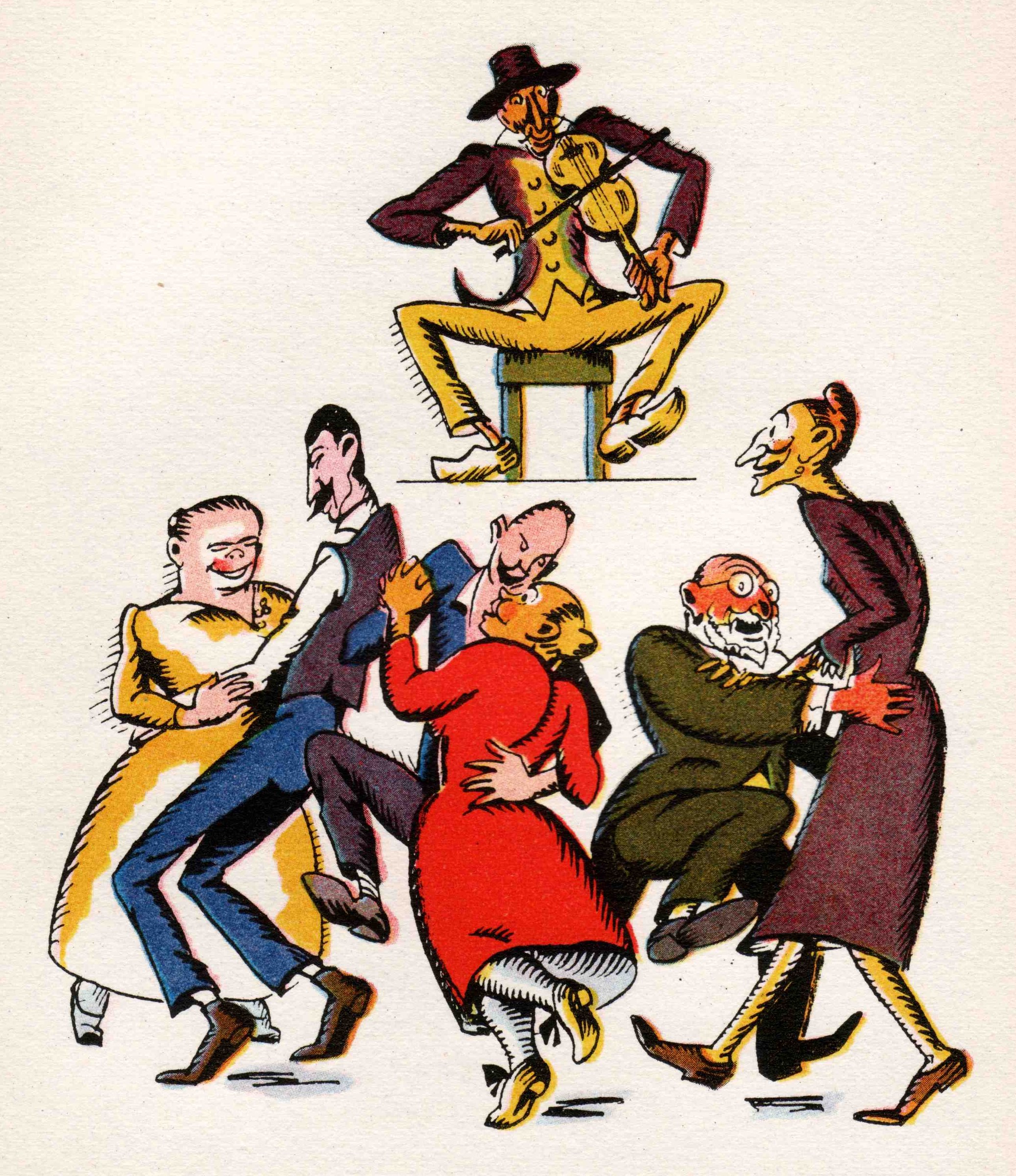
A raucous ballroom or cabaret scene rendered in bright color and exuberant line. At the center, a figure in a yellow jacket perches on a stool with legs splayed wide, playing a violin with both arms raised at sharp angles—a deliberately unstable and comedic pose. Around this musician-dancer, five figures in formal dress execute a social dance in pairs and clusters. The figures wear tuxedos, evening gowns, and suits in jewel tones: deep maroon, gold, blue, and olive. The composition radiates outward from the violinist; the dancers lean, pitch, and embrace with the kind of exaggeration found in satirical prints. The setting is sparse—a pale background with a blue platform beneath the stool—which throws the figures into sharp relief. The style is caricatural: elongated limbs, bulbous noses, wide grins, and impossibly thin torsos suggest mockery of fashionable society. The overall effect is one of coordinated chaos: the music drives the dance, but nobody is quite dancing in sync.
The dancing
The central violinist sits astride a stool with both legs extended in a wide V, torso twisted to hold the instrument aloft. The surrounding dancers are paired loosely rather than in formal ballroom holds. One couple on the left presses together in an embrace; another pair at center-right leans at oblique angles to one another. A solo figure on the right gestures with one hand raised. The bodies throughout are rendered with exaggerated angles and tension—weight appears distributed unevenly, suggesting either awkwardness or deliberate stylization. Arm positions are fluid and emphatic rather than controlled; this is not classical partnering but social dancing rendered as caricature.
The dance depicted
This appears to be a satirical representation of modern social dance, most likely ballroom or jazz-age couples' dancing circa 1924. The title *Le Brelan de Joie* (A Triple of Joy or A Trio of Delights) suggests playful intoxication or reckless merriment. The violin—an instrument associated with gypsy or cabaret performance—places this in a nightclub or dance hall rather than a formal ballroom. The extreme poses and caricatured expressions mock both the dancers and the pretension of fashionable entertainment. The work does not document actual technique but rather ridicules the social spectacle of modern dance culture. This is close to the satirical spirit of 1920s German Expressionism and French critique of contemporary manners.
How it was made
The catalogue identifies this as an oil painting; examination of the image confirms a hand-colored or tinted medium with the flat, bold areas of tone characteristic of early 20th-century illustration or print reproduction. The line is crisp and decisive, the palette limited to primary and secondary colors applied with clear boundaries—a technique suited to commercial reproduction rather than fine art subtlety. This medium allowed the work to function as both a gallery piece and a book illustration (it appears as *hors texte*, an inset plate, in the 1924 novel *Le Brelan de Joie* published by Grasset), reaching readers who would encounter the satire within its narrative context.
About this work
This is a caricatural dance scene from the Jazz Age, created as both a standalone illustration and an inset illustration for a 1924 French novel. It captures the social dance culture of the 1920s—specifically the mix of ballroom partnering and cabaret performance—through the lens of satire and expressionist exaggeration. The work mocks both the dancers and the fashionable pretense of modern nightlife, using distorted bodies, caricatured faces, and deliberately unstable poses to register disapproval or amusement. As a document of artistic attitudes toward dance in the Swing Era, it reveals how visual culture of the time often treated social dance as spectacle worthy of ridicule rather than as a serious or elegant form.
The painting belongs in a dance gallery because it is fundamentally about the act and meaning of dancing—not its technique but its social function and the way it was perceived by a skeptical artistic intelligentsia. The work shows how dance, in the modern period, was contested ground: celebrated as exciting and fashionable by the public, but treated as vulgar or ridiculous by artists. Understanding this split is essential to the history of how dance entered modern visual culture.
How to look at it
Attend first to the central violinist—the artist chose to freeze the moment at which music and dance are most unstable, with the musician perched precariously and the dancers caught mid-step in asymmetrical poses. Notice how no two figures occupy the same spatial or temporal relationship to the music; this is a crowd of individuals, not an ensemble. The exaggerated facial expressions (bulbous noses, wide grins) and the limbs drawn as thin lines stretched to implausible length are marks of caricature, a convention that signals mockery or critique. The bright, flat colors and the black outlines suggest a print or commercial illustration style, which means the work was designed for reproduction and public circulation—it was not made for connoisseurs but for readers of a novel.
The artist
Marcel Arnac (dates not confirmed in available records) was a French illustrator and painter active in the 1920s–1940s. He worked in a caricatural style influenced by German Expressionism and the satirical tradition of French popular prints. His contribution to *Le Brelan de Joie* positions him within a circle of artists commissioned to visualize contemporary social life for literary audiences. Little is documented about his broader career, but this work suggests facility with figuration, exaggeration, and the visual rhetoric of modern manners.
The period
The 1924 date places this work at the height of the Jazz Age in Europe, a moment of rapid social change and anxiety about modern leisure. Jazz-age social dancing—the foxtrot, Charleston, and various ballroom fusions—had become symbols of both liberation and cultural threat. In visual art, this period saw competing responses: some celebrated modern dance and movement (Futurism, Constructivism), while others, particularly in satirical illustration, registered skepticism or disdain. In France, the 1920s were marked by a postwar reassertion of classical values alongside fascination with American popular culture and nightlife. Arnac's sardonic approach reflects the intellectual distance many French artists maintained from the very entertainments the broader public embraced.
Where it lives
This work is documented as a *hors texte* (inset plate) facing page 88 in the original 1924 Grasset edition of *Le Brelan de Joie*; a later 1945 Athena edition also carried the same illustration. The source record lists only Wikimedia Commons, and no holding collection is recorded. The work was originally created as a book illustration, suggesting it may exist in multiple forms: as an original painting or drawing, and as a printed reproduction within the novel.
Dance in this work
Questions about this work
What dance is this supposed to be?
It is not depicting a single, codified dance form but rather the social scene of Jazz Age ballroom and cabaret dancing. The artist has emphasized the chaotic, exaggerated quality of the moment rather than documenting actual steps or holds. The style is caricatural, designed to mock the fashionable dancers of the 1920s.
Why is the violinist sitting on a stool like that?
The pose is deliberately unstable and comic. The artist exaggerates the musician's position to underscore the chaos and mockery of the scene. The violin is the source of the dance's energy, but the rendering suggests that energy is chaotic rather than controlled.
Is this a painting or a print?
The catalogue lists it as an oil painting, but the technique—flat color, bold outlines, high saturation—and its function as a book illustration suggest it may have been created as a drawing or gouache and then reproduced in print. The original may be a painting, but the work circulated primarily as a printed illustration.
What does the title mean?
*Le Brelan de Joie* translates as 'A Triple of Joy' or 'A Trio of Delights.' In French slang, *brelan* suggests a winning hand in cards or a group of three. The title evokes playful excess or reckless pleasure—fitting for a scene of uninhibited social dancing.
More dance artwork