49 works in this view — arrow keys or swipe to move between them.
Dance in Art · 1877
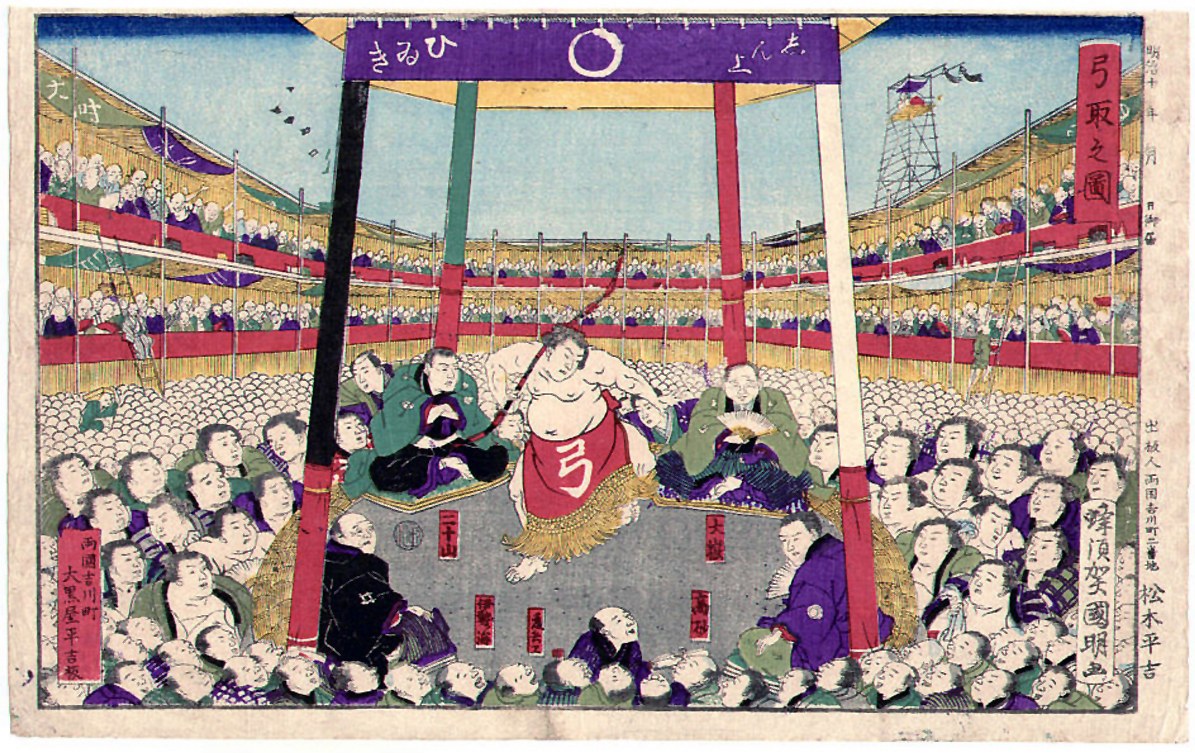
Kuniaki II Bow dance 1877
Unknown artist
- Medium:
- Oil Painting
- Era:
- Late 1800s (Victorian Ballroom)
- Source:
- Wikimedia Commons
- Rights:
- Public domain — free to use, share and adapt.
- Recorded as:
- Public Domain
For historians of Japanese physical culture and spectacle, this print documents the professionalization of sumo in the Meiji era and shows how the sport was marketed and visualized for mass consumption. For students of performance and embodied practice, it demonstrates the visual conventions by which athletic and ritualized movement was recorded and circulated—conventions that shaped how dance itself was depicted and understood.
What you are looking at
A sumo wrestling match in progress at a packed arena, rendered in a Japanese woodblock print style. The ring occupies the center-foreground, where two large rikishi (sumo wrestlers) are engaged—one in a red loincloth leaning forward aggressively, the other in darker clothing responding to the pressure. A referee in formal dress stands between and slightly behind them. The arena is a massive wooden structure with tiered seating crammed with spectators: hundreds of faces fill the galleries in multiple levels, their heads rendered in pale ink against darker clothing. Bright red fabric drapes the railings. Above, a large purple banner with Japanese characters marks the event. The perspective is from ground level looking up at the crowd, which creates a sense of being surrounded by witnesses. The print uses the characteristic Edo-period palette of blue, red, purple, gold, and black ink on cream paper.
The dancing
The two wrestlers are the focal point: their massive, low-centered bodies demonstrate the fundamental sumo posture—knees bent, backs slightly rounded, weight driven low. The wrestler in red is moving forward into contact, his body compressed and engaged; his opponent braces against this force. Both men are nearly naked except for ornate silk loincloths (mawashi), emphasizing the muscularity required for the sport. The referee wears formal samurai-era dress with a tall hat and holds a fan, maintaining a position of authority and readiness to call the bout.
The dance depicted
This is not a depiction of dance but of sumo wrestling (sumō), which belongs to Japanese sacred and martial tradition rather than the dance forms in LODance's taxonomy. Sumo involves ritual movement, formal posture, and ceremonial elements—the salt-throwing purification, the stomp (shiko), the charging stance—that share structural similarities with sacred and martial movement traditions. However, the image captures the agonistic contest itself, not the ceremonial preliminaries or the aesthetic movement vocabularies that would align with dance classification. The work documents a professional sumo match as a spectacle and competitive sport.
How it was made
This is a woodblock print (likely ukiyo-e, the 'pictures of the floating world' tradition), not an oil painting as the catalogue record states. The technique involves carving separate blocks for each color layer—the blue sky, red textiles, flesh tones, black outlines—and printing in sequence. This method allowed for mass production and wide circulation: prints were inexpensive, collectable, and disseminated throughout urban Japan and to international audiences by the late 19th century. The style and subject matter are consistent with Utagawa Kuniaki II's documented practice of theatrical and sporting scenes.
About this work
This woodblock print documents a sumo wrestling match at a public arena in 1877, during the Meiji period when sumo was professionalized and became a commercialized spectacle. The composition emphasizes the social event as much as the athletic contest: the towering crowd dwarfs the wrestlers themselves, placing the match within a context of mass spectatorship and urban entertainment. The print captures a moment of athletic exertion rather than dance, but does so with the aesthetic conventions of performance documentation that locate it within the visual culture of body-centered spectacle. It belongs in a gallery of dance in art as a historical neighbor—a record of how movement, ritual, and athletics intersected in popular visual culture.
How to look at it
Attend to the composition's inversion of scale: the wrestlers are heroic in their muscularity and central positioning, yet they are visually dwarfed by the arena and the crowd that surrounds them. The print freezes a moment of maximum contact and strain, with the red-loincloths wrestler driving forward and the other resisting—the instant of greatest tension in an engagement that typically lasts seconds. The hundreds of faces in the crowd, rendered with minimal individual detail, create a sense of collective witnessing and transform the match into a public, almost ritual event. The formal referee, the dramatic colored textiles, and the architectural framing all signal that this is a sanctioned, ceremonial contest, not casual physical contest.
The artist
Utagawa Kuniaki II (1835–1888) was a prolific woodblock print designer working in the ukiyo-e tradition during Japan's transition to modernity. He specialized in theatrical scenes, portraits of Kabuki actors, and contemporary urban subjects including sporting events and popular entertainments. His prints were part of the commercial woodblock industry that produced thousands of images annually for urban audiences. The subject of sumo was popular in ukiyo-e, as the sport combined spectacle, athleticism, and ritual in ways that appealed to visual artists and print consumers.
The period
By 1877, sumo had been reorganized into a professional sport with regulated tournaments and public arenas, a process that began after the Meiji Restoration (1868). The sport attracted enormous crowds and became a subject of intense visual documentation. Simultaneously, woodblock printing was entering its final decades of dominance—photography and lithography were beginning to displace it—but prints remained the primary medium for documenting contemporary events and entertainments. This print captures sumo at a moment when both the sport and the print medium were integral to Japanese urban culture.
Where it lives
The work is held in Wikimedia Commons and identified as a work by Utagawa Kuniaki II from 1877. The catalogue record identifies it as an oil painting, but the image clearly shows characteristics of a woodblock print, suggesting an error in the medium designation.
Questions about this work
Is this sumo a dance?
Sumo is not classified as dance in the Western taxonomies used by most dance institutions. However, it combines ritualized movement, formal posture, strategic engagement, and ceremonial elements that share structural features with martial and sacred movement traditions. The image documents the competitive contest, not the ceremonial preliminaries (which do include formalized, dance-like movement such as the stomp and salt-throwing). For scholars of embodied practice and performance, sumo occupies an important position as a movement tradition distinct from but adjacent to dance.
Who were Kuniaki II's audience?
Woodblock prints were inexpensive (costing the equivalent of a meal) and widely distributed in urban Japan, particularly Edo (Tokyo). This image would have been bought by merchants, artisans, and urban residents interested in contemporary entertainments. The prints were also exported to Europe and America, where they influenced Western artists and circulated among collectors. By 1877, the print medium was beginning to decline as photography and lithography offered new ways to document events.
What is the purple banner?
The banner displays Japanese characters identifying the event, venue, or tournament. In sumo, such signage marks official tournaments (honbasho) and ranked matches, distinguishing professional bouts from informal wrestling. The banner's prominent placement at the top of the composition emphasizes that this is an official, sanctioned sporting event with ceremonial significance.
Why is the crowd so prominent?
By the 1870s, sumo had become a mass entertainment with large paying audiences. The composition reflects the reality that sumo matches were public spectacles drawing hundreds or thousands of spectators. The emphasis on the crowd also reflects the print tradition's interest in documenting contemporary urban life and social gatherings, not just individual athletes.
More dance artwork