49 works in this view — arrow keys or swipe to move between them.
Dance in Art · 1874
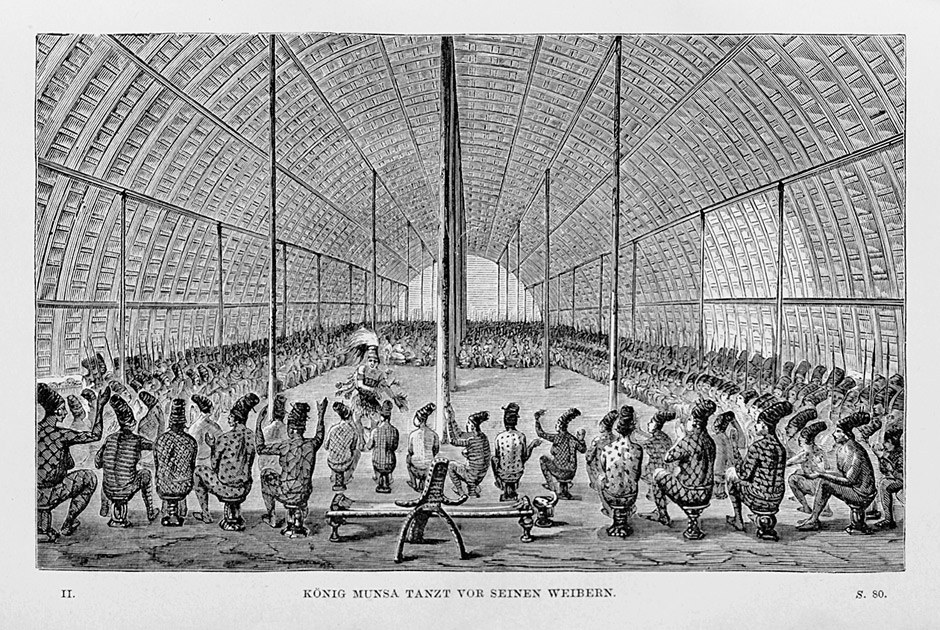
König Munsa tanzt vor seinen Weibern
Unknown
- Medium:
- Oil Painting
- Era:
- Late 1800s (Victorian Ballroom)
- Source:
- Wikimedia Commons
- Rights:
- Public domain — free to use, share and adapt.
- Recorded as:
- Public Domain
This image documents a specific royal performance and its spatial and social organization at a moment when such practices were rarely recorded visually by eyewitnesses. For historians of African dance and courtly culture, it provides rare direct evidence of performance context, audience arrangement, and the role of dance in chiefly authority. The engraving also exemplifies how European science and publishing shaped global understanding of African dance—a legacy that dancers and scholars still navigate.
What you are looking at
A densely populated gathering fills a vast arched structure with a gridded ceiling that recedes into perspective, suggesting either a monumental hall or a carefully constructed enclosure. In the foreground, figures wearing patterned clothing and ornate headdresses are arranged in a loose circular formation around a central axis marked by vertical posts or poles. A single figure in the center appears elevated or separated from the crowd, positioned as if performing while surrounded by many onlookers who stand, gesture, and face inward. The crowd density increases toward the background, with hundreds of heads visible receding into the architectural space. The engraving style renders bodies as linear forms with cross-hatching for volume and shadow, typical of 19th-century documentary illustration.
The dancing
The central performer stands upright with arms raised or extended, distinguished from the surrounding figures by isolation and posture. The surrounding figures display varied arm positions—some raised, some at sides—and many appear to be in standing positions with slight shifts of weight and turning of torsos toward the center. The close observation of individual body positions suggests the artist witnessed or studied the scene carefully: torsos bend, heads turn, and the density of figures creates an impression of animated attention rather than rigid formation. The central figure's position and the radiating gaze of the crowd establish a clear performative hierarchy.
The dance depicted
This is most likely a royal dance or ceremonial performance documented during an ethnographic expedition. The title specifies König Munsa dancing before his wives, and the composition—a single elevated or central performer surrounded by a large audience of women—aligns with courtly or chiefly performance practices in central African societies. The open-armed posture of the central figure, the upright bearing, and the formal arrangement suggest a display of status or authority rather than a social participatory dance. Without clearer detail of footwork or specific movement vocabulary, the precise dance form cannot be named, but the context and composition indicate a ceremonial or courtly performance.
How it was made
This is an engraving, characteristic of 19th-century scientific and travel publication. The gridded hatching, linear definition of form, and capacity to render both architectural perspective and crowd density are typical of wood or steel engraving used to illustrate explorer journals. The medium's ability to capture both grand spatial recession and fine individual detail made it ideal for documenting ethnographic scenes for European audiences. The technique required high technical skill to render both the monumental interior and the numerous individual figures with legible distinction.
About this work
This engraving documents a royal dance performance witnessed during Georg Schweinfurth's expedition into central equatorial Africa (1868–1871). The image records both the physical form of the performance—a solo male figure at the center of a female audience—and the architectural context in which it occurred, likely a large communal or royal structure. As a scientific illustration rather than a romanticized artistic interpretation, it provides specific visual evidence of courtly performance practice, spatial organization, and gender roles in dance gatherings among central African societies during the late 19th century. The work belongs to a crucial period when European exploration and documentation were reshaping knowledge of African cultural practices, though always filtered through the perspective and assumptions of the observer.
How to look at it
Observe the architectural framing first: the artist chose to emphasize the monumental scale and careful construction of the space, suggesting this was not a casual gathering but a formal, prepared event. Then trace the composition: the central figure is isolated by space and posture, while the surrounding figures are rendered with enough individual variation to suggest specific observation rather than generic crowd filler. Notice how the perspective and density create a sense of being surrounded by witnesses, and how the artist differentiated the central performer's raised posture from the standing, turning bodies around him. The moment captured is one of display and attention, not movement in progress—a still point rather than a kinetic peak.
The artist
The work is an illustration from Georg Schweinfurth's *Im Herzen von Afrika* (In the Heart of Africa), published by Brockhaus in Leipzig in 1874. Schweinfurth was a German botanist and explorer whose expedition from 1868 to 1871 penetrated deep into central equatorial Africa. The images in his published account were rendered by professional engravers working from Schweinfurth's field sketches or descriptions. The identity of the specific engraver is not recorded in the catalogue, which is typical for commercial scientific publishing of the period, where engravers were often anonymous craftspeople executing the designs of others.
The period
This engraving dates to the height of European travel literature and scientific exploration narrative (1870s), when illustrated expedition accounts were major publishing successes and shaped European understanding of African societies. In dance history, this period preceded any systematic ethnographic documentation of African dance in the 20th century; visual records were almost entirely dependent on the chance presence of European observers. The engraving style itself was at the end of its dominance—photography was available but still slow and difficult for field work and reproduction. Schweinfurth's expedition occurred during the period of increasingly intensive European penetration of central Africa, before the rapid territorial partitioning and colonization of the 1880s–1890s.
Where it lives
The image is a page illustration from the first edition of Schweinfurth's *In the Heart of Africa: Travels and Discoveries in Central Equatorial Africa during the Years 1868 to 1871*, published in German by Brockhaus, Leipzig, in 1874. It is documented in Wikimedia Commons as a published historical source rather than as an original artwork held in a museum collection.
Dance in this work
Questions about this work
How do we know this is König Munsa and not a generic dance scene?
The caption beneath the image identifies the subject in German as 'König Munsa tanzt vor seinen Weibern' (King Munsa dances before his wives). This labeling comes from Schweinfurth's original publication and field notes. However, like all travel documentation of the period, the caption reflects the European observer's interpretation and the names and categories he recorded or imposed. The scene's specificity—the monumental structure, the formal arrangement, the central performer's distinction—supports that it documents a particular historical event, but we cannot verify independent details from the image alone.
What was König Munsa's real name and what society was he from?
Schweinfurth's publications and field records identify him as a ruler encountered in central equatorial Africa, but the historical identification remains uncertain and debated by scholars. The names recorded by 19th-century explorers often represented European phonetic approximations or misunderstandings. Modern scholarship on Schweinfurth's expedition route suggests the encounter may have been with societies in what is now the Central African Republic or South Sudan, but precise ethnic and chiefly identification requires expertise beyond what the image itself provides.
Is this a photograph or a drawing?
This is an engraving—a printed image made by hand-cutting lines into a metal plate (copper or steel), which is then inked and printed. It is not a photograph, though 19th-century engravings were often commissioned to illustrate travel accounts because they could be mass-produced cheaply and effectively reproduced in books. The image may have been based on a field sketch or description by Schweinfurth, but the final visual form is the work of a professional engraver, not a direct optical recording.
Why is the structure so large and geometric?
The massive arched hall with its gridded ceiling is likely either a real architectural structure documented by Schweinfurth or his interpretation of one. Large communal or royal structures for gatherings and ceremonies existed in many central African societies. The artist's emphasis on geometric precision and perspective may also reflect European artistic conventions for rendering monumental or impressive spaces; the degree to which the illustration is accurate architectural documentation versus artistic interpretation is uncertain.
More dance artwork