43 works in this view — arrow keys or swipe to move between them.
Dance in Art · 1846
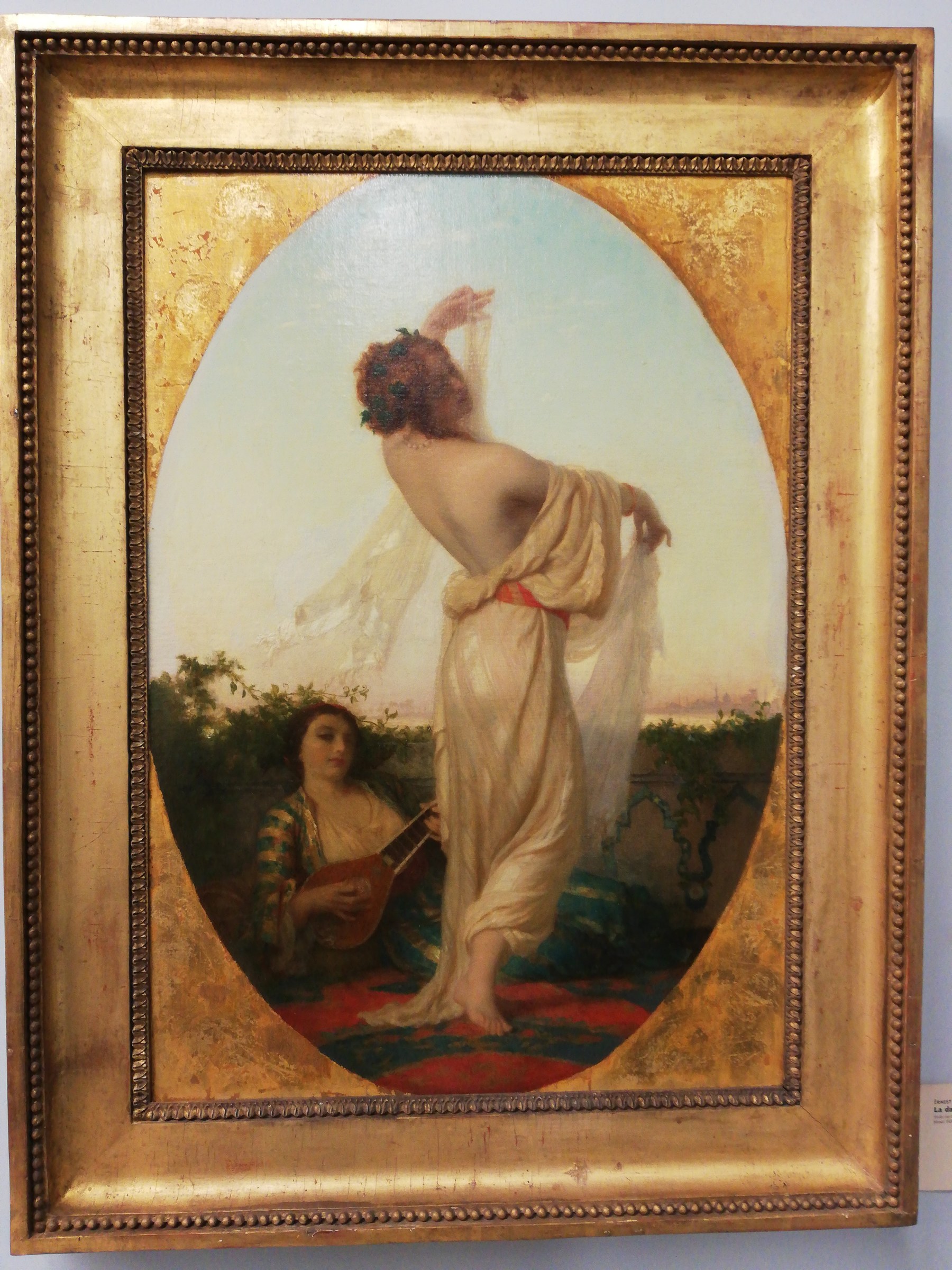
La danse orientale - Hébert
Ernest Hébert
- Medium:
- Oil Painting
- Era:
- Mid 1800s (Polka Era)
- Source:
- Wikimedia Commons
- Rights:
- Public domain — free to use, share and adapt.
- Recorded as:
- Public Domain
For dance historians and scholars of visual culture, this painting is crucial evidence of how Orientalism worked through the dancing body. It shows that 'Oriental dance' in European art was never a documentary form but a projection—one that mapped neoclassical European aesthetics onto an imagined non-European other. Understanding this painting is essential for decolonizing dance history and recognizing the gap between what Europeans said they were depicting and what actually existed in Middle Eastern dance practice.
What you are looking at
A standing female figure in classical drapery dominates the composition, her body twisted in a contrapposto pose with one arm raised dynamically above her head. She wears a pale yellow-cream chiton that falls loosely to her feet, with a red cord or binding at the waist. Her hair is dark and elaborately arranged, crowned with what appears to be a reddish ornament or wreath. The figure's pose suggests movement—the torso turns, the raised arm creates lift, the opposite leg appears to support weight while the other trails. She stands on red drapery or a carpet in the foreground. To the left sits a darker-skinned attendant or musician in green and gold dress, holding what appears to be a stringed instrument (possibly a lute or oud), watching the standing figure. The background shows a hazy Orientalist landscape with low hills and small figures in the middle distance, painted in soft ochre and blue tones. The entire composition is framed within an oval, which itself sits within an ornate gilded frame with beaded molding.
The dancing
The primary dancer's body demonstrates a pronounced S-curve: the weight appears anchored through one leg while the hips and torso twist sharply, the opposite shoulder dropping as the arm lifts overhead. This is not a closed partnered hold but a solo figure in active motion. The raised arm is extended and slightly curved, the hand relaxed. The attendant figure is seated and stationary, providing a base of stillness that emphasizes the dancer's movement. The pose reads as mid-phrase—not an arrival, but a moment of propulsion or transition.
The dance depicted
This is labeled as 'Oriental dance' in the catalogue record, and the painting appears to depict Raqs Sharqi (belly dance) or a related Middle Eastern solo dance form as understood in 19th-century European Orientalist imagination. However, the artist has taken significant liberties. The costume—a loose Greco-Roman chiton rather than the fitted, hip-centered dress of actual Middle Eastern dance—and the contrapposto pose reflect neoclassical rather than authentic belly dance vocabulary. The raised arm, the spinal twist, the weight distribution suggest European academic drawing of the figure in motion rather than the isolated hip and abdominal articulation central to Raqs Sharqi. The musician and setting position this as a courtyard performance for an audience or patron, consistent with Orientalist fantasy. The dance depicted is an invented hybrid: the vocabulary is European neoclassical movement, but the setting, costume, and framing device ('Oriental') attempt to signal non-European origin.
How it was made
Oil painting on canvas, with high finish typical of mid-19th-century French academic art. The artist has used soft glazing and careful modeling to create luminous skin tones and delicate drapery folds. The oval composition within a rectangular frame was a common device for framed prints and engravings of the period, suggesting this work may have been widely reproduced as a print. The gilded wood frame itself is substantial and decorative, indicating this was a high-value, high-visibility object for a wealthy interior. The technique allows for the subtle rendering of movement in the figure's pose and the atmospheric perspective of the distant landscape.
About this work
Ernest Hébert's *La danse orientale* (1846) is an oil painting that deploys the visual grammar of European neoclassical figure drawing to depict an imagined Oriental dance performance. The work sits at the intersection of academic painting, Orientalism, and the early 19th-century European fascination with dance as a marker of exoticism and sensuality. It belongs in a dance history context not because it accurately documents Middle Eastern dance practice, but because it reveals how European artists constructed and circulated ideas about 'Oriental' movement through the apparatus of high art. The painting exemplifies a specific moment when dance was used as a vehicle for colonial fantasy: the standing figure's graceful contrapposto and raised arm read as refined and civilized to a European viewer, while the setting, attendant musician, and Orientalist framing insist that this refinement comes from elsewhere. The work is a primary document of how dance was gendered, exoticized, and consumed as spectacle in the 19th century.
How to look at it
Attend first to the dancer's pose and how it differs from the costume and setting that frame it. The body's architecture—the S-curve, the raised arm, the weight distribution—comes straight from the European academic tradition of figure drawing; there is no articulation of the hips, no isolation of the abdomen, none of the movement vocabulary that defines Raqs Sharqi. Notice too how the seated musician is rendered almost as furniture—ornamental, subordinate, present only to signal 'Orientalism.' The oval frame and the hazy distant landscape create distance and fantasy; this is not a moment the artist witnessed but an imagined scene. Finally, consider how the neoclassical drapery and the dark-skinned attendant together claim that this movement is both refined (European) and exotic (Other). This is the essential work Orientalist art performs.
The artist
Ernest Hébert (1817–1908) was a French academic painter and director of the Académie de France in Rome. He specialized in historical subjects, biblical scenes, and Orientalist imagery, which were immensely popular with wealthy patrons and museums in the 19th century. His work is characterized by romantic sentiment, exquisite finish, and a taste for exotic and sensual subject matter. Hébert was part of the institutional apparatus of the Salon and the French academic tradition that produced and canonized Orientalist painting. His *La danse orientale* is representative of his practice: carefully composed, technically accomplished, and thoroughly immersed in the aesthetics and ideology of his time and place.
The period
In 1846, when this work was painted, European Orientalism was at a cultural peak. The Romantic movement had elevated sensibility, exoticism, and the 'other' as objects of aesthetic desire. Dance, in particular, was being packaged as an expression of non-European, often coded as non-rational, emotional, and erotic otherness. This was the era immediately before Marius Petipa and the Russian Imperial Ballet, when European ballet was still exploring how to incorporate 'character' dances—Spanish, Arab, Persian—into its vocabulary. Meanwhile, actual Raqs Sharqi practitioners and musicians in Cairo, Istanbul, and beyond were developing sophisticated solo and ensemble forms; none of this appears in Hébert's fantasy. The painting also predates the arrival of touring belly dancers in Europe (the 1860s onwards), so it represents European imagination unfettered by direct encounter.
Where it lives
The work is recorded in Wikimedia Commons and is held in an unspecified collection. No current holding institution is documented in the catalogue record. As a finished oil painting by a known 19th-century French academician, the work likely circulated in salon exhibitions and was potentially reproduced as an engraving or lithograph.
Dance in this work
Questions about this work
Is this what belly dance actually looked like in 1846?
No. The pose, arm vocabulary, and body carriage all reflect European neoclassical figure drawing. Actual Raqs Sharqi, whether performed in domestic settings or public venues in the Middle East at this time, centered on isolated movement of the hips, torso, and abdomen—movement that is barely present here. The costume is also fantastical: the loose Greco-Roman chiton bears no resemblance to the fitted dress worn by belly dancers. This is a European fantasy, not a documentary image.
Why is the musician so dark-skinned and subordinate?
This is a work of Orientalism, an aesthetic and political apparatus that represented colonized and non-European peoples as exotic, sensual, and subordinate to the European viewer. The attendant's darkness and her position—seated, functional, watching—reinforce a racial and colonial hierarchy. The standing dancer is elevated and framed as the object of aesthetic contemplation; the musician is merely instrumental.
What does the oval frame mean?
The oval frame was a common device in 19th-century reproductive prints and engravings; it signals that this image was designed to circulate widely, likely as a print, in middle- and upper-class European homes. The rectangular gilded frame around the oval further emphasizes luxury and display. This is not a private sketch but a finished work meant for public exhibition and reproduction.
Could Hébert have actually seen belly dancers perform?
In 1846, probably not. Touring belly dancers did not arrive in Europe in significant numbers until the 1860s and later, especially after the opening of the Suez Canal. Hébert may have drawn on travel narratives, etchings, or literary descriptions, but the painting is clearly a product of imagination and European academic training rather than observed experience.
More dance artwork