49 works in this view — arrow keys or swipe to move between them.
Dance in Art · 1874
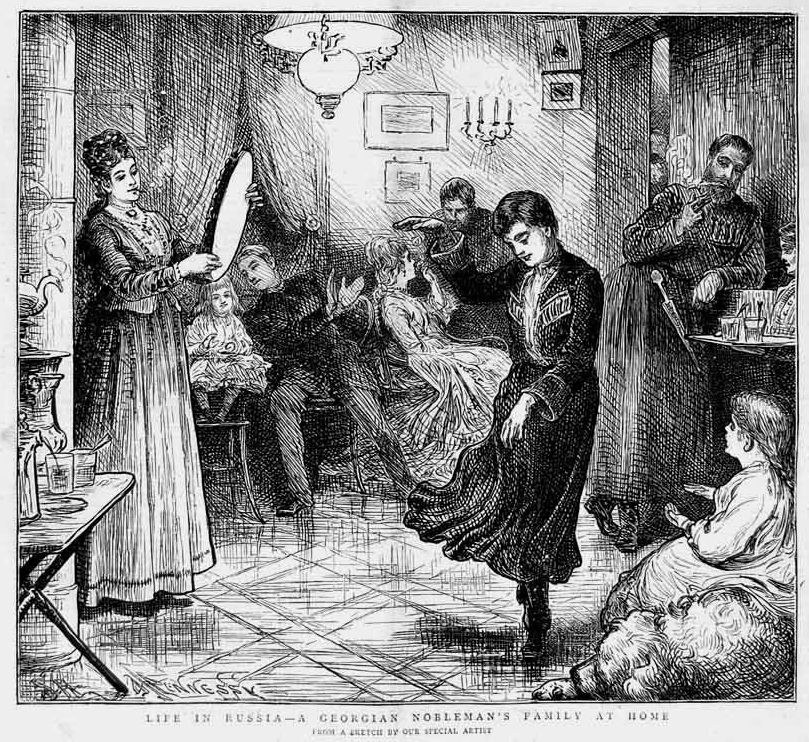
Life in Russia - Georgian nobleman's family at home. The Graphic, 1874
William John Hennessy
- Medium:
- Oil Painting
- Era:
- Late 1800s (Victorian Ballroom)
- Source:
- Wikimedia Commons
- Rights:
- Public domain — free to use, share and adapt.
- Recorded as:
- Public Domain
This engraving documents a non-ballroom form of movement—calisthenic display or acrobatic flexibility—that occupied the same social space as dance in Victorian life but has been largely erased from dance history. It demonstrates how 19th-century periodical illustration functioned as an instrument of social reporting and surveillance, translating private domestic life into public spectacle. The work also offers a window into the training and display of female bodies in aristocratic households, a history that complicates the standard narrative of women's movement practices in the era.
What you are looking at
A Georgian aristocratic household in Imperial Russia gathers in an elegantly appointed interior for an evening's entertainment. The room is furnished with period taste: a mirror hangs above a mantelpiece, a candelabra provides overhead light, and framed pictures punctuate the walls. A young woman in a pale dress stands at the center-left, her body arched backward in an exaggerated pose, supported or steadied by a seated gentleman in dark formal dress. Around them, other family members—men in military or formal coats, women in dark dresses—watch intently. The composition suggests a moment of performance or display rather than ballroom formality: the watching figures are clustered and still, their attention focused on the central pair. The engraving's fine hatching creates depth and shadow, emphasizing the theatricality of the pose and the voyeuristic attention of the onlookers.
The dancing
The central female figure leans backward dramatically, her spine curved, her arms extended, in a posture that suggests flexibility or acrobatic display rather than ballroom partnership. The seated man beside her appears to support or frame her body. The other figures—perhaps five or six additional family members—sit or stand in informal groupings, their bodies angled toward the center, functioning as audience rather than participants. There is no evidence of the closed hold, frame, or symmetrical positioning of formal ballroom dance. The asymmetry and the archival quality of the pose suggest something closer to parlor gymnastics or a demonstration of feminine accomplishment.
The dance depicted
This image most likely depicts not a structured ballroom dance but rather a parlor entertainment or physical display—possibly involving calisthenic exercise, acrobatic posturing, or what Victorians termed 'calisthenics' for ladies. The 1870s saw a growing fashion for physical culture and flexible movement training among aristocratic women, and the exaggerated backward arch and the spectatorial arrangement suggest a demonstration of accomplished flexibility rather than social dance. The title's focus on 'life in Russia' and the domestic setting indicate this is ethnographic or domestic reporting rather than theatrical performance.
How it was made
This is an engraving or wood engraving, evident from the systematic parallel hatching and cross-hatching that model form and shadow throughout the composition. The technique allowed for mass reproduction and circulation via periodical publication—this appeared in The Graphic, a weekly illustrated newspaper with a substantial middle-class readership. The precision of the line and the rendering of fabric, facial expression, and spatial depth were carefully controlled to convey social observation and documentary detail. Engraving was the dominant medium for journalistic illustration in the 1870s, and the technique's capacity to capture nuance of gesture and domestic intimacy made it ideal for the 'slice of life' reporting that characterized The Graphic's editorial mission.
About this work
William John Hennessy's engraving documents a moment in a Georgian nobleman's household, published in The Graphic in 1874 as part of a series of illustrations on Russian aristocratic life. The work captures not a ballroom dance but a parlor demonstration of physical accomplishment—likely a display of flexibility, acrobatics, or calisthenic exercise. The composition emphasizes observation and domestic performance: the central female figure's exaggerated backward arch becomes a spectacle for the assembled family, who watch with rapt attention. This belongs in a gallery of dance in art not because it depicts structured dance technique, but because it records a form of bodily display and movement training that was part of the period's understanding of what counted as accomplished movement for women. The work is also significant as a document of Victorian-era journalism: it shows how illustrated newspapers used engraving to bring foreign and domestic social life into the parlor, framing physical culture and feminine display as worthy of artistic and editorial attention.
How to look at it
Attend to the geometry of the composition: the central backward arch of the female figure and the way all other bodies radiate toward that point, creating a clear hierarchy of importance and a voyeuristic dynamic. Note the contrast between the dramatic, exposed flexibility of the central pose and the formal, clothed stillness of the observers. The engraver's technique—the precise hatching and the careful differentiation of textures (fabric, skin, furniture)—gives the scene a documentary air of factual observation, yet the carefully choreographed attention of the onlookers and the artificial quality of the pose suggest this is staged performance, however domestic. The title's emphasis on 'life in Russia' invites you to read this as anthropological observation, but the theatricality of the arrangement suggests the scene is being framed for Western editorial consumption.
The artist
William John Hennessy (1839–1917) was an Irish illustrator and painter who became a prolific contributor to The Graphic from its founding in 1869. He specialized in domestic and social scenes, often with narrative or sentimental content. His work combined careful observation of contemporary dress and interior design with an eye for gesture and psychological engagement, making him a valued illustrator of the kind of 'slice of life' reporting that defined The Graphic's editorial identity. He exhibited at the Royal Academy and maintained a career as a painter, but it is his journalistic illustrations that have survived most vividly.
The period
The 1870s saw a remarkable expansion of illustrated journalism in Britain, with The Graphic (founded 1869) and The Illustrated London News competing for a growing middle-class readership hungry for visual documentation of contemporary life, both foreign and domestic. Russia held particular fascination for Victorian audiences, and accounts of aristocratic life—their customs, furnishings, and domestic practices—were standard editorial fare. The same decade witnessed growing interest in physical culture and calisthenics for women, driven by concerns about health and the limitations of corsetry, and parlor gymnastics or 'scientific movement' became fashionable among educated and wealthy families. The image sits at the intersection of these currents: it is both a journalistic report on Russian aristocratic life and an inadvertent record of Victorian physical culture and the display of flexible bodies in domestic space.
Where it lives
This is a reproduction from Wikimedia Commons, where the image is sourced from The Graphic, a weekly British illustrated newspaper. The original appeared on 14 February 1874. The holding collection is not recorded in the catalogue, but the work exists as part of the digitized archive of 19th-century periodical illustration.
Questions about this work
Is this actually a ballroom dance?
No. The composition and the posture are incompatible with structured ballroom dance of the period. This appears to be a display of flexibility, acrobatic ability, or calisthenic exercise—forms of physical accomplishment that were part of aristocratic women's training but do not constitute dance in the technical sense. The voyeuristic arrangement—the central figure performing while others watch—also differs from the social reciprocity of ballroom dancing.
Why is this in a dance gallery at all?
Because it documents a form of movement training and display that occupied adjacent social and bodily territory to dance in the 19th century. Calisthenics, acrobatic flexibility, and 'scientific movement' were sometimes conflated with dance or deployed in theatrical contexts. More importantly, the work illuminates how Victorian culture understood and celebrated accomplished movement in women's bodies, and how illustrated journalism framed and circulated knowledge about foreign aristocratic practices.
What does the backward arch tell us about Victorian physical culture?
The exaggerated spinal flexibility on display here was prized as a marker of aristocratic accomplishment and good health. It signaled both the physical freedom and the controlled training available to privileged women. The posture would have been achieved through regular calisthenic exercise and flexibility training, and its display in a family gathering suggests it was understood as a legitimate form of social performance—though a private rather than public one.
More dance artwork