46 works in this view — arrow keys or swipe to move between them.
Dance in Art · 1864
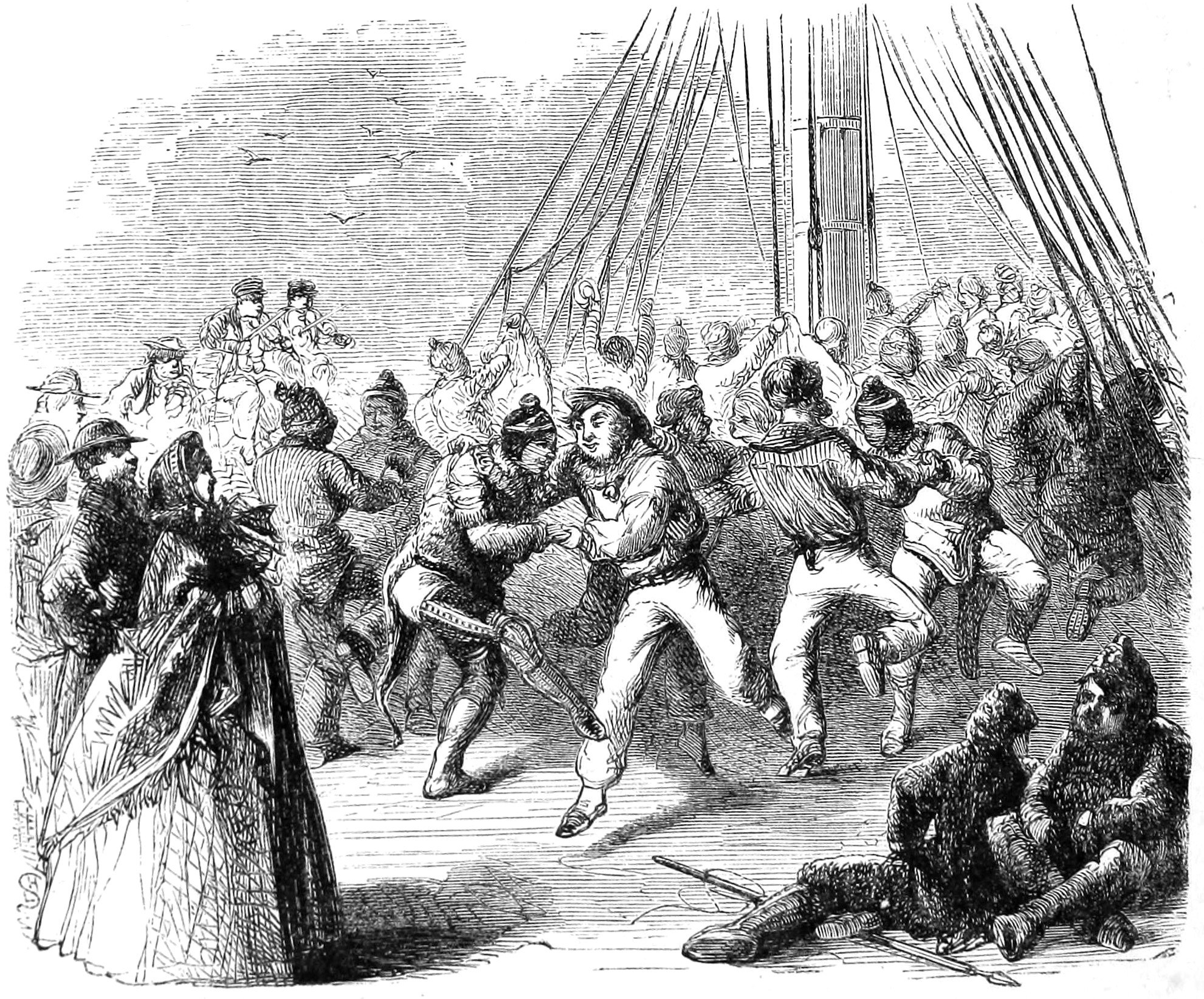
Life with the Esquimaux - 1864 - Volume 1 page 70
Charles Francis Hall
- Medium:
- Oil Painting
- Era:
- Mid 1800s (Polka Era)
- Source:
- Wikimedia Commons
- Rights:
- Public domain — free to use, share and adapt.
- Recorded as:
- Public Domain
This is one of relatively few visual documents of spontaneous, vernacular maritime dancing from the 19th century, showing how sailors and working-class passengers actually moved and socialized rather than how dance masters prescribed they should. It also provides evidence of how dance functioned as cross-cultural encounter and entertainment during exploration voyages, making it valuable to historians of both dance practice and colonial contact.
What you are looking at
A crowded deck scene aboard a sailing ship, rendered in wood-engraving technique with dense cross-hatching. The composition is dominated by a tall mast with rigging running diagonally across the upper half of the frame. On deck below, a large group of sailors and passengers are gathered in informal clusters. In the foreground center, a man in light-colored clothing (white trousers and dark coat) stands with one leg extended in an exuberant posture, apparently dancing or leaping with both arms raised. To his left, other figures stand or gesture; to his right, more onlookers crowd around. The left side of the composition features several women in long dresses and bonnets, observing the scene with the formality of Victorian dress. At the bottom right, two figures who appear to be Indigenous (rendered with darker shading) sit or crouch, watching the proceedings. The sky above is rendered in fine parallel lines suggesting clouds or atmosphere. The entire scene captures a moment of shipboard recreation and cross-cultural encounter, with the light-clothed dancing figure as the focal point of the gathered crowd.
The dancing
The central dancer's posture is exuberant but not formally trained: one leg is extended or kicked forward while the torso is upright and arms are raised. The surrounding figures stand in loose groupings, many with hands gesturing or held at mid-height—some appear to be clapping or encouraging. No couples are in closed hold or ballroom frame. The positioning suggests informal social dancing among crew and passengers rather than choreographed ensemble work. The observer figures, especially the women on the left in Victorian dress, are stationary and contained, watching rather than participating.
The dance depicted
This depicts informal social dancing on shipboard, most likely a sailor's reel or jig of the mid-19th century. The exuberant solo gesture and the gathered audience are consistent with the step-dancing and solo showcasing typical of working-class maritime recreation. The illustration captures a moment of informal merrymaking during a voyage, where individual sailors would demonstrate skill and energy. The presence of Indigenous observers suggests this depicts a voyage of exploration or contact, and the dancing may reflect the cultural mixing that such voyages entailed. The style of movement—high-energy, individual, unpartnered—is consistent with vernacular maritime dance of the period rather than ballroom or theatrical forms.
How it was made
This is a wood engraving, identified by its fine linear cross-hatching, precise line-work, and the tonal range achieved through varying densities of parallel lines. The technique allowed for high-quality reproduction in printed books and periodicals, making this image part of a mass-produced illustrated narrative. The high degree of detail and the controlled tonal work suggest professional engraving. The technique itself was the standard for book and periodical illustration before photographic reproduction, and the density of the linework indicates this was meant to reproduce at a relatively small size within a bound volume.
About this work
This wood engraving illustrates a moment of shipboard social dance aboard the vessel George Henry, likely during an Arctic or polar exploration voyage in the 1860s. It captures an informal sailor's dance performed for the entertainment of crew and passengers, recorded in a popular illustrated account. The work documents how dance functioned as social recreation during long voyages and serves as a rare image of working-class maritime dance practice in the Victorian era. The presence of Indigenous observers and the multi-cultural crew composition adds historical weight to the image as a record of 19th-century contact and cultural encounter at sea.
How to look at it
Notice the solo, high-energy posture of the central dancer and the informal gathered crowd—this is not organized quadrille or cotillion but spontaneous, individual performance. The artist captured a moment of dynamic movement rather than a posed arrangement, with the dancer's raised arms and extended leg suggesting the exuberance of the moment. The composition pulls the viewer into the crowd, and the varied heights and postures of the surrounding figures create a sense of genuine gathering and response. The positioning of the Indigenous figures and the formal dress of the observing women at left establish the social and cultural boundaries within which this recreation took place.
The artist
Charles Francis Hall (1821–1871) was an American Arctic explorer and the captain of the whaling ship George Henry during a voyage to the Arctic in 1860–1862. Hall documented his voyages in illustrated published accounts intended for a popular audience. He was not a professional artist, and the illustrations in his published narratives were likely engraved by professional illustrators based on his sketches or descriptions. His work represents a significant record of 19th-century Arctic exploration and the daily life aboard exploration vessels.
The period
The 1860s saw a surge of public interest in Arctic exploration and illustrated narratives of voyage and discovery. Wood engraving had reached its technical peak and was the dominant medium for book and periodical illustration. Social dance aboard ship was a documented and accepted form of crew recreation and morale-building, particularly on long voyages. The image reflects Victorian attitudes toward "native" peoples and the hierarchies of shipboard society, with Indigenous observers positioned distinctly from the European and Anglo-American crew and passengers. Informal step-dancing and solo showcase dances remained the dominant form of social dance among working-class and maritime populations, in contrast to the ballroom dancing documented in middle-class parlor imagery of the same period.
Where it lives
This engraving appears in Charles Francis Hall's illustrated account of his Arctic voyage, published as Life with the Esquimaux in 1864. The image is part of a narrative documentation of exploration and daily life aboard ship, intended for a popular reading audience. The work exists as part of this published volume and may also circulate as a stand-alone engraving reproduced from the original publication.
Dance in this work
Questions about this work
Was this a formal dance or informal recreation?
This was informal social dancing for crew recreation during a voyage. The solo performer, the casual postures of the surrounding figures, and the spontaneous gathering all indicate this was vernacular entertainment rather than choreographed or ballroom-style dance. Maritime crews regularly organized such dancing as a form of morale-building and social activity during long voyages.
Who are the people in this image?
The image shows crew and passengers aboard the George Henry during an Arctic exploration voyage. The women in Victorian dress at left are likely passengers or officers' wives; the sailors in lighter clothing form the majority of the gathered crowd. The figures at lower right, rendered with darker shading, are identified as Indigenous people, suggesting this voyage had contact with Arctic Indigenous populations.
How do we know this is a real historical moment and not invented?
This engraving comes from Charles Francis Hall's published narrative of his Arctic voyage of 1860–1862, an illustrated account intended as a documentary record for the reading public. While the specific details may be the engraver's interpretation of Hall's descriptions or sketches, it represents the intended record of actual shipboard life and practice during the voyage.
What can this image tell us about how sailors actually danced?
The posture, energy, and individual showcase style suggest sailor's reels or jigs—high-energy, solo or small-group step dances rather than couple dances. The lack of formal hold, the raised arms, and the exuberant leg extension are consistent with vernacular maritime dance traditions of the period.
More dance artwork