47 works in this view — arrow keys or swipe to move between them.
Dance in Art · 1834
Loja (1834)
David Roberts
- Medium:
- Oil Painting
- Era:
- Mid 1800s (Polka Era)
- Source:
- Wikimedia Commons
- Rights:
- Public domain — free to use, share and adapt.
- Recorded as:
- Public Domain
This work matters to dance history as a record of costume, fashion, and social gathering in the 1830s, but not as evidence of dance practice. It is valuable principally for costume historians and those studying Romantic-era travel, tourism, and the aesthetics of landscape painting.
What you are looking at
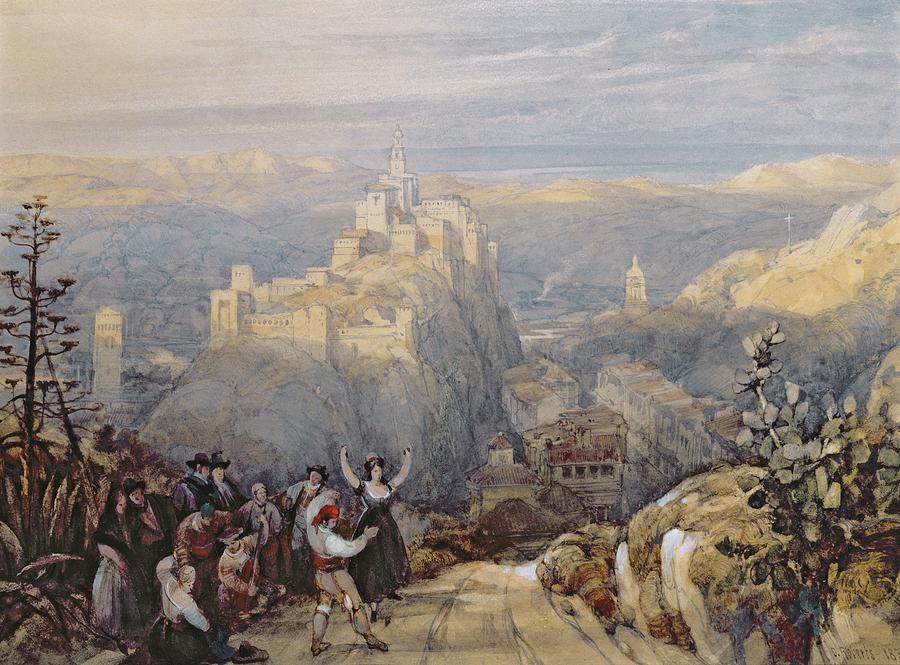
A panoramic landscape painting depicts the fortified city of Loja in Spain, viewed from an elevated vantage point. The composition is dominated by a grand castle perched dramatically on a rocky outcrop at center, its pale stone walls and towers catching warm golden light. The castle overlooks the walled city spreading below it in the middle distance. The foreground is populated with a substantial gathering of figures—at least two dozen people in early 19th-century dress—assembled on a dusty road or gathering ground. They wear the formal clothing of the period: the women in long dresses with bonnets or hats, the men in coats and breeches. The sky is luminous and hazy, rendered in pale blues and whites, and the surrounding landscape shows arid, rocky terrain with sparse vegetation—appropriate to southern Spain. The painting uses atmospheric perspective to recede from the foreground crowd through the middle-ground city to distant mountains. The overall effect is picturesque and Romantic, treating the landscape and architecture as the primary subjects while the assembled company serves to give scale and a narrative of tourism or pilgrimage.
The dancing
The assembled figures in the foreground are standing and moving in small clusters rather than in formal dance positions. A few individuals appear to gesture expressively toward the castle view, while others stand in conversational groups. The figures are painted with less detail than the architecture; their bodies are upright and stationary, their posture social rather than kinetic. There is no evidence of a coordinated dance hold, formation, or the specific framing of bodies that would characterize ballroom or theatrical dance. The gathering reads as an informal social assembly—possibly a tour group, pilgrim party, or local celebration—rather than a choreographed dance event.
The dance depicted
This painting does not depict dance. While it shows a festive or ceremonial gathering of people in a landscape setting, the figures' poses and groupings are social and processional rather than choreographic. The work belongs to the Romantic tradition of landscape painting with staffage figures—secondary human figures included to animate the scene and provide scale. Any movement suggested is tourism, sightseeing, or casual socializing rather than organised dance of any recognisable type.
How it was made
Oil painting on canvas, signed and dated 1834. Roberts was a Scottish painter celebrated for his architectural and landscape paintings, particularly his studies of Middle Eastern and Mediterranean sites. The work demonstrates his characteristic technique of combining precise architectural rendering with atmospheric landscape effects and Romantic golden light. Oil allowed him to build complex layers of detail in both the distant architecture and the populated foreground, achieving the luminosity and depth for which his work was prized. The scale and finish suggest this was a finished exhibition work rather than a sketch.
About this work
This is a Romantic-era landscape painting by David Roberts titled *Loja*, depicting the Spanish fortress city of Loja from an elevated viewpoint. A formal gathering of tourists, pilgrims, or locals in 1830s dress occupies the foreground, providing scale and narrative interest to the dramatic architectural and geological spectacle beyond. The work exemplifies the 19th-century picturesque tradition in which landscape, architecture, and history are the primary subjects, with figures serving a supporting compositional role. It belongs in an art-historical context far more than in dance documentation, as it records neither a dance event nor any choreographic intention.
How to look at it
Look first at the castle and landscape—the clarity and luminosity of the architecture against the hazy distant mountains is the true subject. Note how Roberts has positioned the viewer above and outside the scene, looking down and inward. The figures in the foreground are secondary; observe their posture and groupings as markers of scale and human presence rather than as the focus. The painting asks you to share the experience of the 19th-century tourist discovering a historic landscape, not to attend to their movement or interaction.
The artist
David Roberts (1796–1864) was a Scottish painter and architect best known for his detailed architectural and landscape paintings, particularly his travels and studies of Mediterranean and Middle Eastern sites. He was a founding member of the Royal Scottish Academy and travelled extensively to capture exotic landscapes and historic monuments, producing both oil paintings and lithographs that were widely published and celebrated. His work exemplifies the Romantic interest in distant lands, architectural history, and the picturesque landscape tradition.
The period
In 1834, when this work was painted, the Romantic movement in art was at its height, emphasising emotion, nature, history, and the picturesque. Travel and tourism to historical sites, particularly in the Mediterranean and Spain, were becoming fashionable among educated Europeans. Simultaneously, in dance, the Waltz Revolution was well underway in European ballrooms, but this painting does not engage with ballroom culture or formal social dance; instead, it reflects the broader Romantic fascination with landscape, history, and cultural exoticism.
Where it lives
The work is recorded as oil painting dated 1834, attributed to David Roberts. The current holding collection is not recorded. The painting was sourced via Wikimedia Commons, suggesting it is in a public collection but the specific institution is not stated in the available record.
Questions about this work
Is there actually dancing in this painting?
No. While the foreground includes a substantial gathering of people in formal dress, they are standing in conversational groups or gazing at the view. Their postures and positioning do not suggest choreography, formation, or any recognised dance form. This is a landscape and architectural painting with figures, not a dance scene.
Who was David Roberts and why did he paint Spanish landscapes?
David Roberts was a Scottish painter and architect (1796–1864) celebrated for his detailed renderings of historic buildings and landscapes across the Mediterranean and Middle East. He was a prolific traveller and draftsman, publishing his sketches as lithographs that were enormously popular. Loja was part of his broader project documenting the architecture and landscape of Spain and the Islamic world.
What is the painting's historical significance?
The work is significant as a record of 19th-century Romantic aesthetics, tourism, and architectural enthusiasm. It documents costume and fashion of the 1830s and the contemporary taste for picturesque travel to historic European sites. For dance history, it is a peripheral source only—useful for understanding the social context and dress of the period, but not evidence of dance practice.
More dance artwork