48 works in this view — arrow keys or swipe to move between them.
Dance in Art · 1850
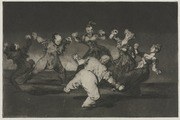
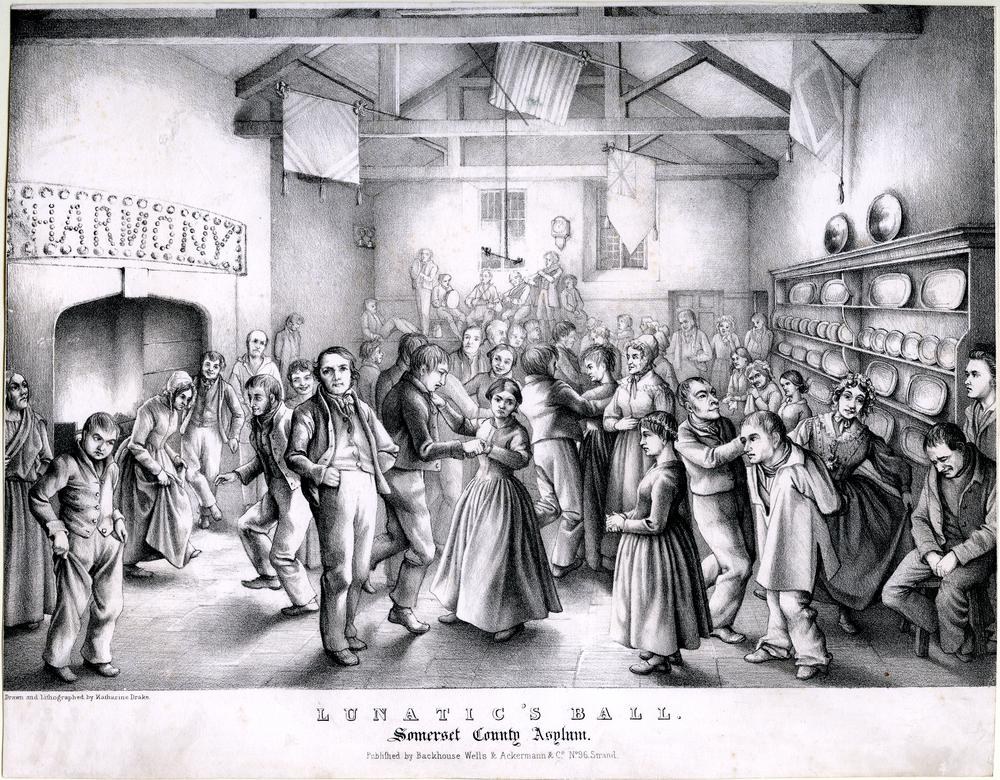
Lunatic's Ball (BM 2013,7081.1)
Print made by: Katherine Drake Published by: Backhouse Published by: Ackermann
- Medium:
- Lithograph
- Era:
- Mid 1800s (Polka Era)
- Source:
- Wikimedia Commons
- Rights:
- Public domain — free to use, share and adapt.
- Recorded as:
- Public Domain
This is rare visual testimony to institutional dance and the physical culture of the supposedly irrational or mad in the mid-19th century. It shows dance not as a refined art or courtship ritual but as cathartic collective action, and it records how the bodies and movements of marginalized people were mediated through print culture for mass consumption—sometimes with sympathy, sometimes with mockery.
What you are looking at
A crowded kitchen or hall erupts in chaotic revelry: men and women of all ages dance, leap, and caper together in a space defined by vernacular domesticity. A fireplace dominates the left wall, marked above with a painted sign reading "Harmony"—an ironic caption to the pandemonium below. To the right, a tall dresser displays crockery in neat rows, a sharp contrast to the tumbling figures in the foreground. The ceiling is open to timber beams from which white cloths hang. In the background, a small stage or platform holds musicians playing for the dancers below. The lithograph captures a moment of uninhibited social mixing: a woman in a long dress stands near the center while men in breeches and shirts gyrate around her; children appear among the adults; figures lean, twist, and contort their bodies in ways that suggest genuine abandon rather than practiced steps. The crowded composition and overlapping figures create visual confusion that mirrors the scene's supposed disorder.
The dancing
The dancers exhibit exaggerated, often grotesque body positions—limbs akimbo, torsos bent at severe angles, faces contorted. There is no closed hold or formal frame visible; instead, bodies are isolated, sometimes adjacent but rarely partnered in the ballroom sense. Footwork is indistinct and secondary to the overall impression of physical release. The range of figures—tall men, women of varying build, small children—dancing together without hierarchy or formal grouping suggests social leveling. The energy is centrifugal rather than structured; no clear couples or sets emerge, and the viewer's eye cannot follow a coherent pattern of movement.
The dance depicted
This depicts social dance as practiced in a charitable or institutional setting—most likely a benefit or fundraiser at an asylum, workhouse, or similar establishment, suggested by both the title and the heterogeneous, un-self-conscious character of the participants. The dance appears to be a generic "country" or "barn" dance—the kind of unscripted, improvised social dancing that was common in working-class and institutional settings in the early 19th century. There is no evidence of fashionable ballroom technique (no waltz frame, no cotillion formation, no minuet deportment). Instead, this is caper and reel dancing of a raucous, even therapeutic kind: the physical exuberance reads as cathartic rather than refined. The title references lunacy, and the visual language suggests a satirical or sympathetic representation of the body in collective pleasure.
How it was made
This is a lithograph, a medium that allowed for detailed parallel work and tonal variation across a wide surface—visible here in the careful cross-hatching of shadows and the subtle gradations in the figures. The technique was well-suited to comic and narrative subjects and was relatively economical to produce and distribute. The publication by Ackermann (a major publisher of satirical and theatrical prints) and the credit to Katherine Drake as the lithographer place this work within the mass-market print culture of 1840s–1850s Britain. Lithography's capability to capture loose, gestural line-work is exploited here: the dancers' poses are sketched with energy and minimal detail, conveying movement rather than precision.
About this work
Lunatic's Ball documents a moment in the history of dance as social welfare and spectacle. Created during an era when the visibility of marginalized bodies—the poor, the mad, the institutionalized—was a source of both morbid fascination and satirical commentary, this print captures a dance event staged for and perhaps by inhabitants of an asylum. The work sits at an intersection: it is both a genuine record of dance as practiced outside the ballroom (and thus a document of vernacular physical culture) and a satirical or pitying representation of bodies understood as disordered or abnormal. The title itself—with its pun on "harmony"—marks the irony: a scene of supposed chaos bearing the label of order. For historians of dance, this is evidence of how dance functioned as entertainment, therapy, and spectacle in institutional life; for art historians, it exemplifies the 19th-century fascination with the "grotesque" body and marginal populations.
How to look at it
Attend to the contrast between the orderly dresser and fireplace (the domestic interior) and the chaotic human figures that inhabit it. Notice how the artist has used overlapping and crowding to convey simultaneity and confusion—there is no single focal point or moment of peak action, but rather a simultaneous eruption. Look at the individual poses: many dancers are mid-leap or mid-contortion, caught in ungainly positions that would be unthinkable in polite ballroom dancing. The sign "Harmony" above the fireplace is the key to reading the work's irony or satire: visual disorder beneath a label of order. Finally, observe the social mixing—age, gender, size, apparent status all dance together without distinction, which may read as leveling and democratic, or as evidence of the chaos attributed to institutionalized or "mad" bodies, depending on the viewer's sympathies.
The artist
Katherine Drake was an active lithographer in London during the 1840s–1850s, working primarily on satirical and theatrical subjects for the publisher Rudolph Ackermann and others. Women lithographers of this period were not uncommon—the medium's lower technical barrier compared to engraving made it more accessible—but few are recorded by name. Drake's output included satirical scenes of social life and theatrical performance, positioning her within the tradition of graphic satire and social commentary that flourished in British print culture after the Napoleonic Wars.
The period
The 1840s–1850s saw a growing interest in dance as an object of social observation and satire. The waltz and polka had recently arrived in Britain and were subjects of intense moral scrutiny; simultaneous with this anxiety about fashionable dance, there was a counter-tradition of celebrating rural, working-class, and folk dance as more "authentic." The expansion of institutional care (asylums, workhouses, orphanages) during this period brought the bodies and behaviors of the poor and mad into new visibility. Dance was sometimes prescribed as therapy or amusement in these settings, and such events were occasionally documented or satirized in the press. Lithography itself was at the height of its popularity as a medium for social and political commentary.
Where it lives
This lithograph is recorded in the British Museum (accession 2013,7081.1) and is known through Wikimedia Commons. It was published by Ackermann and others in the mid-19th century, placing it within the circulation of satirical and theatrical prints available to a broad London audience. The work survives as a discrete print, not as part of a series, though similar scenes of institutional or working-class revelry were common in contemporary print culture.
Dance in this work
Questions about this work
Is this a real dance, or the artist's invention?
The dance appears to be a generic social dance—a reel or country dance—of the kind common in working-class and institutional settings. The chaotic, individual poses suggest the artist was capturing the spirit of uninhibited social dancing rather than a specific choreographed form. It is both a record of how people actually danced in such settings and a satirical exaggeration of their supposed disorder.
What was a 'lunatic's ball'?
Some asylums and charitable institutions held dances or entertainments for and sometimes by their residents, as therapy, amusement, or fundraising spectacle. These events were occasionally documented in prints and newspapers. The term 'lunatic's ball' could refer to an actual benefit or event, or it could be satirical or generic—a label applied to any scene of apparent chaos or uninhibited behavior.
Why is 'Harmony' written above the fireplace?
The word 'Harmony' is ironic: the sign promises order and concord, while the scene below depicts tumult and individualistic action. This is characteristic of 1840s–1850s satirical print culture, which often used text and image in deliberate contradiction to generate humor or commentary on social chaos or hypocrisy.
What does this tell us about attitudes toward the mad or poor in the 19th century?
The print captures a moment when the bodies and behaviors of institutionalized or marginalized people were subjects of both fascination and derision. Whether the artist intended sympathy, satire, or mere spectacle is unclear; the work may reflect genuine therapeutic use of dance in asylums, or it may mockingly exoticize the bodies and movements of people deemed irrational or disordered. Both readings are historically plausible.
More dance artwork