43 works in this view — arrow keys or swipe to move between them.
Dance in Art · 1679
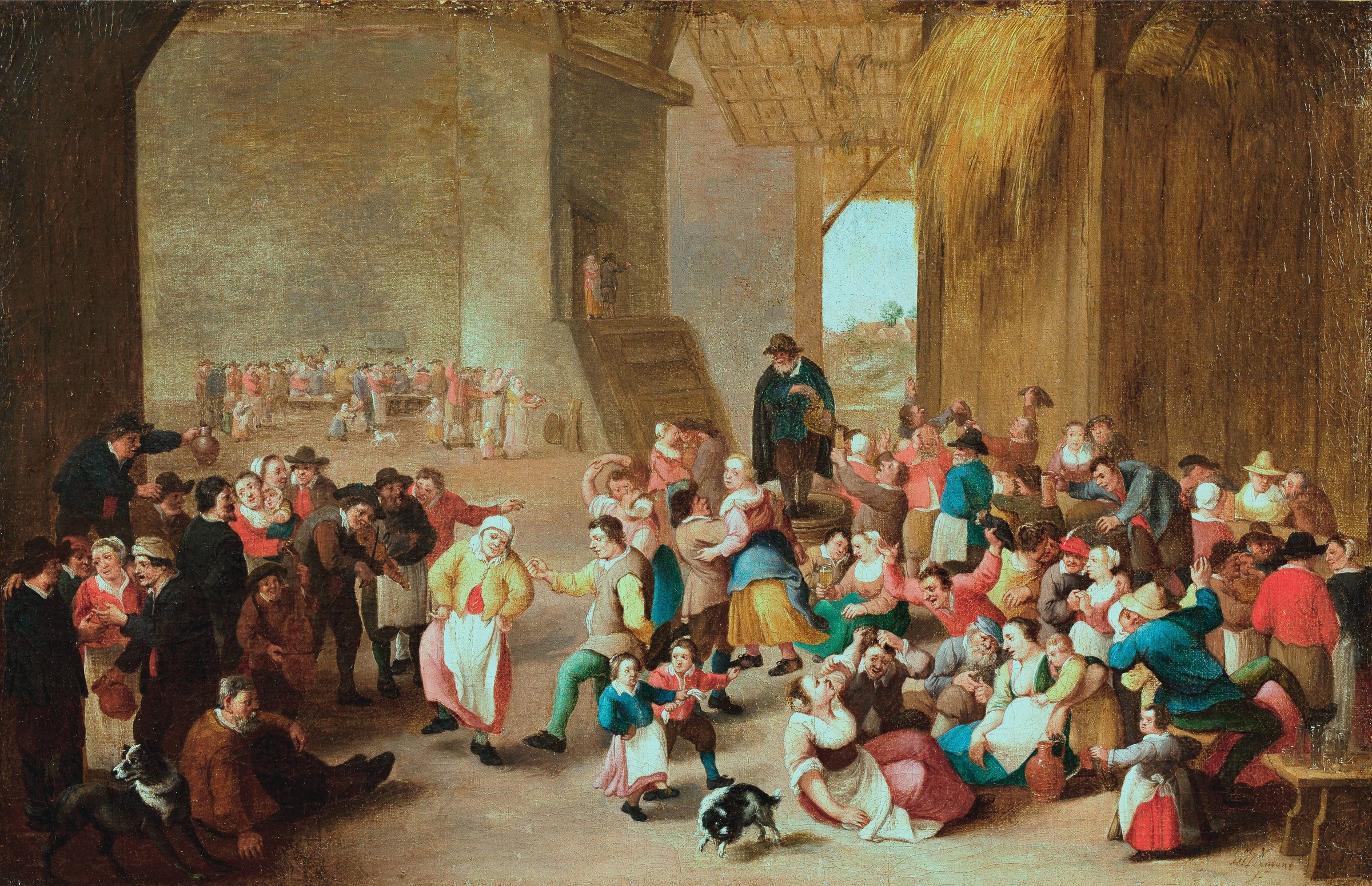
Mattheus van Helmont Feiernde Bauerngesellschaft
Mattheus van Helmont
- Medium:
- Oil Painting
- Era:
- Pre-1700 (Renaissance/Baroque)
- Source:
- Wikimedia Commons
- Rights:
- Public domain — free to use, share and adapt.
- Recorded as:
- Public Domain
For historians of social dance, the work offers rare visual evidence of how ordinary people danced together in non-theatrical settings—their clothing, spatial arrangements, partnering conventions, and the mixed-age, inclusive nature of village festivity. For art historians, it exemplifies the Baroque interest in genre scenes and vernacular life. For dancers, it provides a record of the embodied culture from which many surviving choreographies emerged.
What you are looking at
A crowded village celebration fills a cavernous stone building or barn with earthen floor. The architectural setting—massive stone walls, timber roof structure, and deep recesses suggesting rural construction—frames a dense, animated gathering of at least seventy figures of mixed ages. Peasants in bright reds, blues, yellows, and earth tones cluster throughout the space. In the middle distance, a small group dances: a woman in a red skirt and white apron is partnered with a man, while another couple moves nearby. Children play and sit scattered across the floor; dogs wander among the crowd. The light is warm and golden, entering from openings in the building and illuminating the scene unevenly, creating a sense of interior depth. The overall mood is festive and chaotic—multiple simultaneous activities rather than a single focal point, capturing the texture of village leisure rather than a formal performance.
The dancing
The central dancers appear to be in a closed or semi-closed hold, typical of couple dances. The woman in red shows a high-stepped, energetic carriage consistent with energetic social dancing. Surrounding figures stand, sit, crouch, and cluster in conversation or observation; several children are at ground level. The dancers move with verticality and lightness, their bodies upright and animated. No one wears pointe shoes or formal dance costume; all figures are dressed in period peasant and working-class garments. The overall impression is of vernacular social dancing among community members rather than trained or theatrical performers.
The dance depicted
This appears to document the kind of couple dances and group celebrations that were central to Northern European village culture in the 17th century. The specific style cannot be securely identified from the image alone, but the context—closed partnering, energetic movement, community setting—aligns with popular social dances of the Baroque period such as country dances, courantes, or regional variants. The presence of multiple dancers, onlookers, and children suggests this is a village festivity or celebration, likely a seasonal gathering or feast day. The painting documents the social function and community context of dance rather than its technical detail.
How it was made
Oil on linen canvas, modest in scale (33.5 × 54.5 cm). The technique is careful and observational: figures are rendered with attention to individual costume, gesture, and spatial relationship, yet the crowded composition and warm, unified tonality prevent any figure from dominating. The artist has used warm ochres, reds, and browns for the architecture and clothing, with cooler blue-greens for accents, creating atmospheric depth. The work appears designed for private collection or merchant display rather than for church or civic institution, consistent with the rise of genre painting among Northern European artists in this period.
About this work
This is an oil painting documenting a rural festivity or village celebration, likely from the Southern Netherlands or Flanders in the later 17th century, in which social couple dancing is embedded within a broader scene of communal leisure. The painting records not a formal dance occasion but the spontaneous, mixed-age, multi-activity character of village celebration. It belongs to a small but significant body of Baroque-period paintings—including works by Pieter Bruegel the Elder and his followers, and later genre painters—that took popular entertainment and peasant life as worthy subjects for artistic attention. The image is valuable precisely because it situates dance within its lived social context rather than isolating it as spectacle or technique.
How to look at it
Attend first to the multiple scales of activity: the dancing couple at center, the onlookers and conversationalists, the children at ground level, the dogs. Notice how the artist has compressed a whole village occasion into a single interior space. Look at the hands and arm positions of the dancing couple—where does the woman's arm go, how do their bodies relate? The spatial chaos and overlapping figures are not compositional weakness but documentary evidence: this is what a real village celebration looked like, not a staged or idealized scene. The warm light and warm palette create a mood of comfortable, lived experience rather than spectacle.
The artist
Mattheus van Helmont (c. 1623–after 1695) was a Flemish painter active in Antwerp and Brussels, specializing in genre scenes of rural and village life. He was part of a tradition of Netherlandish painters who drew subjects from peasant celebrations, markets, and domestic interiors, a tradition extending back to Pieter Bruegel. Van Helmont's work is characterized by densely populated compositions, careful attention to costume and regional detail, and a warm, earthy palette. His paintings were collected by prosperous merchants and minor nobility and circulated as cabinet paintings—small, portable works for private viewing.
The period
In the later 17th century, social dancing in rural and urban communities of Northern Europe took place primarily in outdoor spaces, inns, and communal buildings during celebrations tied to seasons, religious feast days, or life events. These dances—allemandes, courantes, country dances, and local variants—were documented in dance manuals for the aristocracy but also existed in vernacular forms that left little written record. Simultaneously, Baroque painters were increasingly interested in scenes of everyday life, peasant customs, and village entertainments as subjects worthy of serious artistic treatment. This painting sits at the intersection of these developments: it records the visual texture of 17th-century community life while participating in the art market's appetite for scenes of popular culture.
Where it lives
The work is recorded from Wikimedia Commons; no current holding collection is recorded in the catalogue. The painting appears to have been a private merchant or minor noble collection piece, likely Flemish in origin or sale, and may be held in a private European collection or a regional museum with limited online documentation.
Dance in this work
Questions about this work
What dance are they doing?
The specific dance form cannot be identified with certainty from the image, but the posture and partnering suggest a European couple dance of the Baroque period such as a courante or country dance. The painting documents the social context of dancing—mixed ages, festive setting, informal grouping—rather than the technical steps.
Is this a real event or an imagined scene?
It is almost certainly an imagined or generalized scene rather than a record of a specific event, but it is observational and detailed enough to serve as historical evidence about how villages actually celebrated. Genre painters of this period drew from life and from conventional scenes; the accuracy of costume and setting suggests familiarity with such occasions.
Why did Baroque artists paint peasants?
From the 16th century onward, Netherlandish and other Northern European painters found in village life and peasant customs a rich visual subject: bright colors, varied poses, narrative complexity, and the appeal of 'otherness' to an urban merchant and noble audience. Peasant scenes were also thought to contain moral lessons or comic value. By the 17th century, they were established as a respectable genre.
What does this tell us about 17th-century social dance?
It shows that social dancing was inclusive of multiple generations, integrated into broader festive activity, and practiced in communal interior spaces. Dancers wore ordinary working clothes, not special costumes. The movement appears energetic and upright, consistent with surviving dance manuals. The informal, spontaneous context stands in contrast to the formality of court dance.
More dance artwork