49 works in this view — arrow keys or swipe to move between them.
Dance in Art · 1846
Medve Imre Az ivó
Imre Medve
- Medium:
- Oil Painting
- Era:
- Mid 1800s (Polka Era)
- Source:
- Wikimedia Commons
- Rights:
- Public domain — free to use, share and adapt.
- Recorded as:
- Public Domain
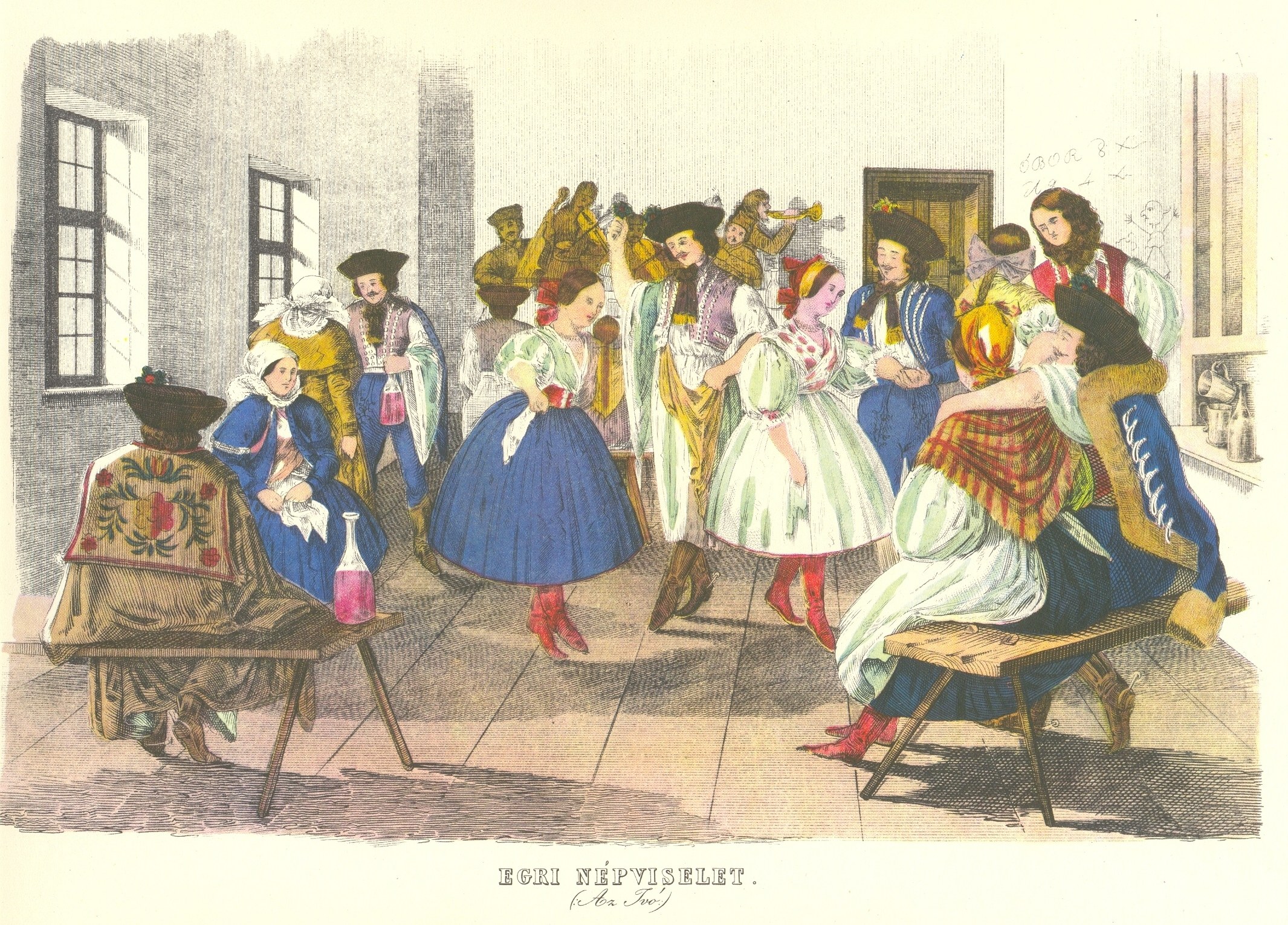
This is one of the few surviving images of 19th-century Central European village social dance made during the period itself, rather than a later nostalgic reconstruction or theatrical interpretation. It shows the dance not as movement technique but as social practice—how people actually danced together in taverns, what they wore, who participated, and how dance sat alongside music, drink, and conversation. For dance historians working outside the ballroom and theater, images like this are rare documentary evidence of how the majority of people danced.
What you are looking at
A crowded tavern or public room in 19th-century Hungary fills with figures in vivid regional dress. The setting is austere—whitewashed brick walls, tall windows with small panes, a tiled floor—but the color concentrates entirely on the people. In the center, a woman in a white dress with pink accents dances with a male figure, while around them clusters a dense group of onlookers and participants in jewel-toned jackets (blues, purples, deep greens), embroidered waistcoats, high-crowned hats, and headscarves. On the left, an elderly woman in a blue dress sits nursing a red bottle; on the right, another figure reclines on a bench. The composition is panoramic and busy, with no clear hierarchy—the dance is embedded in the social fabric rather than staged for display. Light enters from the tall windows on the left, creating a daylit tavern scene rather than an evening ball.
The dancing
The central dancing couple face each other in what appears to be a upright, social hold—not a closed ballroom frame but an open, conversational stance. The woman's white skirt suggests movement and weight shift; the man stands attentively. Around them, figures gesture, converse, and observe; several hold instruments (a trumpet or pipe is visible). The postures are relaxed and social rather than formalized—this is participatory village dance, not courtly performance. The density of figures suggests a social event where multiple interactions—dancing, drinking, conversation, music-making—occur simultaneously.
The dance depicted
This depicts Hungarian folk or village social dancing, most likely from the Eger region based on the catalogue note on regional costume. The specific dance form is not legible from the composition alone, but the setting—a tavern, daylight, mixed-gender couples, instrumental musicians present, dense social grouping—indicates social recreational dance rather than ceremonial or theatrical performance. The dress and the date (1846) suggest this is documentation of contemporary peasant or working-class village practice, captured at a moment when such scenes were becoming subjects of artistic interest in Central European visual culture. The relaxed stance and open positioning differ markedly from the closed holds and formal frames of contemporary ballroom waltz and quadrille, suggesting a local or regional style.
How it was made
This is a hand-colored engraving or lithograph, as evidenced by the fine hatching visible in the brick walls and the precise linear definition of the figures. The technique allowed for mass reproduction and distribution, suggesting this was made for a popular or illustrated press audience rather than a unique oil painting. The hand-coloring—applied in distinct, flat tones—indicates a commercial print, possibly from a journal or anthology of regional costumes and customs. The precision of the technique permits fine detail in dress and setting while the simplified color application keeps production cost manageable.
About this work
This work documents Hungarian village social dance in the 1840s, capturing the moment when such scenes became legible as subjects of ethnographic and artistic interest. The image is a record of how dance functioned in working-class and peasant social life: not as a discrete performance art but as one strand of a complex social gathering that included drinking, music, conversation, and courtship. The dense, non-hierarchical composition—where the dancers are embedded in a crowd rather than elevated above it—tells us that dance was participatory and social rather than spectatorial. For historians of dance practice outside formal or theatrical contexts, this image is valuable precisely because it refuses to isolate or romanticize the dance: it shows the dance as it was lived, as part of a tavern gathering, in regional dress, in daylight, with multiple simultaneous social acts occurring.
How to look at it
Attend first to the density and simultaneity of the scene: this is not a posed tableau but a moment of social gathering, with multiple actions and conversations occurring at once. The artist has chosen a moment mid-dance, but the dancer occupies no more visual weight than the drinking, talking, and music-making around them. Look at the dress: the embroidered waistcoats, high hats, and headscarves are meticulously rendered, suggesting the artist understood these as markers of regional identity and social belonging. Notice the open stance of the dancing couple and the absence of a closed ballroom frame—this tells you this is a different dance form from the contemporary ballroom waltz, more rooted in local practice and less influenced by urban fashion.
The artist
Imre Medve (also known as Medve Imre) was a Hungarian painter and lithographer active in the mid-19th century. Little is recorded of his training or exhibition history, but his practice appears to have concentrated on genre scenes and illustrations of Hungarian regional life, dress, and custom. The present work sits within a broader 19th-century European interest in ethnographic and costume imagery, often produced as hand-colored prints for popular circulation.
The period
The 1840s saw a surge of interest across Central Europe in documenting regional costume, folk practice, and 'peasant' life, driven both by nationalist sentiment and by the commercial success of illustrated periodicals and print collections. This was the era of the Waltz Revolution, when the closed-hold waltz had recently become mainstream social dance in ballrooms, yet village and working-class dance remained largely distinct in form, setting, and social meaning. Medve's image captures this divergence: while the urban ballroom waltz was formalized and increasingly codified, village dance retained open positioning, daylit settings, and deep integration with communal gathering. The work also dates to a moment when Hungarian national identity was becoming increasingly articulate and visually documented, making regional costume and custom subjects of pride and representation.
Where it lives
The work is recorded as sourced from Wikimedia Commons, with no holding collection noted in the catalogue record. It appears to be a historical print, likely from a 19th-century journal, costume collection, or illustrated publication documenting Hungarian regional life.
Dance in this work
Questions about this work
Is this a real dance or a made-up scene?
This appears to be a documentation of actual village social practice in 1840s Hungary. The specificity of the dress, setting, and social arrangement suggests the artist was recording what he observed, even if the scene is a composite or idealized version rather than a literal record of a single moment. The tavern setting, daylight, mixed-gender participation, and open dancing postures all align with documented practices of the period, making this credible as ethnographic rather than purely imaginative.
What dance form is this?
The specific Hungarian village dance form cannot be identified with certainty from the image alone. The open positioning and social tavern setting rule out the contemporary formal ballroom waltz and quadrille, suggesting a local or regional social dance form, but without more documentation we cannot name it precisely. What is clear is that this is not ballroom dance—it is community and village practice.
Why is everyone dressed so formally for a tavern?
This is not formal dress by 19th-century urban standards, but rather regional costume—everyday wear for the people of Eger and surrounding areas. The embroidered waistcoats, headscarves, and high hats were markers of regional identity and social belonging, not special occasion wear. The image documents how people in this region dressed for social gatherings.
How does this compare to the ballroom waltz of the same era?
This scene shows an entirely different dance world from the contemporary ballroom waltz. The setting is daylit and communal rather than a formal evening ballroom; the couple uses an open stance rather than a closed hold; there is no separation between dancers and non-dancers; music is provided by visible musicians rather than an orchestra. This reflects how dance was lived outside urban and aristocratic contexts—as participatory, social, and integrated into tavern life.
More dance artwork