49 works in this view — arrow keys or swipe to move between them.
Dance in Art · 1850
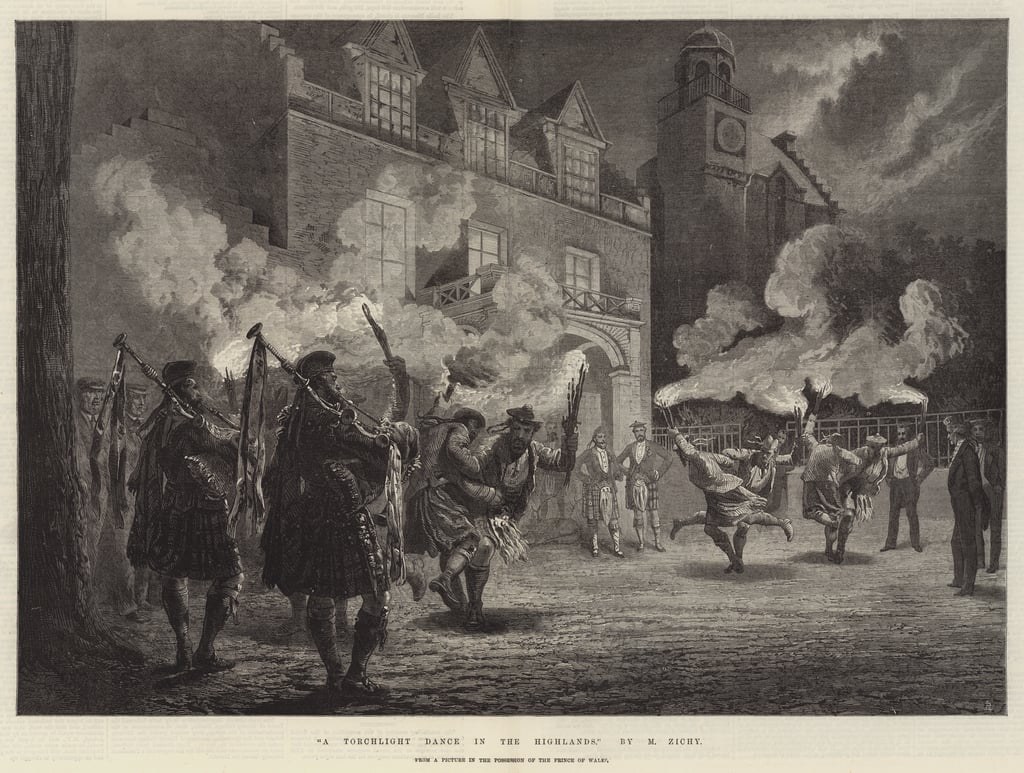
Mihaly Zichy-Torchlight Dance in Highlands
Mihály Zichy, painter
- Medium:
- Oil Painting
- Era:
- Mid 1800s (Polka Era)
- Source:
- Wikimedia Commons
- Rights:
- Public domain — free to use, share and adapt.
- Recorded as:
- Public Domain
Torchlight dancing was a genuine tradition in the Scottish Highlands, and Zichy's work documents its appearance and social context in the nineteenth century. For historians of folk dance and community celebration, the image preserves evidence of how this tradition was performed and understood by educated European audiences of the period. The work also demonstrates how artists of the era used engraving to capture movement and atmosphere in scenes of non-professional, non-staged dancing.
What you are looking at
A nocturnal Highland gathering unfolds around a bonfire in what appears to be a Scottish village street. Stone buildings with crow-stepped gables frame the scene, their windows glowing from interior light; a clock tower rises to the right. The fire burns intensely in the center, throwing dramatic light and smoke across the figures. Two soldiers or guards in full Highland dress—kilts, sporrans, and feathered bonnets—stand prominently on the left with flags or banners, suggesting official status. The crowd around them is mixed: men in civilian dress coats, women in long dresses typical of the mid-nineteenth century, and what appears to be children. The torchlight catches the swirling smoke and illuminates faces and fabric in strong chiaroscuro. The composition draws the eye from the guardians on the left toward the fire and the energetic movement of figures in the center and right.
The dancing
The two central uniformed figures stand relatively still and monumental, commanding the scene through their formal bearing and Highland regalia. Around them, other figures are captured mid-movement: several bodies are in active, animated postures suggesting rapid footwork and turning. Arms are raised and extended; skirts billow. The poses suggest spontaneous social movement rather than formal partnered dance—individuals and small groups moving in a kind of ecstatic or celebratory motion around the fire. No formal closed holds or structured couples are evident; instead there is the suggestion of swirling, leaping motion captured in the moment.
The dance depicted
This appears to be a social or folk gathering dance in a Scottish Highland setting, not a formal ballroom dance. The title specifies torchlight dancing, which was a real tradition in Scottish Highlands associated with celebrations, military gatherings, and communal festivals. The Highland dress of the soldiers and the mixed crowd suggest this is a moment of public revelry rather than staged performance. The energetic, loose groupings and the lack of formal partnership suggest this is closer to folk-regional or communal celebration than to the structured styles of the ballroom. The specific tradition of torchlight dancing in the Highlands is difficult to match to a single codified style, but the image conveys the spirit of spontaneous, celebratory movement in a public space.
How it was made
This is an engraving, as evidenced by the hatching, fine lines, and monochromatic tonal gradations characteristic of that medium. The technique allows for dramatic effects of light and shadow—the flames and smoke are rendered through densely worked parallel lines that create atmosphere and movement. The medium was widely used for reproduction and circulation in the nineteenth century, and the presence of a caption and credit line at the bottom suggests this was published as a print, making it accessible to a broad educated audience. The engraving technique's capacity for fine detail and dramatic tonal range makes it well-suited to capturing the theatrical energy of the scene.
About this work
Mihály Zichy's engraving depicts a torchlight dance in the Scottish Highlands, a social gathering animated by firelight and marked by the presence of uniformed Highland soldiers. The work captures a moment of communal celebration rather than formal staged dance, with figures in energetic, spontaneous motion around a central fire. It belongs in a gallery of dance in art as documentation of a specific folk tradition and as evidence of how nineteenth-century artists rendered movement, gathering, and the social life of dance outside the ballroom or theatre. The engraving is both a record of a cultural practice and a dramatic study in chiaroscuro and human energy.
How to look at it
Pay attention to the interplay of light and shadow: the fire is the center of emotional and compositional energy, and Zichy uses it to unify the diverse figures around it. The two uniformed soldiers function as a still point of authority and order against which the more fluid, animated movement of the celebrants reads most vividly. Notice the variety of poses and the lack of symmetry or formal arrangement—this is not a choreographed scene but a moment of spontaneous social motion. The engraver has captured movement through the angle of limbs, the sweep of drapery, and the overall restlessness of the composition, conveying the effect of firelight and collective energy rather than individual technique.
The artist
Mihály Zichy (1827–1906) was a Hungarian painter and printmaker known for historical scenes, genre works, and prints that circulated widely across Europe. He was active in the nineteenth century and produced both oil paintings and engravings, often depicting dramatic historical moments, military subjects, and cultural scenes. His work was popular among European collectors and publishers, and his prints were widely distributed, making him a significant figure in visual documentation of nineteenth-century life and history.
The period
The mid-nineteenth century saw a strong European interest in regional and folk traditions, particularly those associated with Scotland, which had been romanticized in literature and art since the late eighteenth century. Highland dress, culture, and customs became fashionable subjects for artists seeking to document and celebrate national identity and 'picturesque' traditions. Simultaneously, the engraving and print industry was at its height, and artists like Zichy produced works that fed public appetite for exotic or distant cultural scenes. The torch-lit gathering also resonates with Romantic-era interest in nocturnal, emotionally intense moments of human gathering and celebration.
Where it lives
The work is known through Wikimedia Commons. It is identified as an engraving and bears a caption crediting Zichy and noting that it comes from 'a picture in the possession of the Prince of Wales,' suggesting it was a published reproduction of a larger work and circulated as a print.
Dance in this work
Questions about this work
Was torchlight dancing a real practice in Scotland?
Yes. Torchlight gatherings and dancing were associated with Scottish Highland celebrations, military gatherings, and communal festivals, particularly in the eighteenth and nineteenth centuries. Such events combined social dancing with the spectacle of firelight and were documented by visitors and artists of the period. Zichy's work is a visual record of this tradition as understood by European audiences of the era.
What style of dance does this show?
The image does not depict a formal ballroom or theatrical dance style. Instead, it shows spontaneous, communal movement around a fire—the kind of joyful, unstructured social dancing that would have been common at Highland public celebrations. The Highland dress and military presence suggest this is documented as a cultural or national tradition rather than as a codified dance form.
Why does the image have soldiers in it?
The uniformed figures establish the context and lend authority or ceremony to the gathering. Highland soldiers were important to the romantic mythology of Scotland in the nineteenth century, and their presence may indicate a military or official occasion. They also serve compositionally to anchor the scene and contrast with the more fluid movement of the civilian dancers.
More dance artwork