49 works in this view — arrow keys or swipe to move between them.
Dance in Art · 1837
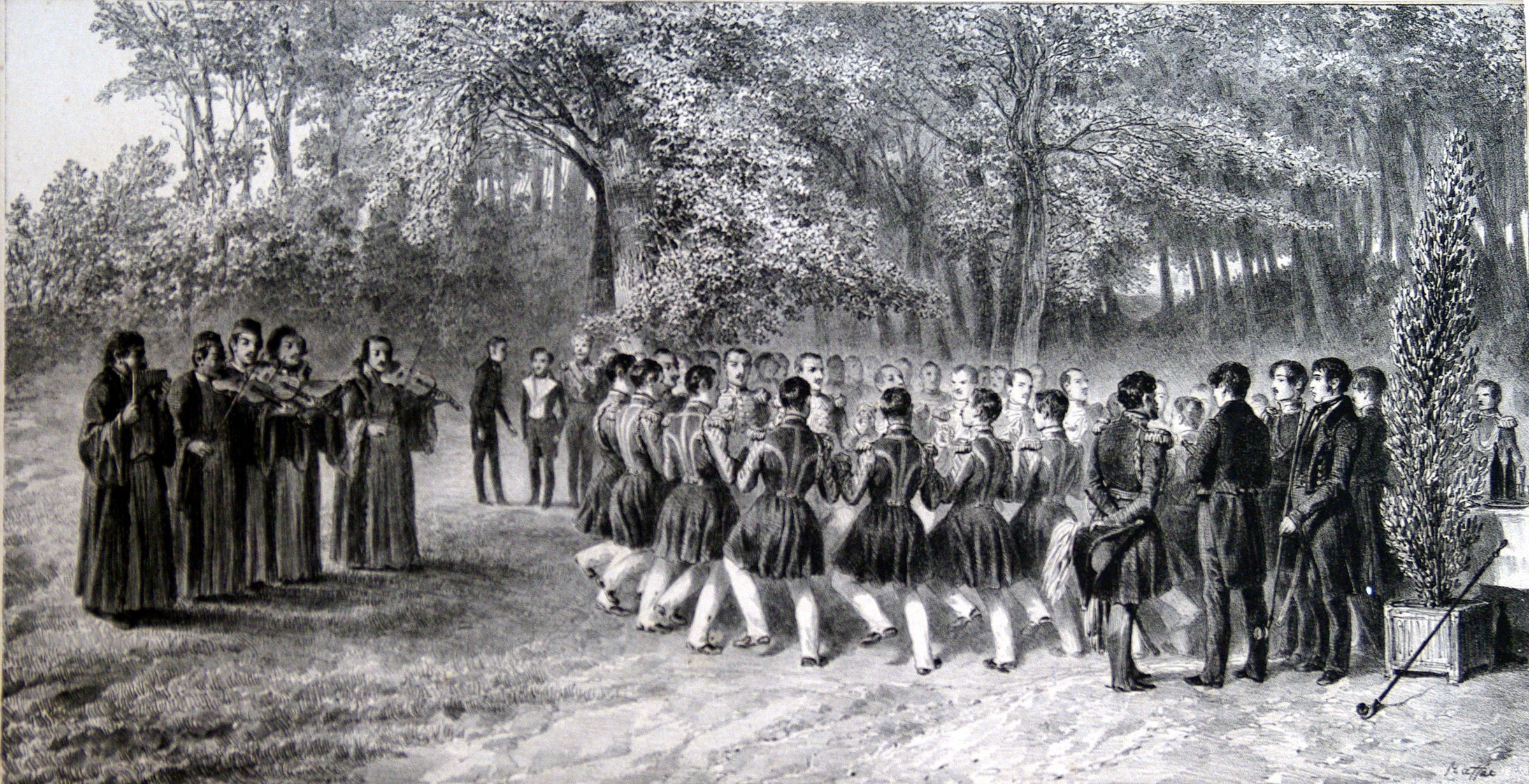
Musicians of the 2nd regiment, 1837
Auguste Raffet
- Medium:
- Oil Painting
- Era:
- Mid 1800s (Polka Era)
- Source:
- Wikimedia Commons
- Rights:
- Public domain — free to use, share and adapt.
- Recorded as:
- Public Domain
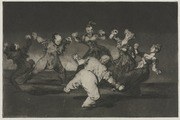
This is rare visual evidence of early-19th-century Wallachian dance practice from a credible eyewitness source, executed with enough technical precision to convey the dancers' actual formation and apparent movement quality. For historians of Romanian, Romani, and Balkan dance, the image preserves details of costume, group structure, and the social framing of performance that would otherwise be lost; it also documents the encounter between European military culture and local dance tradition at a specific historical moment.
What you are looking at
A formal outdoor gathering in a wooded setting depicts a circle of uniformed military musicians and soldiers observing a group of dancers in the center. The dancers, dressed in long dark skirts and white stockings, form a tight circular formation and appear to be executing a coordinated turning or spinning movement together. The composition is classical and symmetrical: spectators in dark military dress line both sides, creating a frame around the dancers, while tall trees recede into atmospheric perspective in the background. The engraving technique creates sharp contrasts between the figures and the forest, emphasizing the formal nature of this documented performance. The scene captures a specific moment—the dancers mid-motion, leaning inward, suggesting vigorous circular motion—with the watching soldiers standing at attention, suggesting this is an official or ceremonial occasion rather than spontaneous celebration.
The dancing
The eight to ten dancers in the center stand very close together, bodies angled inward toward a common axis, creating a unified turning or spinning formation. Their posture is upright but dynamic, with weight shifted as though executing rapid rotational steps. The dancers appear to be in a closed circular formation with arms at their sides or engaged with neighbors, moving as a coordinated unit. The surrounding soldiers stand rigidly in formal dress uniforms, creating a stark contrast: their stillness and vertical alignment emphasizes the kinetic energy of the dancers. The difference in bearing between the two groups—the dancers' lean and momentum versus the soldiers' formal stance—is the visual heart of the composition.
The dance depicted
This is documented as a ronde valaque, a Wallachian (Romanian) round dance, performed by Romani dancers at the residence of Prince Ghika, the Voivode (governor) of Wallachia, with the musicians of the 2nd Regiment providing accompaniment. The circular formation, close proximity of dancers, and inward-leaning posture are consistent with Southeastern European folk circle dances of the period. The Wallachian ronde is a traditional communal dance in which participants maintain contact and move in unified circular or spiral patterns, often with significant rotational or stamping elements. The presence of military musicians and the formal setting suggest this was a documented performance or demonstration rather than a village celebration, possibly for diplomatic or ceremonial purposes within the Ottoman-influenced Balkans of the 1830s.
How it was made
This is an engraving, a technique allowing fine linear detail and wide reproduction. The medium is evident from the parallel hatching that creates tonal gradation, the crisp outlines of figures and trees, and the characteristic white-on-black rendering. Engravings were the primary means of circulating visual documentation in the 1830s, particularly for documentary or ethnographic subjects; this technique allowed the image to reach military archives, print collections, and the educated public across Europe. The precision of the engraving technique suited the dual purpose of military documentation and artistic representation, capturing both the formal ceremonial context and the dynamic movement of the dancers with equal clarity.
About this work
This engraving documents a Wallachian round dance (ronde valaque) performed by Romani musicians and dancers in the household of the Prince of Wallachia around 1837, at a moment when the region was still under Ottoman suzerainty. The work is both an ethnographic record and a formal composition, capturing a specific cultural practice while observing the conventions of European print culture. It belongs in a dance gallery because it visually preserves a now-historical performance practice, showing not only the formation and movement of the dance but also its social context—the relationship between performers and patrons, the role of military musicians, and the formal documentary impulse that drove European artists to record non-Western dance traditions during this period.
How to look at it
Attend first to the dancers' formation and posture: the inward lean, the close grouping, and the apparent circular or spiral motion are the keys to understanding the dance itself. Notice how Raffet has frozen the movement at a moment of high energy—the dancers are clearly in motion, not posed—which tells us this was a vigorous, rhythmic dance rather than a stately one. Then observe the composition as a whole: the way the soldiers' rigid formality frames the dancers' kinetic energy creates the work's central tension, showing us not just what the dance looked like but what it meant in its social context—a performance for an audience of military and political authority. The engraving's linear precision allows us to read both the individual dancers' positions and the overall geometric order of the formation.
The artist
Auguste Raffet (1804–1860) was a French printmaker and draughtsman known for military and historical subjects, frequently traveling with military campaigns to document events and local customs. He worked extensively in etching and engraving, producing works of considerable technical refinement that combined artistic skill with documentary precision. Raffet was part of the 19th-century European fascination with ethnographic and orientalist subjects, and his travels—including time in Eastern Europe and the Mediterranean—yielded numerous prints recording regional customs, dress, and performance. His works were widely published and circulated, making him a significant transmitter of images of non-European cultures to European audiences.
The period
The 1830s marked both the height of Romantic interest in folk culture and the systematic European military and colonial expansion into the Balkans and the Eastern Mediterranean. Wallachia and Moldavia, semi-autonomous principalities under Ottoman suzerainty, were subjects of intense European curiosity and diplomatic maneuvering. The Romantic era celebrated folk dance and music as expressions of national character and authentic tradition, making them subjects of serious artistic and scholarly attention. Simultaneously, European military establishments were documenting the regions they moved through, creating hybrid works that combined artistic ambition with administrative record-keeping. The formality with which this dance is framed—surrounded by uniformed soldiers, set in a dignified wooded space, rendered with technical precision—reflects the period's simultaneous respect for folk tradition and assertion of European military and cultural authority.
Where it lives
The work comes from Wikimedia Commons and appears to be from a published engraving, likely distributed widely in 19th-century European prints and military or ethnographic publications. The catalogue record provides no accession number or current holding institution, suggesting the source is a digital reproduction of a work in public collections or archives not currently indexed in the record system.
Dance in this work
Questions about this work
What was a ronde valaque, and how is it different from other circle dances?
A ronde valaque is a Wallachian (Romanian) circle dance performed in close formation, typically with participants maintaining contact as they execute coordinated turning or stamping steps. It is regional to Wallachia and belongs to the broader family of Southeastern European folk circle dances. In this engraving, the dancers are packed tightly and leaning inward, suggesting vigorous rotational movement—quite different from the stately processional circles of some Western European traditions.
Why are soldiers surrounding the dancers?
The 2nd Regiment's musicians were the official accompaniment, suggesting this was a formal performance rather than a village celebration. The soldiers' presence and formal dress indicate this was likely a documented ceremony or demonstration, possibly for diplomatic purposes, given the setting in the household of the Prince of Wallachia. The military frame transforms the dance into an act of cultural representation rather than spontaneous celebration.
Who were the Romani dancers, and what was their role in Wallachian society?
Romani musicians and dancers held an important place in Wallachian entertainment and court life during the Ottoman period. The catalogue description identifies these performers as Romani (tsiganes), reflecting the historical role of Romani musicians in Balkan and Eastern European courts and noble households. Their performance for the Prince and his military guests shows their status as valued cultural practitioners, though they occupied a complex and often precarious position in Ottoman-era society.
How do we know what the dance actually looked like from this image?
The engraving captures the formation, posture, and apparent motion of the dancers with technical precision. The inward lean of the bodies, their close grouping, and the moment Raffet chose to freeze—mid-motion rather than at rest—all convey the dance's character: tightly coordinated, vigorous, and circular or spiral in motion. However, we cannot see footwork detail or the precise sequence of steps, so the image is a visual snapshot rather than a complete choreographic record.
More dance artwork