36 works in this view — arrow keys or swipe to move between them.
Dance in Art · 1829
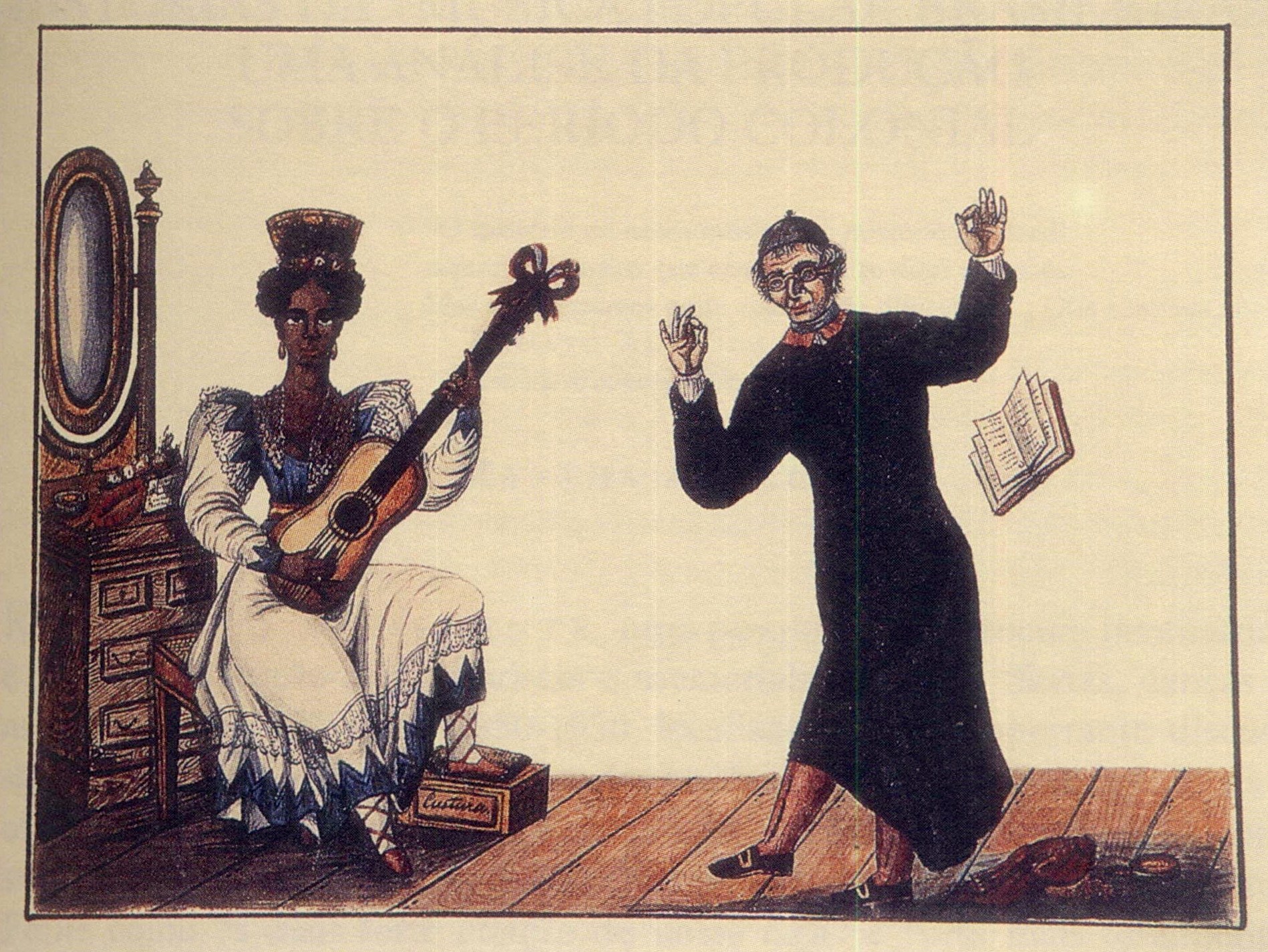
Negra ao violão, padre dançando
Unknown, c.1829
- Medium:
- Oil Painting
- Era:
- Early 1800s (Waltz Revolution)
- Source:
- Wikimedia Commons
- Rights:
- Public domain — free to use, share and adapt.
- Recorded as:
- Public Domain
This image documents an early visual engagement with Black musical culture and the transgressive dancing it could provoke in European and European-descended male subjects, offering insight into how dance functioned as a site of racial and class anxiety in the early 19th century. It is one of few surviving images that capture an encounter between a Black female musician and a white male dancer, and it does so through the distorting lens of satire and exoticization.
What you are looking at
A white woman seated at a dressing table plays a classical guitar while looking into an ornate oval mirror. She wears an elaborate white dress with blue and decorative lace detailing, and an ornamental headdress. Behind and to the right, a man in dark formal dress—a priest or clergyman, identifiable by his white collar and formal black coat—dances with his hands raised in a celebratory or ecstatic gesture. His posture is dynamic and energetic, with one arm extended upward and outward. The setting is an interior domestic space with a wooden floor and period furnishings. The composition creates a narrative tension: the woman is self-absorbed in her musical performance, while the man responds with uninhibited joy or religious fervor.
The dancing
The male dancer stands in a loose, open position with knees slightly bent and weight shifting. His arms are lifted and spread—one raised high, the other at mid-height—in a gesture that conveys exuberance or spiritual rapture rather than the controlled frame of European ballroom dance. His facial expression is animated and somewhat grotesque, suggesting performance or caricature. The female figure is seated and stationary, her posture formal and composed, creating a stark contrast with the man's abandon. The spatial relationship emphasizes a moment of response: her music provokes his dance.
The dance depicted
This appears to depict an improvised or vernacular social dance rather than a codified ballroom form. The man's uninhibited arm movements, open stance, and animated expression suggest a folk or creole dance tradition, possibly Brazilian, though the musical tradition (classical guitar) and the formal attire complicate a simple reading. The title 'Negra ao violão, padre dançando' (Black woman with guitar, priest dancing) indicates the two figures are differentiated by race and social status—the guitarist is identified as Black, the dancer as a priest. The image may document a moment of cultural exchange, social transgression, or satirical commentary on the crossing of class and racial boundaries through music and dance. The specific dance form cannot be definitively identified from movement alone.
How it was made
This is a hand-colored engraving or aquatint dating to approximately 1829, executed in the style of European satirical and ethnographic prints of the early 19th century. The medium allowed for sharp outlines and detailed costume rendering, while hand-coloring added social and racial signification through skin tone. The technique was well-suited to narrative and comic narrative—the exaggerated facial features and gestural clarity typical of the period's social commentary prints. Works of this type circulated widely in Europe and the Americas as popular prints, satirizing colonial subjects, musical entertainment, and cross-racial social interaction.
About this work
This early 19th-century print captures a charged moment of musical and terpsichorean encounter in what appears to be a Brazilian colonial or post-colonial setting. The woman's formal classical guitar performance and the priest's ecstatic response map onto broader anxieties about race, religion, sexuality, and cultural propriety in the Atlantic world. The image belongs in a gallery of dance because the priest's movement—however informal or improvised—is the subject of the composition, and the image documents a specific historical moment when vernacular dance and European formality collided in visual culture. The work sits at the intersection of dance history, visual satire, and colonial representation, showing how movement and music were encoded with social meaning.
How to look at it
Attend to the contrast in bodily control between the two figures: the woman's composed seated posture versus the man's unbounded, vertical extension. The artist has captured the priest mid-movement, his body caught in a moment of loss of clerical dignity—a satirical point about the power of music to unmake social order. The exaggeration of his facial features and the distortion of his gestures mark this as commentary rather than documentation. Look also at the setting: the dressing table, mirror, and domestic interior suggest private rather than public space, intensifying the sense of impropriety.
The period
The 1820s–1830s saw an explosion of lithographic and engraved satirical prints across Europe and the Americas, many depicting encounters with colonial subjects and non-European music and dance. Brazil, recently independent from Portugal (1822), was a subject of intense visual and literary fascination in European culture. The guitar was associated with Spanish and Portuguese culture but also with seduction and impropriety; a Black woman playing it for a priest to dance to compressed multiple layers of transgression. This period also marks the early documentation of what would become samba, lundu, and other Afro-Brazilian dance forms in visual culture, though rarely with sympathy or accuracy. The image reflects the era's simultaneous fascination with and contempt for non-European bodies in motion.
Where it lives
The work is catalogued as a c.1829 oil painting but appears visually consistent with hand-colored engraving or aquatint of the period. The source is listed as Wikimedia Commons. The collection or holding institution is not recorded in the catalogue.
Questions about this work
What is the priest dancing?
The specific dance form cannot be determined from the image alone, but the open stance, raised arms, and animated gesture suggest an improvised response to the woman's guitar music rather than a codified European ballroom dance. It may reference Brazilian folk traditions, but the artist's satirical intent and exaggeration complicate any definitive reading. The dance appears to be the point: an uncontrolled eruption of movement provoked by the music.
Why does the title identify the woman as 'Negra'?
In early 19th-century European racial taxonomy, 'Negra' marked a woman of African descent, signaling that the encounter depicted was understood as transgressive—a priest moved to dance by a Black woman's music. The specificity of this identification was crucial to the image's satirical meaning: the transgression was racialized.
Is this a real scene or a fantasy?
It is likely both: the image probably documents a real practice (servants or enslaved or free Black musicians entertaining in domestic settings) while exaggerating and distorting it for comic and moralizing effect. Satirical prints of this era often drew on observed reality but filtered it through caricature and stereotype.
More dance artwork