49 works in this view — arrow keys or swipe to move between them.
Dance in Art · 1874
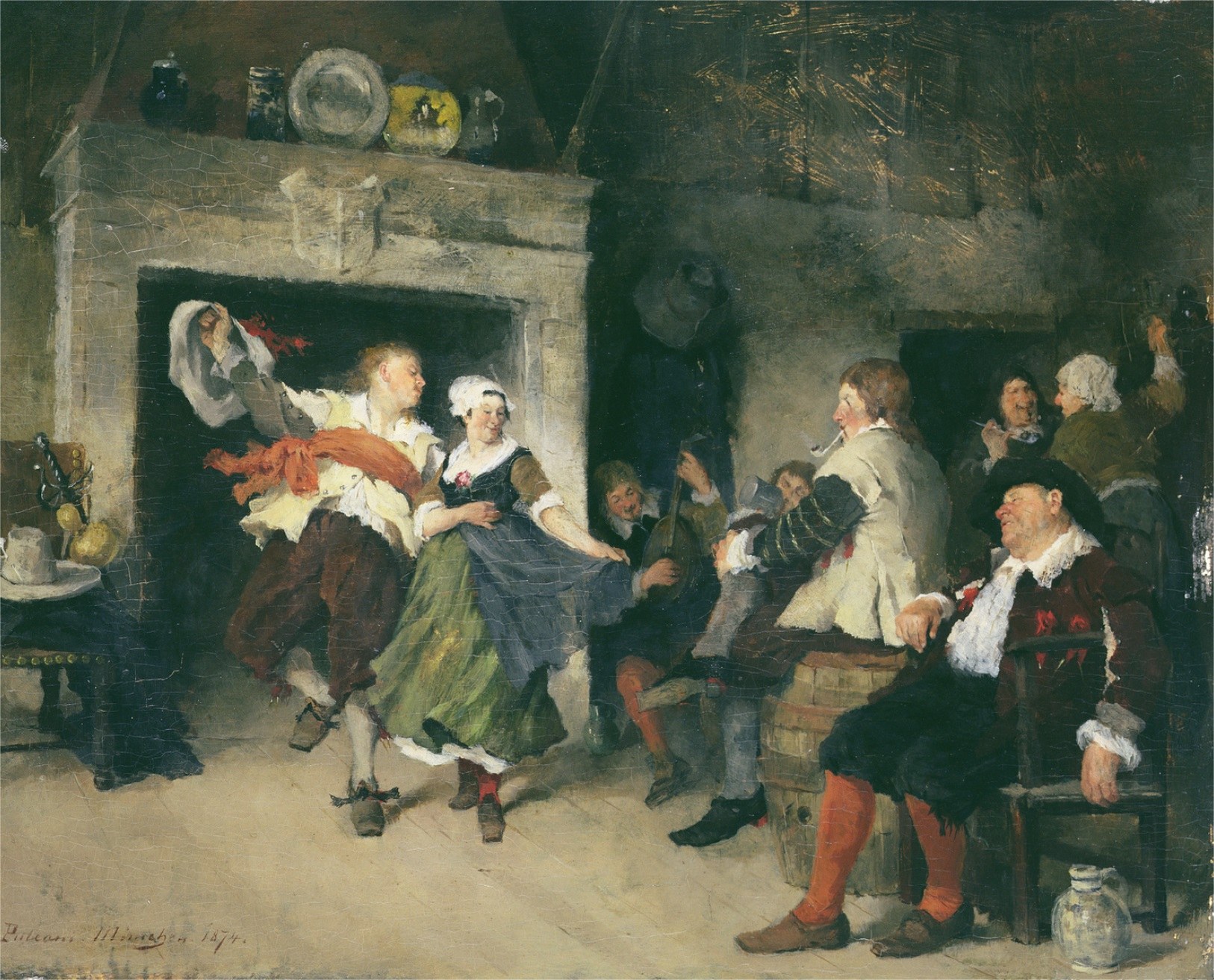
Friedrich von Puteani - Couple Dancing in a Tavern (1874)
Friedrich von Puteani
- Medium:
- Oil Painting
- Era:
- Late 1800s (Victorian Ballroom)
- Source:
- Wikimedia Commons
- Rights:
- Public domain — free to use, share and adapt.
- Recorded as:
- Public Domain
This work documents vernacular social dance in its actual context—a tavern among working people—rather than as spectacle or instruction. It shows the open-position folk forms that coexisted with and preceded modern ballroom dance, with body mechanics and spatial relationships entirely different from formal society dancing. For dance history, it is evidence of how ordinary people moved together in the nineteenth century.
What you are looking at
A tavern interior alive with movement: a couple dances at center while a crowd of onlookers gathers around them. The woman, in a green skirt with white apron and kerchief, is caught mid-spin, her red shawl flying outward; the man opposite her wears dark breeches and a white shirt. The setting is deliberately humble—a large fireplace dominates the left wall, its opening dark and cavernous, with simple pottery and plates ranged on the mantelshelf. The floor is bare earth or stone. The crowd—at least a dozen figures in various states of attention—fills the right side and background: men in brown coats and hats, women in bonnets and long skirts, some seated on wooden benches, others standing and watching. The light is warm and domestic, the paint handling loose and gestural, with heavy shadow dominating the right half of the canvas.
The dancing
The lead couple are in open or semi-open position rather than closed ballroom hold, suggesting a folk or village dance rather than formal society dance. The woman's weight is on one leg, her torso twisted, arms raised and extended in the throw of the spin; the man faces her with arms also raised or gesturing. The supporting figures are seated or standing as spectators; no other couples are dancing. The composition emphasizes the central pair as performers for an audience of villagers.
The dance depicted
This is almost certainly a folk or popular village dance of the 1870s German-speaking lands—a Ländler, polka, or similar peasant dance done in a tavern setting. The open or semi-open position, the woman's vigorous rotation, and the absence of rigid ballroom frame all point away from formal dance and toward social or celebratory country dancing. The tavern setting, humble dress, and onlooking crowd confirm this is not ballroom society but vernacular practice. The spin itself—the most legible moment of the movement—is characteristic of Alpine and Central European folk forms.
How it was made
Oil painting on canvas. The technique is painterly and impressionistic in handling—loose brushwork, warm ochres and greens, heavy use of shadow. The date 1874 is visible in the lower left corner (signature and date). The work is executed with sufficient finish to suggest exhibition or salon ambition, but the subject matter—working people in a tavern—places it in the social realist tradition of mid-19th-century European painting. The warm, dramatic lighting and the narrative focus on a specific social moment suggest influence from Realist practice.
About this work
This is a tavern dance scene from 1870s Central Europe, documenting a moment of folk celebration and social dancing among working people. The painting captures a specific dance tradition—likely Alpine or Germanic—at a precise historical moment when such scenes were being recorded by artists interested in peasant life and vernacular culture. The work is neither a formal dance instruction nor a theatrical performance, but a social document: ordinary people dancing for pleasure and community, watched by their peers.
The image matters because it records how social dancing actually happened outside ballroom convention, and because it places dance at the center of working-class life and celebration. For historians and dancers, it is evidence of what nineteenth-century country dancing looked like in practice—the open position, the vigorous footwork, the communal witnessing.
How to look at it
Attend first to the moment of the spin itself—the woman's body at the apex of a turn, weight and momentum fully committed, the shawl and skirt lifted by rotation. Notice that this is not the closed hold of a waltz or formal dance, but an open position allowing for exactly this kind of vigorous, full-bodied rotation. Observe the crowd: they are not participating but witnessing, which tells us this is exhibition within a social gathering, not ballroom decorum. The tavern interior—the fireplace, the earthen floor, the simple furnishings—is as much the subject as the dancers; the work is about this as a place and a practice, not a moment extracted from context.
The artist
Friedrich von Puteani (also recorded as Friedrich Puteani or von Putteani) was an Austrian or German painter active in the mid-to-late 19th century, part of the Realist movement's interest in genre subjects and social life. Little is widely documented about his individual practice, but his choice of subject—working-class tavern life—places him within the tradition of European social realism. The work's date and style suggest training in mid-century academic practice applied to vernacular subject matter.
The period
The 1870s was a period of intense artistic interest in peasant and working-class life across Europe, particularly in painting. The rise of social realism and the documentary impulse in art meant that folk customs, including dance, were being recorded by trained artists. Simultaneously, this was the era in which formal ballroom dance (waltz, quadrille, new variants of polka and schottische) dominated the social dance of the educated classes, making folk tavern dancing increasingly a marker of rural or working-class identity. The painting documents a cultural divide widening in the nineteenth century between ballroom and folk practice.
Where it lives
The work is recorded as sourced from Wikimedia Commons; no holding collection or accession information is available in the catalogue record. It is an oil painting and appears to be a museum-quality work, but its current location is not documented here.
Dance in this work
Questions about this work
Is this a waltz?
No. The open position, vigorous spinning, and tavern setting all point to a folk dance—likely a Ländler, polka, or similar Central European country form. The waltz required a closed ballroom hold and was a dance of educated society, not taverns. This couple is dancing in a completely different tradition.
What is the artist depicting about working-class dance?
That it was communal, participatory, and social rather than formalized. The onlookers are not passive but part of the event. The dance involves open position and full-bodied movement—rotation, vigor—that would have been shocking in a ballroom. The tavern is a place of legitimate public sociability, not something hidden or shameful.
Why paint this subject in 1874?
By the 1870s, industrialization and urbanization meant folk traditions were disappearing or being recorded as vanishing culture. Artists influenced by Realism and by Romantic nostalgia for peasant life documented these customs. Puteani was capturing something he and his audience knew was already changing.
What can we learn about 19th-century dance from this?
That ballroom and folk dance were entirely separate worlds with different bodies, positions, contexts, and audiences. This shows what ordinary people actually did, away from etiquette books and dance manuals written for the middle classes. The vigorous, open-position movement is evidence of movement practices that survive in modern folk dance.
More dance artwork