49 works in this view — arrow keys or swipe to move between them.
Dance in Art · 1890
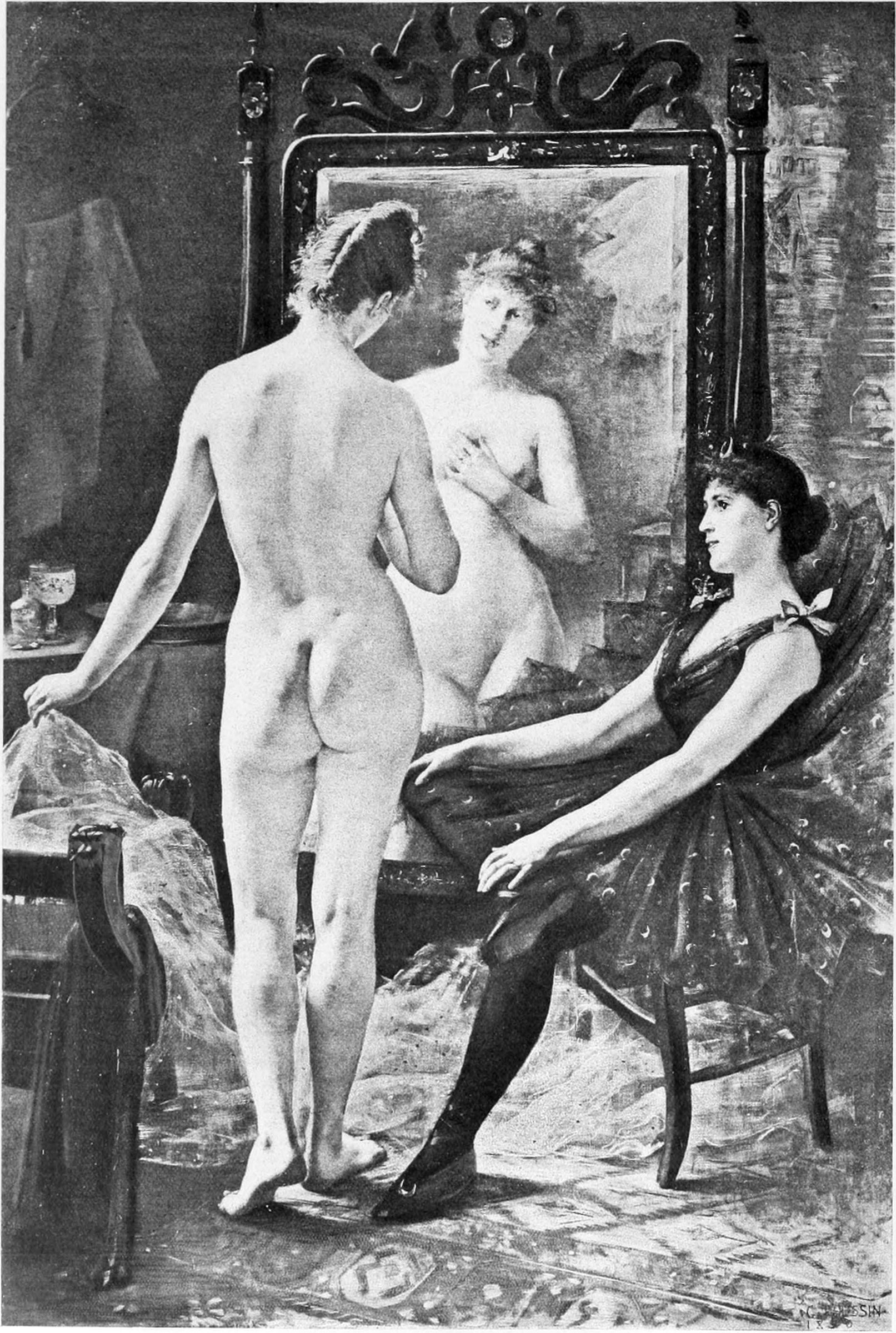
Georges Roussin - Danseuses
Roussin, Georges French painter and draftsman, 1854-1941 (VIAF 96394780)
- Era:
- Late 1800s (Victorian Ballroom)
- Source:
- Wikimedia Commons
- Rights:
- Public domain — free to use, share and adapt.
- Recorded as:
- Public Domain
For dance historians, this work is valuable as evidence of how dancers and their bodies were imagined and represented in fine art during the 1890s—not in motion, but in studied repose. It shows the contemporary conflation of dancers with artists' models and with classical nudes, a confusion that shaped how female dancers were seen and valued in the period.
What you are looking at
A studio or dressing room scene depicting three women in a moment of intimate observation and preparation. Two nude models stand before an ornate mirror with an elaborate carved and decorated frame, their bodies reflected and facing each other in conversation or contemplation. A third woman, fully dressed in a dark silk gown with a bow at the neckline, sits to the right, watching the scene. The setting is intimate and private, lit by soft, diffuse light that models the figures' flesh tones and creates gentle shadows. The floor is scattered with fabric and drapery in pale tones; bottles and vessels sit on a low table to the left. The ornate mirror dominates the composition, its dark frame and decorative top drawing the eye upward.
The dancing
The two nude figures stand in contrapposto with weight shifted and bodies angled toward each other and the mirror. Their postures are self-aware and graceful rather than stiff, with soft arm positions—one figure's arm raised toward her hair or head, the other's arm crossing her body in a gesture of modest self-consciousness. The seated woman leans slightly forward, her body in an attentive S-curve, fully clothed and observing rather than participating. The composition emphasizes the relationship between observer and observed, between public dress and private undress.
The dance depicted
This is not a depiction of dance in the theatrical sense, but rather a scene of the female nude body in an artistic or theatrical studio context. The figures may represent artists' models, dancers preparing or posing for portraiture, or nymphs in a classical allegorical setting. The intimate grouping and the mirror suggest themes of self-reflection, narcissism, and the aestheticization of the female form that were central to Symbolist and Decadent art of the 1890s. No specific dance style is being performed.
How it was made
This is a black-and-white photograph or photogravure of a painting, not the painting itself. The image shows tonal subtlety and fine detail consistent with early photographic reproduction techniques. The loss of color and the monochromatic rendering emphasize composition, light, and form over decorative surface—a common choice for art historical documentation and reproduction in the late 19th and early 20th centuries.
About this work
Roussin's *Danseuses* (1890) is a studio scene from the Symbolist era that frames the female body not in dance movement but in studied, self-aware stillness before a mirror. The title suggests these may be dancers or performers, but the image shows them removed from the stage, in a private moment of observation and preparation. The work participates in late 19th-century fascinations with the female nude, artistic labor, and the boundary between public performance and private interior life. It is a work about display and self-reflection rather than about dance technique or choreography.
How to look at it
Attend to the mirror as the organizing principle of the composition. The reflection creates a doubling of the body and a meditation on representation itself—the nude figures see themselves as the viewer sees them. The ornate frame draws attention to artifice and display. Note the contrast between the two nude figures, who are objects of aesthetic attention, and the clothed, seated woman, who is the subject of action and agency. The softness of the light and the languor of the poses suggest a moment suspended from time, typical of Symbolist treatment of the body.
The artist
Georges Roussin (1854–1941) was a French painter and draftsman working in the late 19th century. He was active during the Symbolist and Decadent movements, which favored intimate interior scenes, literary and mythological subjects, and the aestheticization of the human body. His practice centered on female nudes in domestic, theatrical, or allegorical settings, often with an emphasis on refinement, texture, and psychological mood rather than narrative action.
The period
In the 1890s, the figure of the dancer held a complex position in French art and culture. Dancers—especially ballerinas and cabaret performers—were subjects of intense artistic interest, but they were often represented not in performance but in rehearsal, preparation, or repose. Artists like Degas had established the rehearsal room and the dressing room as sites of aesthetic investigation. Simultaneously, the classical female nude remained the touchstone of fine art, and dancers' bodies were frequently assimilated to that tradition. Roussin's work sits at the intersection of these interests, treating dancers as classical nudes in a private, interior world rather than as performers in action.
Where it lives
The work is known from a black-and-white photographic reproduction held in Wikimedia Commons. The original painting's current location is not recorded in the catalogue.
Questions about this work
Is this a dance painting or a nude study?
It is both and neither. The title *Danseuses* suggests these are dancers, but the image shows them in stillness before a mirror, not performing. The work is best understood as a studio scene that treats dancers' bodies as classical nudes—a common practice in late 19th-century art, when dancers and artists' models occupied overlapping social and artistic roles.
Who are the three women?
The catalogue provides no information about the identities of the figures. They are generic types—two models or dancers and an observer—rather than portraits of named individuals. The composition suggests a relationship of labor (the models) and leisure or authority (the observer).
What is the significance of the mirror?
The mirror is central to the work's meaning. It allows the figures to see themselves and creates a doubling of the body that plays with representation and narcissism. In the context of Symbolist art, mirrors often signal themes of self-reflection, illusion, and the nature of appearance itself.
More dance artwork